

Asian stock markets suffered a sharp sell-off on Monday as renewed tensions between Iran and Israel, combined with growing concerns over US interest rate hikes, triggered a wave of risk-off sentiment across global markets.
The steepest losses were recorded in South Korea, where investors rushed to exit technology stocks, particularly those tied to the artificial intelligence boom that has fueled much of this year’s market gains.
South Korea Leads Regional Market Decline
South Korea’s benchmark KOSPI index plunged nearly 9 percent shortly after trading opened, forcing authorities to activate a circuit breaker designed to curb panic-driven selling.
The Korea Exchange halted trading for 20 minutes, marking the second time the emergency measure has been used this year. The previous activation came on March 4, when the benchmark index suffered a record one-day decline of 12.06 percent.
Although trading later resumed, losses remained severe. By the closing bell, the KOSPI had finished the session down 8.29 percent.
Some of South Korea’s biggest corporate names took substantial hits. Tech heavyweight Samsung Electronics dropped 10.2 percent, while memory chip maker SK Hynix lost 7.6 percent.
Technology Stocks Face Heavy Pressure
The market downturn reflected broader investor concerns surrounding the technology sector, particularly companies that have benefited from strong enthusiasm around artificial intelligence.
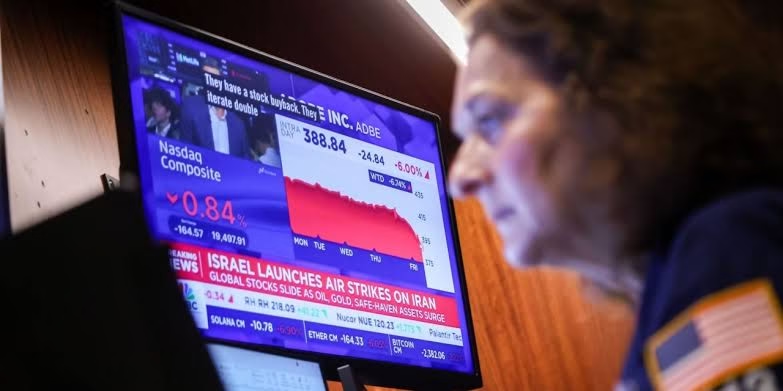
Investors reacted to a sharp decline on Wall Street late last week, where major US indexes sold off after stronger-than-expected employment data raised concerns that the US Federal Reserve may keep monetary policy tighter for longer.
The technology-focused Nasdaq Composite recorded its biggest daily loss since April 2025, falling 4.18 percent on Friday.
“The sharp declines have been triggered by the large correction in US tech last Friday following the blowout numbers on non-farm payrolls,” Fabien Yip, a market analyst at online trading and investment company IG Group, told Al Jazeera, referring to the strong jobs figures in the US.
Regional Markets Join The Sell-Off
 The weakness was not limited to South Korea.
Japan’s benchmark Nikkei 225 dropped 3.9 percent, while China’s SSE Composite Index fell 1.7 percent.
Hong Kong’s Hang Seng Index declined 1.3 percent, and Taiwan’s TAIEX lost 3.5 percent.
Taiwan’s market was weighed down by weakness in semiconductor shares, including industry leader TSMC, the world’s largest contract chip manufacturer.
Geopolitical Tensions Add To Market Anxiety
Meanwhile, investors also grappled with escalating geopolitical risks after Iran and Israel exchanged attacks for the first time since April.
The renewed conflict pushed energy prices higher as traders assessed potential disruptions to oil supplies in the region.
Brent crude, the global benchmark for oil, climbed 3.7 percent and moved above $88.50 per barrel.
The combination of rising energy costs, geopolitical uncertainty and concerns about future US monetary tightening created a challenging environment for equities across Asia.
“There was a spillover from the fading optimism on the AI trade, particularly affecting picks-and-shovels tech companies in Asia, which enjoyed a spectacular run in the past two months,” Yip said.
“Further, the weak won and potential tightening from South Korea could potentially add strain for the leveraged positions in Korea.”
Investors Reassess Risks
Monday’s market rout highlights how quickly investor sentiment can shift when geopolitical uncertainty and monetary policy concerns converge.
After months of strong gains driven largely by AI-related optimism, traders are increasingly reassessing valuations and exposure to high-growth technology stocks. With tensions in the Middle East escalating and interest rate expectations remaining uncertain, volatility may continue to dominate market sentiment in the near term.