

How to Improve Your Cricket Batting Technique Fast
Updated: August 2026
Cricket is one of the fastest-growing sports in the United States, and more players — from weekend club cricketers in Dallas to junior academy students in New Jersey — are searching for real, usable ways to fix their batting faster. This guide breaks down exactly how to do that, with drills, a training table, and a local practice guide for players across the US.
Quick Answer: How to Improve Cricket Batting Technique Fast
The fastest way to improve your cricket batting technique is to fix your stance and head position first, then train with short, focused sessions: 15 minutes of shadow batting, 20 minutes of throw-downs or side-arm practice, and 10 minutes of footwork drills, done 4–5 times a week. Most club-level players notice measurable improvement in shot timing and balance within 3 to 4 weeks of consistent, technique-focused practice rather than just net hitting.
Key Takeaways
- Stance and balance come first. Most batting errors — including late shots and poor footwork — trace back to an unstable base or incorrect head position over the front foot.
- Short, focused drills beat long, unstructured net sessions. 45 minutes of purposeful practice (stance, footwork, shadow batting) outperforms two hours of casual net hitting.
- Cricket is expanding fast in the US. USA Cricket and Major League Cricket (MLC), launched in 2023, have driven a sharp rise in youth and adult coaching programs across Texas, Florida, New York, and North Carolina.
- Video review accelerates learning. Recording your batting on a phone and comparing it frame-by-frame to your stance and bat swing cuts correction time significantly compared to relying on feel alone.
- Local coaching access matters. Cities like Dallas, Houston, New York/New Jersey, Los Angeles, and Morrisville, NC now have dedicated cricket training facilities, making structured coaching easier to find than it was five years ago.
What Is Good Cricket Batting Technique?
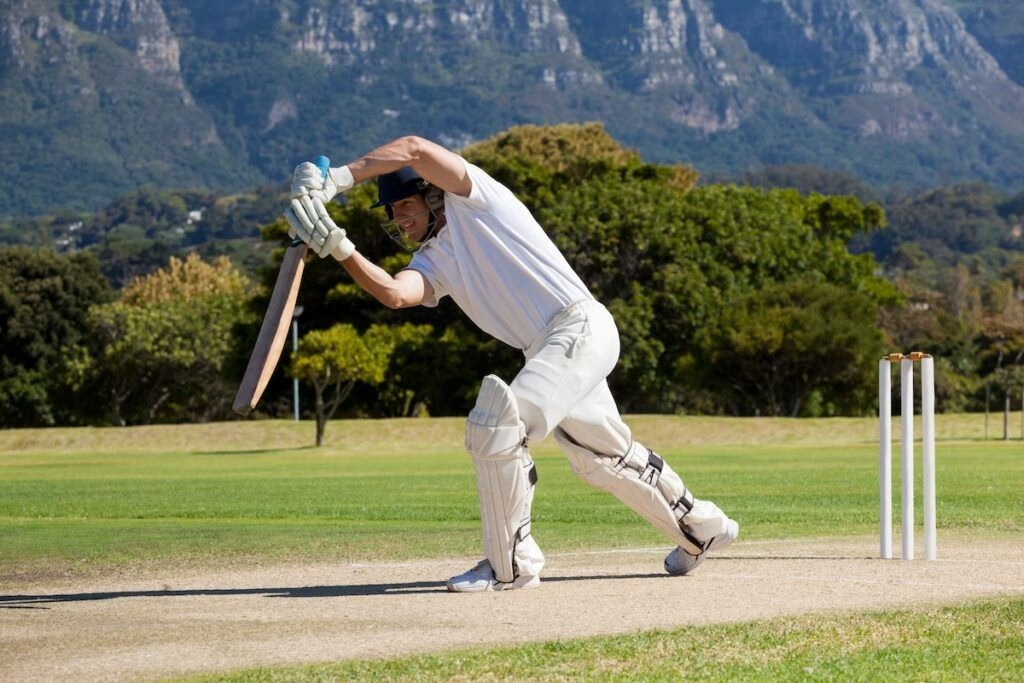
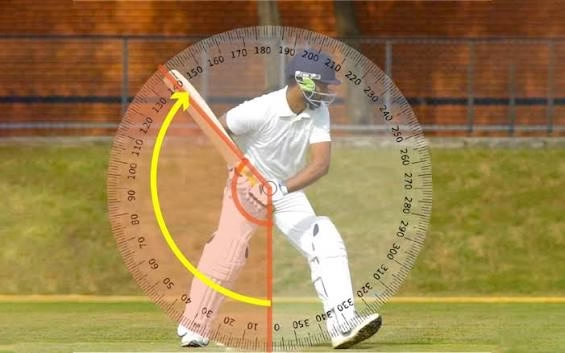
Good cricket batting technique means having a balanced, repeatable base that lets a batter react to the ball rather than pre-planning a shot. It includes four core elements: a stable stance, a straight backlift, head position over the ball, and controlled footwork that moves the body toward the line of the delivery. Coaches at the England and Wales Cricket Board (ECB) and Cricket Australia both teach these same fundamentals as the foundation of their junior coaching syllabus, and most USA Cricket-affiliated academies follow a similar framework.
A batter with correct technique doesn’t necessarily hit the ball harder — they hit it more consistently, because their base and head position don’t change from ball to ball.
Why Does Batting Technique Matter More Than Power?
Power without technique breaks down under pressure — against a fast bowler, a turning ball, or a tricky pitch. Technique is what lets a batter adjust late, control the shot, and still generate power through proper weight transfer instead of arm strength alone.
Data from junior coaching reviews conducted by state cricket associations consistently show that technically sound batters make fewer errors in the 15–25 run range, which is often where inexperienced batters get out. In short, technique reduces risk while power alone increases it.
How to Improve Your Cricket Batting Technique Fast: 7-Step Practice Plan
Follow this sequence 4–5 days a week for the fastest realistic improvement:
- Fix your stance (Day 1 focus). Feet shoulder-width apart, weight balanced on the balls of your feet, bat resting lightly behind the back foot. Avoid a stance so open or closed that it forces early commitment to a shot.
- Correct your head position. Your head should stay still and level, with your eyes as close to over the ball as possible at the point of contact. A moving head is the single most common cause of mistimed shots.
- Practice shadow batting daily (10–15 minutes). Without a ball, repeat your backlift, downswing, and follow-through in front of a mirror or on video. This builds muscle memory without the pressure of facing a delivery.
- Add footwork drills. Practice moving front foot and back foot separately to cones placed at different lengths, simulating short, good-length, and full deliveries.
- Use throw-downs or a side-arm thrower. This isolates hand-eye coordination and timing without the unpredictability of a full bowling run-up, making it easier to correct one flaw at a time.
- Face variable-pace bowling machines or net bowlers. Once the basics are grooved, add pace and spin variation to test the technique under realistic match conditions.
- Record and review. Film your batting from side-on and front-on angles. Comparing footage week to week shows concrete progress and flags flaws that are hard to feel in real time.
Best Cricket Batting Drills: Beginners vs Advanced Players
| Drill Type | Best For | Frequency | Primary Goal |
|---|---|---|---|
| Shadow batting in front of a mirror | Beginners | Daily, 10–15 min | Build stance and swing muscle memory |
| Cone footwork drills | Beginners & intermediate | 3–4x/week | Improve front-foot/back-foot movement |
| Throw-downs (underarm/side-arm) | Beginners & intermediate | 3x/week | Hand-eye coordination, shot timing |
| Bowling machine (variable pace) | Advanced | 2–3x/week | Reaction time against pace and bounce |
| Video analysis review | All levels | Weekly | Identify and correct technical flaws |
| Match-simulation net sessions | Advanced | 1–2x/week | Apply technique under pressure |
This progression mirrors the structure used by most USA Cricket junior development pathways and MLC-affiliated academy programs, which typically move players from isolated drills to full net simulation over a 6–8 week training block.
Which Equipment Helps Improve Batting Technique?
You don’t need expensive gear to fix technique, but a few tools speed up the process:
- A full-length mirror for shadow batting and stance checks.
- Cones or markers for footwork drills.
- A side-arm thrower or bowling machine, commonly available at cricket academies in Dallas, Houston, and the New York/New Jersey area.
- A smartphone tripod for consistent video angles when reviewing your swing.
- A weighted training bat (used in short bursts only) to reinforce a straight, controlled backlift — not for full-power hitting.
Cricket Training Near Me: Where to Practice in the US
Cricket infrastructure in the US has grown quickly since Major League Cricket launched its inaugural season in 2023 and the ICC Men’s T20 World Cup was co-hosted by the USA in June 2024, with matches played at the purpose-built Nassau County International Cricket Stadium in New York. That momentum has pushed more cities to build or expand batting facilities:
- Dallas, TX area — Grand Prairie Cricket Stadium and several club-run academies in Plano and Frisco offer net sessions and coached batting clinics on weekends.
- Houston, TX area — Prairie View Cricket Complex and local club nets serve a large South Asian cricket community across greater Houston.
- New York / New Jersey — The Cricket Association of Greater Chicago-style club model has been replicated across New Jersey towns like Edison and Somerset, alongside facilities near Eisenhower Park in Nassau County.
- Los Angeles, CA area — Growing club cricket in Woodley Park and Van Nuys supports batting clinics for both youth and adult recreational players.
- Morrisville, NC — Home to the Church Street Park cricket stadium, one of MLC’s official venues, with academy programs open to local youth players.
- South Florida (Lauderhill, FL) — Central Broward Regional Park has hosted international matches and runs community coaching sessions for area players.
If you’re searching for “cricket coaching near me,” start with your nearest USA Cricket-affiliated club or MLC academy partner, since these programs generally follow standardized coaching curricula rather than informal, inconsistent instruction.
Common Batting Mistakes That Slow Progress
- Chasing wide deliveries instead of leaving them — often caused by poor head position rather than poor judgment.
- Overcorrecting after one bad shot, which breaks rhythm more than it fixes technique.
- Skipping footwork drills and going straight to full-pace net hitting, which reinforces bad habits instead of correcting them.
- Training without any video or coach feedback, which makes it hard to identify flaws that “feel” fine but look wrong on camera.
FAQ: Cricket Batting Tips
Q1: How long does it take to improve cricket batting technique? Most club-level players see noticeable improvement in balance and shot timing within 3–4 weeks of focused, structured practice done 4–5 times a week. Full technical changes, like a reworked backlift, typically take 8–12 weeks to feel natural in match conditions.
Q2: What is the most important batting technique for beginners? Stance and head position are the most important fundamentals. A stable base and still head make every other part of batting — footwork, timing, and shot selection — easier to develop correctly.
Q3: Can I improve my batting technique without a coach? Yes, to a point. Shadow batting, mirror work, and video self-review can fix many basic flaws. However, a qualified coach spots issues — like a hidden bat-swing flaw — that are difficult to catch on your own.
Q4: How often should I practice cricket batting to see fast results? Four to five sessions a week of 45–60 minutes, mixing shadow batting, footwork drills, and throw-downs, produces faster results than fewer, longer sessions of unstructured net hitting.
Q5: Where can I find cricket batting training near me in the US? Check USA Cricket’s affiliated club directory or search for Major League Cricket academy partners in cities like Dallas, Houston, New York/New Jersey, Los Angeles, and Morrisville, NC, all of which run structured youth and adult coaching programs.
Q6: Do bowling machines actually help improve batting technique? Yes. Bowling machines let you isolate specific problems, such as playing the short ball or adjusting to pace, without depending on a live bowler’s consistency, making them useful once basic technique is already in place.
Conclusion
Improving your cricket batting tips fast comes down to fixing the fundamentals — stance, head position, and footwork — before adding pace, power, or match pressure. With cricket’s rapid growth across the US since the 2024 T20 World Cup and the rise of Major League Cricket, players now have more access than ever to structured coaching, proper facilities, and community nets in cities from Dallas to New Jersey to Los Angeles. Start with the 7-step practice plan above, stay consistent for a few weeks, and track your progress on video — that combination is what turns generic cricket batting tips into real, visible improvement at the crease.