
Freshly released emails from the early months of the COVID-19 pandemic have ignited new controversy surrounding Dr. Anthony Fauci and his communications with top health officials. The messages, revealed by Sen. Rand Paul, appear to show Fauci instructing colleagues to delete certain emails after reading them, raising questions about recordkeeping and transparency during one of the most critical periods of the global health crisis.
The disclosures also clash with Fauci’s sworn testimony to Congress last year, when he denied deleting official records or attempting to block the release of public documents under federal transparency laws.
Newly Released Emails Raise Fresh Questions
Sen. Rand Paul (R-Ky.) made the emails public this week as part of an ongoing congressional probe into the origins of COVID-19. The Kentucky senator posted the communications on X, along with a letter requesting additional records from Fauci and asking him to testify before Congress.
The emails date back to 2020 and show Fauci, then director of the National Institute of Allergy and Infectious Diseases, asking colleagues on multiple occasions to remove messages after reviewing them.
According to Paul, such directives could potentially conflict with federal recordkeeping requirements that govern communications by public officials.
Meanwhile, the emails also reveal discussions among prominent health officials about managing scientific messaging during the earliest days of the pandemic.
Congressional Investigation Intensifies
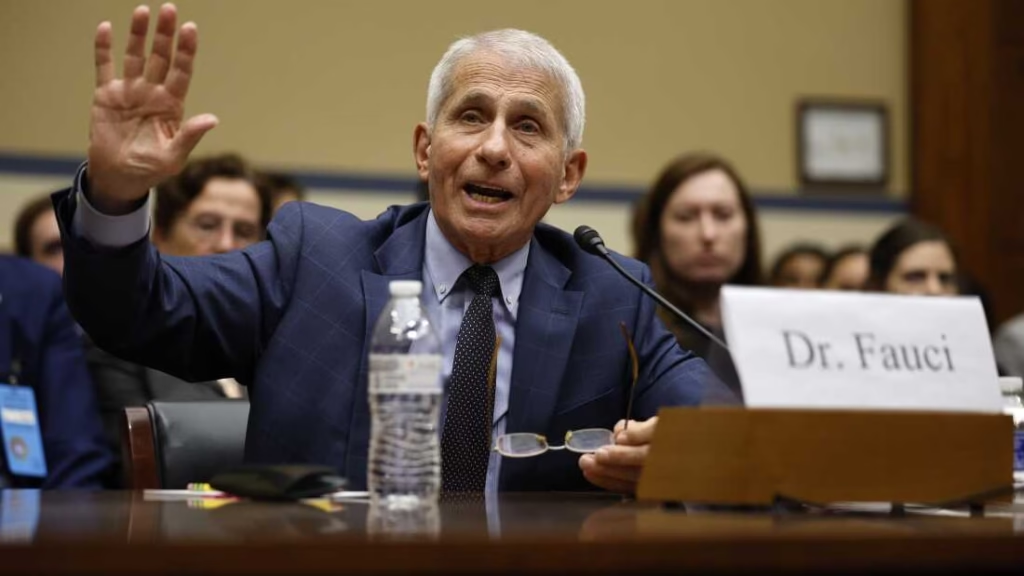
Paul’s release of the messages comes amid a broader congressional investigation launched last year into the origins of the SARS-CoV-2 virus.
In the letter sent to Fauci, the senator said he has “reason to believe” Fauci “may be in possession of additional records” tied to the inquiry.
Paul wrote that the documents are “necessary … to fully understand the federal government’s actions to identify the origins of COVID-19, and the extent to which taxpayer dollars were used to conduct risky virological research.”
The request asks Fauci to produce emails, text messages, and other communications sent or received between 2018 and 2023 related to COVID-19, gain-of-function research, and laboratories in the United States and China where such research may have taken place.
Fauci has been asked to deliver the materials by Sept. 23 and indicate whether he can appear before Congress on several possible dates later this year.
Critics Say Testimony Could Carry Legal Risk
Paul has repeatedly clashed with Fauci over the years, particularly during Senate hearings on the pandemic.
In both 2021 and 2023, Paul submitted criminal referrals to the U.S. Department of Justice accusing Fauci of perjury, a federal offense punishable by up to five years in prison.
Earlier this year, former President Joe Biden issued a sweeping pardon covering potential offenses committed by Fauci dating back to 2014 while serving in government roles.
However, legal observers note that the pardon may not fully protect Fauci from congressional proceedings or allegations related to false statements before lawmakers.
Journalist and former Senate investigator Paul D. Thacker said the new revelations place Fauci in a difficult position if he testifies again.
“Paul caught Fauci lying under oath before, but there’s zero wriggle room for Fauci this time. Only the most deranged Fauci fan can defend this,” Thacker said.
Attorney Greg Glaser also weighed in on possible legal steps should Fauci decline to cooperate with the investigation.
“[Paul] would first pursue enforcement through the full chamber by a motion to hold Fauci in contempt. Upon Senate vote and passage, the matter would be referred to the DOJ for criminal prosecution and a court order to authorize U.S. Marshals to seize Fauci’s devices and documents for forensic examination.”
Early Pandemic Emails Come Under Scrutiny
One of the most closely examined communications dates to Feb. 2, 2020, when Fauci emailed then-National Institutes of Health Director Francis Collins regarding discussions about the emerging coronavirus.
The message followed conversations among scientists and public health leaders about the origins of the virus and how to communicate scientific findings to the public.
In that email exchange, Fauci concluded the message with a directive: “Please delete this e-mail after you read it.”
According to Paul, the correspondence suggests that discussions about the origin of the virus were underway even before COVID-19 became a major concern across the United States.
The email came shortly after the Feb. 1, 2020 teleconference involving Fauci, Collins, Jeremy Farrar, and several virologists. Participants in that call later contributed to the influential scientific paper titled “The proximal origin of SARS-CoV-2,” which argued that the virus likely developed through natural processes.
Published in March 2020 in Nature Medicine, the paper quickly became one of the most cited scientific articles of that year and played a central role in shaping the early narrative about the virus’s origins.
However, critics argue that some authors initially questioned whether the virus could have arisen naturally before the paper ultimately supported a zoonotic explanation.
Another Email Exchange Draws Attention
Paul also released a separate email exchange dated July 20, 2020, between Fauci and Greg Folkers, then chief of staff in Fauci’s NIAID office.
Folkers had forwarded Fauci a social media post by Paul discussing COVID-19 death rates across different states.
Fauci responded sharply, writing that Paul was “full of s..t” and that he did not want to “engage any more with this nonsense.”
He ended the exchange with another instruction: “please delete this e-mail after you read it.”
Paul later wrote on X that the message reveals “another layer of the Fauci COVID Coverup” and indicates that Fauci “knew the reckoning was eventually coming.”
Questions Surround Gain-Of-Function Research
The congressional investigation is also examining the controversial field of gain-of-function research, which involves modifying viruses to study how they spread or evolve.
Such work has long been debated within the scientific community due to concerns about safety and the potential creation of highly transmissible pathogens.
Some experiments involving coronaviruses were conducted at China’s Wuhan Institute of Virology, fueling speculation that the virus could have originated from a laboratory accident.
Fauci has repeatedly maintained that the National Institutes of Health did not fund gain-of-function experiments at the Wuhan facility.
During a congressional hearing in 2021, he rejected claims that the virus originated in a Chinese lab.
“I don’t think there’s ever been a clearer case of perjury in the history of government testimony, and I don’t say that lightly,” Paul told.
The issue resurfaced during a closed-door congressional interview last year in which Fauci responded more than 100 times that he “did not recall” key information or discussions related to the pandemic.
Paul later said those responses suggested that Fauci and the NIH were “more secretive than the CIA.”
Funding And Research Partnerships Examined
The inquiry has also touched on the role of EcoHealth Alliance, a nonprofit organization that worked with scientists at the Wuhan Institute of Virology.
Its former president, Peter Daszak, collaborated with researchers who proposed Project DEFUSE to the U.S. Defense Advanced Research Projects Agency in 2018.
The proposal, which was ultimately rejected, described engineering coronaviruses with features that could increase their infectivity.
Last year, the U.S. Department of Health and Human Services suspended federal funding to EcoHealth Alliance after concluding the organization had failed to properly oversee high-risk coronavirus experiments.
Meanwhile, Paul’s request to Fauci seeks all communications involving Daszak, EcoHealth Alliance, the Wuhan lab, and the Wellcome Trust, along with discussions about the “Proximal Origin” paper and gain-of-function research.
Calls For Greater Oversight Of High-Risk Research
Some scientists and policy advocates say the email revelations reinforce concerns about how gain-of-function research has been handled in recent years.
Rutgers University molecular biologist Richard Ebright, Ph.D., has been among the most outspoken critics.
“The evidence shows that they misfeasantly violated federal policies on gain-of-function and enhanced potential pandemic pathogen research and that, to cover up their misfeasance and its role in causing COVID-19, they committed criminal conspiracy to defraud, fraud, destruction of federal records, obstruction, misuse of federal funds and perjury.”
Separately, lawmakers have introduced new proposals aimed at strengthening oversight of such research.
Earlier this year, Sen. Paul introduced the Risky Research Review Act, which would establish independent oversight of federally funded gain-of-function studies.
He also proposed the NIH Reform Act, legislation intended to increase congressional oversight of the agency and restructure the National Institute of Allergy and Infectious Diseases.
Meanwhile, broader federal policy changes are already underway. In May, President Donald Trump signed an executive order ending U.S. funding for gain-of-function research in countries such as China and Iran.
The order also temporarily halted federally funded gain-of-function research in the United States for 120 days while new safety policies are developed.
As congressional investigators continue reviewing the newly released emails and additional documents, the debate over the origins of COVID-19 and the role of high-risk virological research shows no sign of slowing down.