
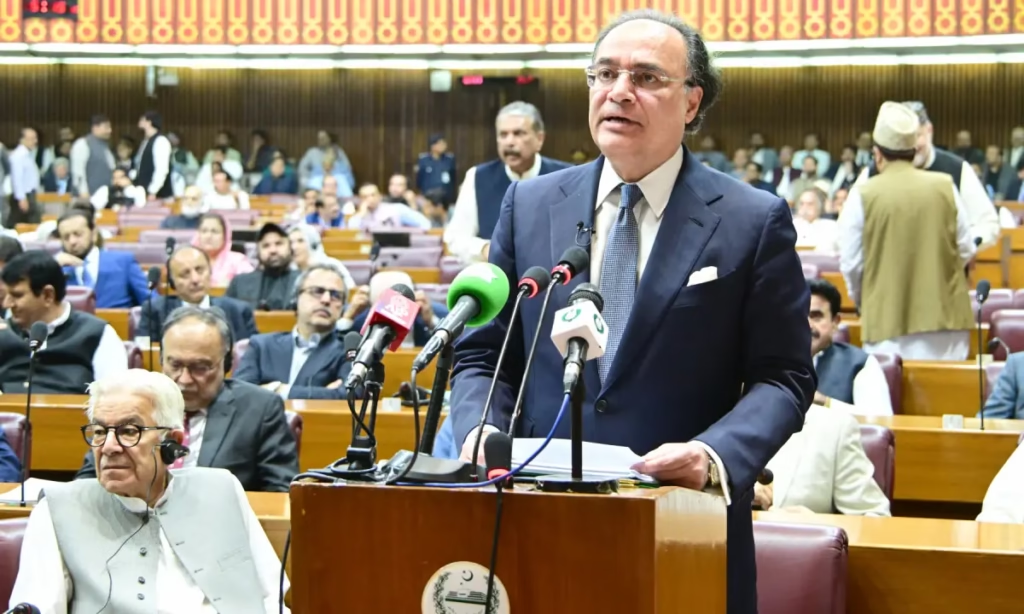
Pakistan’s federal government rolled out a Rs18.8 trillion budget for FY2026-27 on Friday, setting a 4pc GDP growth target while projecting average inflation at 8.2pc. Finance Minister Muhammad Aurangzeb presented the budget in the National Assembly after a two-hour delay, as opposition lawmakers staged loud protests and tore up copies of the budget document.
The budget mixes tax relief, higher defence spending, a wider welfare net, salary and pension increases, and major allocations for debt servicing. However, the biggest number still tells the hardest story: Rs8,045 billion has been earmarked for markup payments, showing how heavily debt costs continue to shape Pakistan’s fiscal choices.
Finance Minister Lays Out Economic Strategy
Aurangzeb said the new budget had been built around a “clear and purposeful” strategy, with the government aiming to increase production capacity and push exports higher.
“For this reason, we are giving tax concessions to large industries and are providing resources to exporters through the Export Financing Scheme,” he added.
The finance minister also pointed to new loan initiatives for farmers, saying “agriculture is the backbone of our economy”. Meanwhile, he said the government wanted to raise revenues through enforcement and compliance rather than simply adding new pressure on citizens.
“For this purpose, we are making changes to the compliance and enforcement mechanism and carrying out reforms in the FBR,” he said.
Aurangzeb argued that regional uncertainty had also shaped the budget, particularly in defence. Given the security environment, he said, “a significant increase has been made in the defence budget”.
Rs18.8tr Budget Places Debt Payments At The Center
The government has proposed total spending of Rs18.8 trillion for FY2026-27. Out of that, Rs8,045 billion will go toward markup payments, making debt servicing one of the largest expenses in the federal plan.
Aurangzeb said the economy was expected to grow by 4pc, while inflation would average 8.2pc. The fiscal deficit target has been set at 3.6pc of GDP, while the government will aim for a primary surplus of 2pc.
Tax revenue has been projected at Rs15,264 billion, up 17.6pc from Rs12,983 billion in the outgoing year. Of this amount, Rs8,848 billion will go to the provinces.
The finance minister said the federal and provincial governments had agreed on a mechanism to meet “some national imperatives”.
“Under this arrangement, the federal and provincial governments together will receive a share from the Federal Divisible Pool in accordance with the National Finance Commission (NFC) Award as per the constitution,” Aurangzeb explained.
“The federal government’s expected revenue receipts for FY 2026-27 from the Federal Board of Revenue are projected at Rs15,264 billion. Under this arrangement, for strategic national purposes […] a minimum of Rs13,350 billion has been kept protected.
“From a minimum of Rs13,350 billion up to Rs15,264 billion, the amount to be received [by the provinces] will be given back to the federal government as grants under Article 164 of the Constitution for the completion of strategic national requirements. This arrangement will come into effect for FY 2026-27 and for the fiscal years,” the finance minister said.
“The country will experience the positive impact of this mechanism,” he said, adding that the arrangement had been reached through “cooperative federalism”.
The minister added that the mechanism would be “renewed along similar lines with provinces’ consultation for FY28 and FY29”. He then thanked provincial governments for “stepping up for the national cause”.
Development, Defence And Subsidy Allocations Announced
 The federal non-tax revenue target has been set at Rs5,336 billion, while net federal revenue has been budgeted at Rs11,751 billion.
The federal Public Sector Development Programme has been allocated Rs1,000 billion. However, when funds for state-owned enterprises and public-private partnership projects are included, the total rises to Rs1,451 billion.
Provincial development schemes have been assigned Rs2,224 billion, while Rs451 billion has been set aside for investment by state-owned enterprises.
“This distribution reflects the division of responsibilities under the 18th Amendment, under which provinces are largely responsible for the social sector and the federal government focuses on strategic projects,” he added.
Defence has been allocated Rs3,000 billion, while civil administration spending has been set at Rs1,071 billion. Current federal expenditure is budgeted at Rs17,495 billion.
The government also proposed Rs1,169 billion for pension payments and Rs1,091 billion for subsidies in the power sector and other areas.
Tax Cuts, Salary Raises And Welfare Measures
Aurangzeb announced proposed income tax relief for four salaried slabs. Those earning between Rs2.2 million and Rs3.2 million annually would face a maximum tax rate of 20pc instead of 23pc.
The rate for annual income between Rs3.2 million and Rs4.1 million would fall from 30pc to 25pc. For those earning Rs4.1 million to Rs5.6 million, the rate would drop from 35pc to 29pc. Meanwhile, people earning between Rs5.6 million and Rs7 million would pay a maximum rate of 32pc instead of 35pc.
The government also proposed ending the 9pc surcharge on the salaried class. For businesses, the super tax would be abolished for annual income between Rs150 million and Rs500 million, while businesses earning more than Rs500 million would see the rate reduced from 10pc to 8pc.
The budget also proposes removing taxes on sanitary pads and contraceptives.
Government employees would receive a 7pc salary increase, while retired employees would get a 7pc pension raise. The minimum wage would also rise by 10pc under the proposal.
The Benazir Income Support Programme, Azad Jammu and Kashmir, Gilgit-Baltistan and merged districts of Khyber Pakhtunkhwa have collectively been allocated Rs2,680 billion.
Defence Capability And Foreign Policy Take Center Stage
Aurangzeb opened his speech by thanking coalition allies, including PPP Chairperson Bilawal Bhutto-Zardari, whose attendance had earlier been uncertain.
He said the budget came at a moment when Pakistan had gained international attention and influence. “But this was not coincidental. It began when Pakistan gave a befitting response to India in May 2025.”
“This success was a result of decades-long professional training and preparedness,” he added. “Today, the world praises Pakistan’s defence capabilities. This is the reason that many countries are in contact with Pakistan to procure the fighter jets protecting our skies for their fleet.”
The finance minister said Pakistan’s defence sector had also become a potential source of foreign exchange. “It is proof that strong defence is not just important for the country’s sovereignty but could also contribute to economic progress.”
“This defence capability has reshaped our strategic partnerships not just in the region but in the world,” he said, referring to the defence pact signed between Pakistan and Saudi Arabia last year.
Aurangzeb also discussed Pakistan’s role in regional diplomacy after tensions involving the US, Israel and Iran.
“Pakistan’s efforts are directed towards establishing long-term peace in the region through an agreement and restoring the transit of oil through the Strait of Hormuz,” he said.
He added that Pakistan had “complete support” from China in these efforts.
“Pak-China relations are an important part of our foreign policy. China is Pakistan’s most important trading partner,” he said.
On oil prices, Aurangzeb said global fuel costs had surged after the regional conflict, but Pakistan had not passed the full burden on to consumers.
“Had the government passed on the entire burden to the people, the local prices would have been much higher,” he said, adding that the government had provided Rs128 billion in relief through subsidies.
Government Highlights Growth And Reserves
Before turning fully to the next fiscal year, Aurangzeb reviewed the government’s economic record over the past two years.
He said GDP growth in the outgoing fiscal year stood at 3.7pc. Large-scale manufacturing grew by 6.1pc, while the services sector posted 4.1pc growth.
“The growth in LSM and services sectors is the highest in four years,” he added.
The finance minister said the economy had reached $452 billion, calling it a “new milestone”. Per capita income increased from $1,751 to $1,901, while the policy rate recorded a “historic decline” over the past two years.
Foreign exchange reserves, he said, had climbed from $4 billion three years ago to $17 billion. “This gives us an import cover for three months.”
Aurangzeb added that remittances had reached $38 billion in the first 11 months of the outgoing fiscal year and could cross $41 billion by the end of FY26. “It will be the highest in history,” he said.
He also said the tax-to-GDP ratio had risen to 10.3pc, up 2 percentage points over three years. The fiscal deficit-to-GDP ratio is expected to fall to 4pc from 7.8pc in June 2023.
Average inflation, he added, is expected to stay near 7pc in the outgoing year, with further easing possible if regional tensions cool.
Opposition Protest Disrupts Budget Session
The budget speech unfolded in a charged National Assembly session. As Speaker Ayaz Sadiq asked Aurangzeb to present the budget, opposition lawmakers, mainly from PTI, began shouting slogans.
They shouted “thief” as Prime Minister Shehbaz Sharif entered the hall. However, Leader of the Opposition Mehmood Achakzai went over to the premier and shook his hand.
PTI lawmakers then surrounded the speaker’s dais, holding placards that read, “Who will save Pakistan, Imran Khan”. Other placards said, “Restore provinces’ rights” and “IMF budget unacceptable”.
The protest grew tense when PTI MNA Shahid Khattak got into a scuffle with treasury lawmakers, forcing security staff to step in. PTI members also tore copies of the budget document and threw them toward the prime minister.
PPP Attends After Last-Minute Uncertainty
The PPP’s role added another layer of drama before the session began. The party initially said Bilawal would not attend, though it clarified that it was not boycotting the budget process.
“Some members will attend the session. The PPP will be a part of the budget process in the national interest,” the party posted on X before deleting the post.
Later, the party said Deputy Prime Minister Ishaq Dar and Law Minister Azam Nazeer Tarar had met Bilawal at Parliament. Another party post said Bilawal was chairing a joint parliamentary meeting where the budget, Gilgit-Baltistan elections and the situation in Azad Kashmir were discussed.
PPP and PML-N leaders had held several rounds of talks before the budget and eventually settled their differences on budget-related matters.
Still, PPP lawmakers staged a protest inside the National Assembly before the budget speech, demanding Sindh’s water share.
“Sindh is facing 48 per cent water shortage,” said a placard held by Shazia Marri. PPP members briefly surrounded the speaker’s dais before returning to their seats and chanting “Give us water to drink and live”.
The PPP has also complained of “unjust reduction” in Sindh’s water share by the Indus River System Authority.
Marri later said the party would only have “token participation” in the budget session because of the PML-N’s “unreasonable” attitude.
“PPP has always cooperated in matters of national interest; however, PML-N has its own personal and political interests, and we cannot sacrifice our workers and voters for it,” she said.
She added that PPP wanted its rightful “political space”.
“Wherever PPP has the mandate, it should be respected,” she added, recalling that PPP had helped PML-N form the federal government.
“Do not conspire against PPP’s political space and give us our rightful mandate,” she warned.