

Global bond markets are staging a sharp comeback, as investors rush back into government debt amid mounting fears that geopolitical tensions could choke off economic growth. What began as an inflation scare driven by soaring oil prices is now evolving into something deeper, a growing concern that the global economy may be heading toward a slowdown.
Meanwhile, traders are recalibrating expectations at a rapid pace. The same bonds that were under pressure just weeks ago are now in demand again, signaling a shift in sentiment that is unfolding across major economies.
Investors Pivot From Inflation To Growth Fears
Government bonds climbed across the US, UK, and Japan as investors weighed the potential fallout from the ongoing Middle East conflict. Rising oil prices, once seen primarily as an inflation trigger, are now being viewed as a possible catalyst for a broader economic slowdown.
That shift is crucial. For months, inflation concerns dominated market thinking, pushing yields higher and weakening bond prices. However, sentiment has turned, and fast.
“The market is now letting its imagination run wild about what the world might look like in a month’s time if there is no resolution by then” to the war, said Gareth Berry, a strategist at Macquarie Group Ltd. “Parallels with Covid are already being identified as economies are at risk of shutting down — this time due to lack of fuel.”
His warning captures the growing unease. Could supply disruptions spiral into something larger? Investors seem to think so.
Treasury Yields Slide As Rate Hike Bets Fade
As fears of slowing growth intensify, expectations for aggressive central bank action are easing. Traders are pulling back from earlier bets that policymakers would continue raising interest rates to combat inflation.
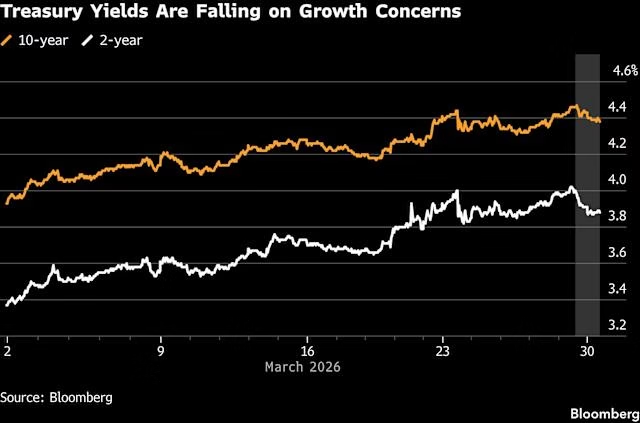
US Treasury yields reflected that shift clearly. Two-year yields, which are highly sensitive to monetary policy, dropped six basis points to 3.85%, extending a sharp decline from the previous session. Meanwhile, benchmark 10-year yields slipped nearly seven basis points to 4.36%.
In contrast to last week, when markets priced in further tightening, rate hike expectations have now largely been unwound. Swaps tied to the Federal Reserve’s December meeting are hovering near zero, a dramatic reversal from just days earlier.
All Eyes On Federal Reserve Signals

Investors are now looking ahead for clarity. A key moment is expected when Federal Reserve Chair Jerome Powell speaks at Harvard University.
His remarks could provide critical insight into how policymakers are balancing two competing risks, persistent inflation versus a potential slowdown in growth.
That tension lies at the heart of current market dynamics. If growth concerns deepen, central banks may be forced to shift away from tightening, even if inflation remains elevated.
Global Bond Markets Move In Sync
The rally was not limited to US markets. Across Europe and Asia, government bond yields also declined as investors embraced safer assets.
UK 10-year yields fell about five basis points to 4.92%, while German equivalents dropped to 3.04%. In Japan, yields edged down to 2.36%, reflecting a synchronized global move toward defensive positioning.
“The bull-steepening trend is likely to extend as investors pivot toward concerns about a growth slowdown after spending much of March pricing in a war-induced surge in inflation expectations”
Garfield Reynolds, Markets Live strategist
The message is clear. Markets are no longer singularly focused on inflation. Growth risks are taking center stage.
Rising Oil Prices Add Pressure
At the core of these concerns is energy. Oil prices continue to surge, raising fears of supply shortages that could ripple across global economies.
The conflict, now entering its second month, shows no signs of easing. Efforts to reopen key shipping routes have yet to produce results, keeping markets on edge.
Brent crude climbed more than 2% to around $115 a barrel in Monday trading, putting it on track for a record monthly gain. Such levels are already feeding into broader economic worries, from higher production costs to reduced consumer spending.
Strategic Bets Reflect Changing Outlook
Major financial institutions are adjusting their strategies accordingly. Some of the largest bond funds in the US are warning that markets may be underestimating the risks tied to the ongoing conflict.
Goldman Sachs has raised the probability of an economic downturn over the next year to roughly 30%, underscoring the seriousness of the situation.
Meanwhile, Donald Trump signaled continued pressure on Iran, stating that the administration is in “serious discussions” with the regime, while also threatening further action targeting the country’s energy infrastructure.
That uncertainty is feeding directly into market volatility.
Wall Street Sees Opportunity In Treasuries
Despite the turbulence, some strategists see opportunity. Analysts at major institutions are recommending targeted bets in government debt, particularly in medium-term Treasuries.
“If energy prices continue to climb, then downside risks to growth should rise further,” he wrote.
Others argue that parts of the bond market may already be oversold. Veteran market watcher Ed Yardeni pointed to excessive pessimism in short-term yields.
“The front end of the yield curve is priced for a tightening policy response that we doubt is coming, so we consider it to be oversold,” Yardeni wrote in a research note, referring to Treasuries.
That view suggests a potential rebound may still have room to run.
A Market At A Turning Point
So where does this leave investors?
Markets appear to be at a critical juncture. On one side lies inflation, still elevated and fueled by rising energy costs. On the other, a growing fear that economic activity could stall under the weight of geopolitical disruption.
For now, bonds are benefiting from that uncertainty. But the next move will depend heavily on how events unfold, both in the Middle East and within central bank policy rooms.
One thing is certain, sentiment has shifted, and the global bond market is responding fast.