

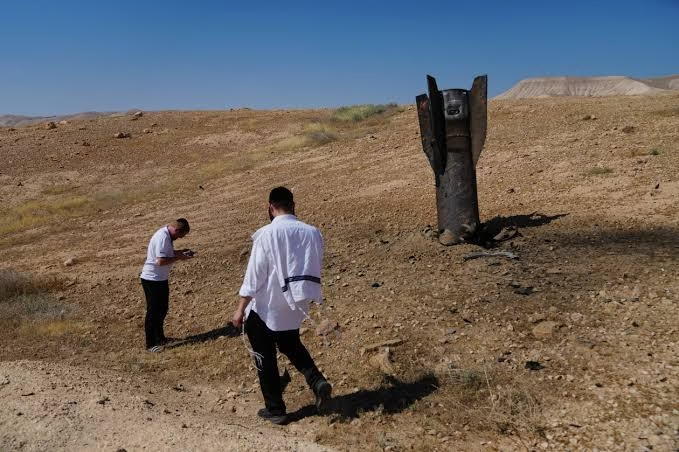
Israel launched a series of strikes across western and central Iran on Monday, targeting locations linked to the country’s military infrastructure following Iranian missile attacks earlier in the day.
The operation marked a significant escalation in the latest round of hostilities between the two longtime adversaries, despite ongoing diplomatic efforts aimed at reducing tensions.
Israeli Forces Hit Missile-Linked Facilities
According to the Israeli military, several targets were struck across western Iran, including a petrochemical facility near the southwestern city of Mahshahr.
Israeli officials said the site was being used in the production of ballistic missiles. Iranian reports indicated parts of the facility suffered damage, while local authorities began evacuating the surrounding area.
The strikes followed reports that Israeli leaders had been weighing both the timing and scale of a response to what they viewed as an Iranian violation of a ceasefire arrangement.
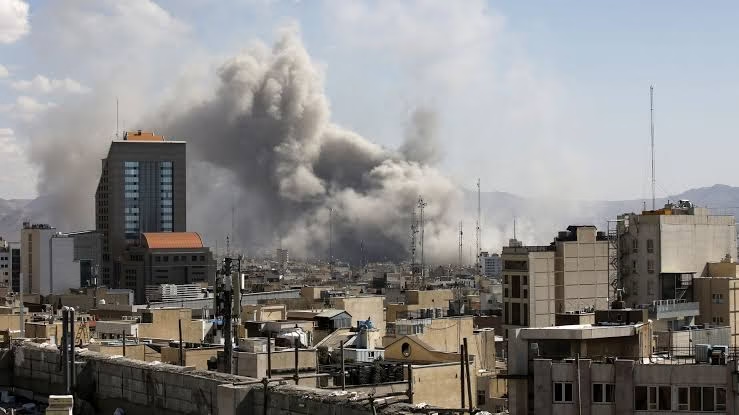
Meanwhile, Iran’s Islamic Revolutionary Guard Corps-linked media outlets reported that explosions were heard in multiple locations, including Tehran, Isfahan, Tabriz, and Karaj.
In addition, Iran’s official news agency reported that flights at Tehran’s Mehrabad Airport were suspended indefinitely following the attacks.
Conflicting Signals Over Possible Retaliation
Just hours before the strikes, a U.S. official had downplayed the likelihood of an immediate Israeli response.
“I don’t think anything is imminent in terms of an Israeli strike,” he said.
That assessment was quickly overtaken by events as Israeli aircraft carried out attacks on multiple targets inside Iran.
Iranian state media claimed previous operations involving Israel had prompted threats of retaliation from Tehran, adding another layer of complexity to the rapidly developing conflict.
Trump Urged Restraint
 As tensions mounted, US President Donald Trump reportedly urged Israeli Prime Minister Benjamin Netanyahu to avoid further military action against Iran.
According to reports, Trump told Netanyahu: “Israel has responded enough, no need for more.”
The president also highlighted ongoing diplomatic efforts between Washington and Tehran.
“I don’t want it to blow up because of what is happening now,” he said.
Trump later expressed optimism about negotiations, saying the United States is “very close to a final deal with Iran.”
However, he warned that continued retaliation could trap both sides in an endless cycle of conflict.
“If Netanyahu strikes them back, it’s just gonna keep going like the last 47 years, or last 3,000 years,” added Trump, noting that the Iranian attack on Israel “didn’t hurt anybody.”
Iran Blames Washington For Escalation
Iran’s Foreign Ministry sharply criticized the United States following the latest developments.
Foreign Ministry spokesperson Esmail Baghei argued that Washington bears direct responsibility for recent ceasefire violations and insisted Israeli actions cannot be separated from broader US policy.
He also warned that the latest military exchanges could further damage diplomatic efforts between Iran and the United States.
Israeli Military Targets Air Defense Network
Alongside the strikes on infrastructure sites, the Israeli military announced the completion of what it described as a large-scale operation against strategic Iranian defense systems.
Dozens of Israeli Air Force fighter jets reportedly participated in the mission, acting on intelligence gathered by military analysts.
Israeli officials said Iran had been working aggressively to rebuild its air defense network since the April 7 ceasefire that followed earlier clashes in 2025 and 2026.
Those systems had been weakened during Operation Roaring Lion, a campaign that significantly degraded Iran’s air defense capabilities.
According to the Israeli military, recently restored defensive assets had been deployed across multiple regions of Iran as part of efforts to rebuild detection and interception capabilities.
The latest strikes, officials said, further reduced those defenses and increased the Israeli Air Force’s operational freedom over Iranian airspace.
Israel Signals Readiness For Extended Conflict
Despite diplomatic pressure and international concerns, Israeli military officials indicated they remain prepared for a range of scenarios.
One Israeli military official said the campaign could continue for several days or longer if necessary.
According to the official, the military is prepared for options that could last “as long as it takes.”