


Meta has quietly embedded face-recognition technology into the software that powers its smart glasses, according to a new analysis of the company’s code. While the feature has not yet been activated for consumers, researchers say much of the infrastructure appears to already be in place.
The discovery has sparked renewed concerns among privacy advocates, particularly because the technology was found in an app downloaded tens of millions of times while Meta publicly maintained that such capabilities were still under consideration.
Hidden Feature Raises Privacy Questions
Researchers examining Meta’s AI companion app uncovered references to an internal system called “NameTag.” The feature is designed to identify people captured by smart glasses cameras and notify the wearer when a recognized individual appears in view.
The code was reportedly added across several software updates this year. Investigators found evidence suggesting that key parts of the technology had already been shipped to users’ devices months before Meta publicly discussed the possibility of introducing face recognition to its wearable products.
In April, the company stated that if face recognition were ever introduced, it would first take “a very thoughtful approach.” However, the software analysis indicated that important elements of the system had been integrated into the app as early as January.
How The Technology Appears To Work
 Although the feature remains inactive, researchers say the system is largely operational behind the scenes.
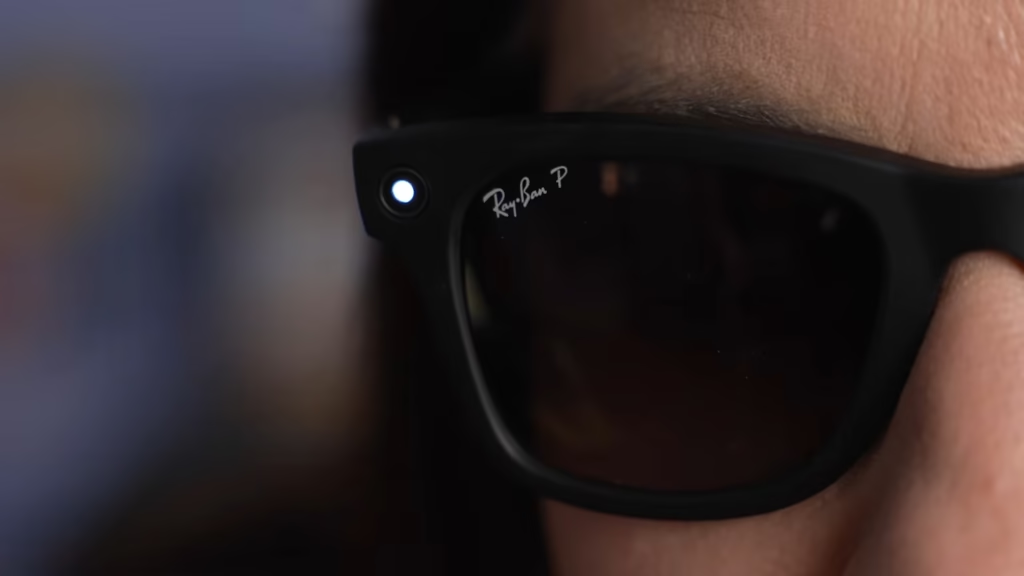
The companion app, which supports Meta’s Ray-Ban and Oakley smart glasses, appears capable of converting faces captured by the glasses into biometric identifiers known as faceprints. These faceprints could then be compared against a database stored locally on a user’s phone.
According to the analysis, recognized individuals would trigger alerts, while unrecognized faces could be cropped, indexed, and placed into a folder marked “pending.”
The app has reportedly surpassed 50 million downloads, making the discovery particularly significant given its widespread distribution.
AI Models Already Installed On Devices
Researchers found that three artificial intelligence models tied to the recognition process have already been delivered to users’ phones.
One model detects faces. Another crops facial images. A third converts those images into biometric signatures that can be matched against stored faceprints.
Two independent experts reviewed the findings and reproduced key parts of the analysis.
“The feature is not yet exposed to consumers but seems nearly ready to go,” says Cooper Quintin. “Despite the billions of reasons not to, Meta seems to have created the capacity to turn their customers into a distributed surveillance machine.”
The app also contains traces of a user-facing interface. In a May version of the software, the feature appears under the name “Connections,” with messaging encouraging users to “remember the people you met.”
Researchers Demonstrate Recognition Capability
Independent security researcher Buchodi conducted additional testing on the system.
Using a faceprint generated from an image of French philosopher Michel Foucault, Buchodi triggered the recognition pipeline and received a notification stating: “Person recognized.”
“The main components of a face-recognition feature are already in Meta’s companion app,” Buchodi says. “Not many pieces stand between this and a working feature.”
The test added to concerns that the technology may be closer to launch than previously understood.
Meta Defends Ongoing Development
 The controversy comes after more than 70 advocacy organizations, including the American Civil Liberties Union, Electronic Privacy Information Center, and Fight for the Future, urged Meta to abandon the project.
At the time, the company responded by saying: “Our competitors offer this type of face-recognition product, we do not. If we were to release such a feature, we would take a very thoughtful approach before rolling anything out.”
Former Meta Reality Labs policy official Joseph Jerome questioned whether such technology could be deployed responsibly.
“You’re setting norms and standards by putting technology into the ecosystem,” Joseph Jerome, a former Meta Reality Labs policy official who worked on privacy reviews for the company’s AR and VR products, says of Meta’s role in the wearable tech industry. “I don’t know how Meta can responsibly deploy a technology like this.”
Meta spokesperson Ryan Daniels pushed back against concerns, saying: “Regardless of any sensational reporting, the facts are simple: We’ve said before we’re exploring these types of features, and what you’re seeing is just evidence of that exploration. Nothing has shipped to consumers and no final decision has been made on what to do here, if anything. If we do decide to roll something out, we will take a thoughtful approach and do so with full transparency. One decision we can be clear about—we are not building a central face database.”
A Return To A Controversial Technology
The discovery revives memories of Meta’s earlier face-recognition efforts.
Facebook launched a facial recognition system in 2010 that automatically suggested tags for people appearing in photos. The platform eventually grew into one of the largest consumer face-recognition systems in the world, serving more than a billion users.
That technology faced years of legal and regulatory scrutiny. Critics questioned whether users had truly consented to the creation of biometric data, while regulators in both Europe and the United States investigated privacy concerns.
Meta later paid $650 million to settle a class-action lawsuit involving Illinois residents and reached a separate $1.4 billion settlement with Texas over allegations related to biometric data collection.
In November 2021, the company announced it would delete its facial recognition database and discontinue the system.
Yet insiders suggest the discussion never completely disappeared.
“There was always this tension of, well, when do we roll back out face recognition?”
Future Of Smart Glasses Recognition Remains Unclear
Internal planning documents previously indicated Meta had considered introducing facial recognition through its smart glasses, initially targeting accessibility applications for blind users before a wider rollout.
The company has not publicly explained whose faces could eventually be included in NameTag’s recognition database, how profiles would be created, or whether users would need to actively opt in.
Privacy experts argue that even an opt-in framework may not fully address concerns.
“We know that the more these systems are deployed, the more people come to see them as unexceptional,” Hartzog says. “And the more we come to see them as unexceptional and routine, the more people tend to start to take their moral cues about whether it’s desirable or good to have your face scanned. That’s just human psychology.”
For now, Meta says no final decision has been made. However, the presence of functioning facial recognition components inside software already installed on millions of devices is likely to keep the debate alive.