

A powerful earthquake struck the southern Philippines on Monday morning, leaving at least 15 people dead, damaging major buildings, and triggering tsunami warnings across several parts of Asia before most alerts were later lifted.
The magnitude 7.8 quake hit off the coast of Mindanao just before 7:40 a.m. local time, according to the United States Geological Survey. The violent shaking was felt across southern regions of the country and prompted emergency responses from national and local authorities.
The disaster also unleashed a series of aftershocks that continued for more than an hour, adding to fears among residents already rattled by the initial tremor.
General Santos Suffers Heavy Damage
Among the hardest-hit areas was General Santos City, home to more than 700,000 residents in southern Mindanao.
The Philippine Institute of Volcanology and Seismology classified the shaking in the city as a “very strong” seismic event on its internal intensity scale.
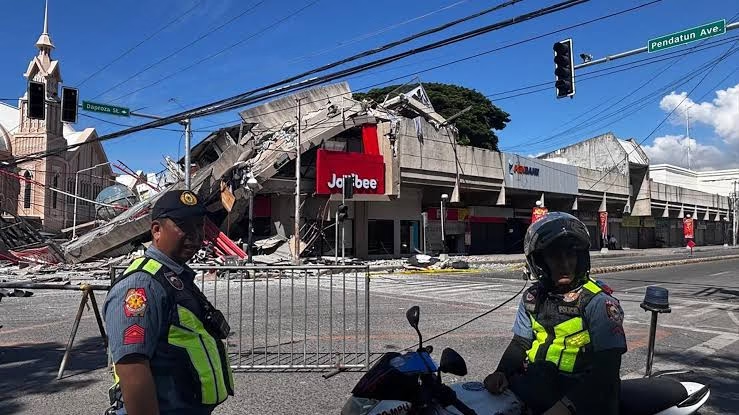
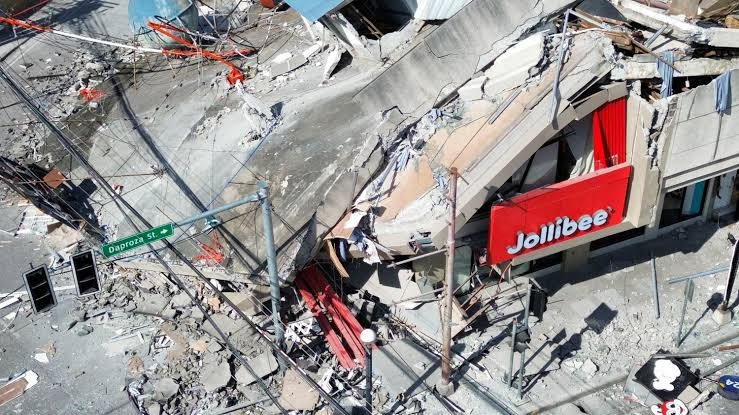
Videos shared through official channels captured dramatic scenes as a three-story building housing a Jollibee restaurant collapsed, sending massive clouds of dust and debris into the air while stunned bystanders watched nearby.
Additional images from the city revealed shattered windows, partially collapsed structures, and roofs that had caved in under the force of the quake.
A damaged hospital also became a focal point of emergency operations. Police spokesperson Robert Dagun told a local radio station that sections of St. Elizabeth Hospital sustained severe structural damage, forcing staff and patients to evacuate. Medical services were temporarily moved outside the main building while authorities assessed the extent of the destruction.
Witnesses Describe Violent Shaking
 Residents who experienced the earthquake firsthand described chaotic scenes as the ground moved beneath them.
Mary Ann Blanco Rhudy, a Catholic nun affiliated with Notre Dame of Dadiangas University in General Santos, was on her way to campus when the quake struck.
“The cars on the road were moving erratically. I am lucky that they didn’t crash against each other,” she told Al Jazeera.
“The trees on the side of the road were also swaying violently.”
Rhudy said several buildings at the university suffered partial collapses as the shaking rippled through the area.
Emergency Response Mobilized
As rescue and assessment efforts began, Philippine President Ferdinand Marcos Jr announced that emergency response agencies had been activated.
The Office of Civil Defence and the National Disaster Risk Reduction and Management Council were among the agencies mobilized to coordinate relief and recovery efforts.
The president also ordered schools in affected regions to close immediately.
“The safety of our children comes first,” Marcos said.
The timing of the earthquake created additional challenges because it struck on what was expected to be the first day of classes in many parts of the country.
According to the state-run Philippine News Agency, approximately 3.2 million students and 128,000 teachers and school personnel were affected by the closures.
Tsunami Warnings Spread Across Asia
The earthquake’s strength prompted tsunami alerts in several countries around the region, raising concerns about possible coastal impacts.
Authorities in both the Philippines and Indonesia initially issued warnings before later cancelling them as the threat diminished.
However, officials in Japan maintained a tsunami advisory for portions of the country’s southern coastline and remote islands. Residents were urged to avoid beaches, river mouths, and low-lying coastal areas until authorities declared conditions safe.
While the broader tsunami threat has largely receded, emergency officials continue monitoring coastal regions as aftershocks remain possible.
Recovery Efforts Continue
Search and rescue teams are continuing operations in damaged communities while engineers inspect buildings for structural risks.
Authorities are also working to determine whether the death toll will rise as assessments continue in affected areas across Mindanao.
The earthquake ranks among the strongest to hit the Philippines in recent years, underscoring the country’s vulnerability to major seismic events due to its location along the Pacific Ring of Fire.