


Spain has become one of Europe’s most attractive places for remote workers who want sunshine, strong internet, good transport, and a slower everyday rhythm without leaving their careers behind. The spain nomad visa gives eligible non-EU remote workers a legal path to live in Spain while working for companies or clients outside the country. It is not just a travel permit. It is a residence route designed for international teleworkers, freelancers, and professionals who can prove stable remote income, relevant work experience, and a clean legal record. For many applicants, it also offers a longer-term way to build life in Spain beyond the usual 90-day tourist stay.
spain nomad visa Explained Clearly
The spain nomad visa is officially linked to Spain’s residence route for international teleworkers. It was created for non-EU and non-EEA professionals who can work remotely from Spain while serving employers or clients mainly outside Spain.
In simple terms, the visa lets a qualified remote worker live in Spain legally while continuing their foreign-based work. Spain’s official guidance describes the category as a visa for people who carry out remote work using computer, telecommunication, or digital systems.
The visa is usually issued through a Spanish consulate when applying from abroad. People who are already legally in Spain may be able to apply directly for a residence authorization instead of first getting the visa. Official consular guidance notes that the visa can have a maximum validity of one year, while the residence permit may be valid for up to three years.
This makes the spain nomad visa especially useful for remote workers who want more stability than a tourist stay. It can support long-term planning, housing, schooling for children, banking, and residence paperwork.
Who Can Apply for It
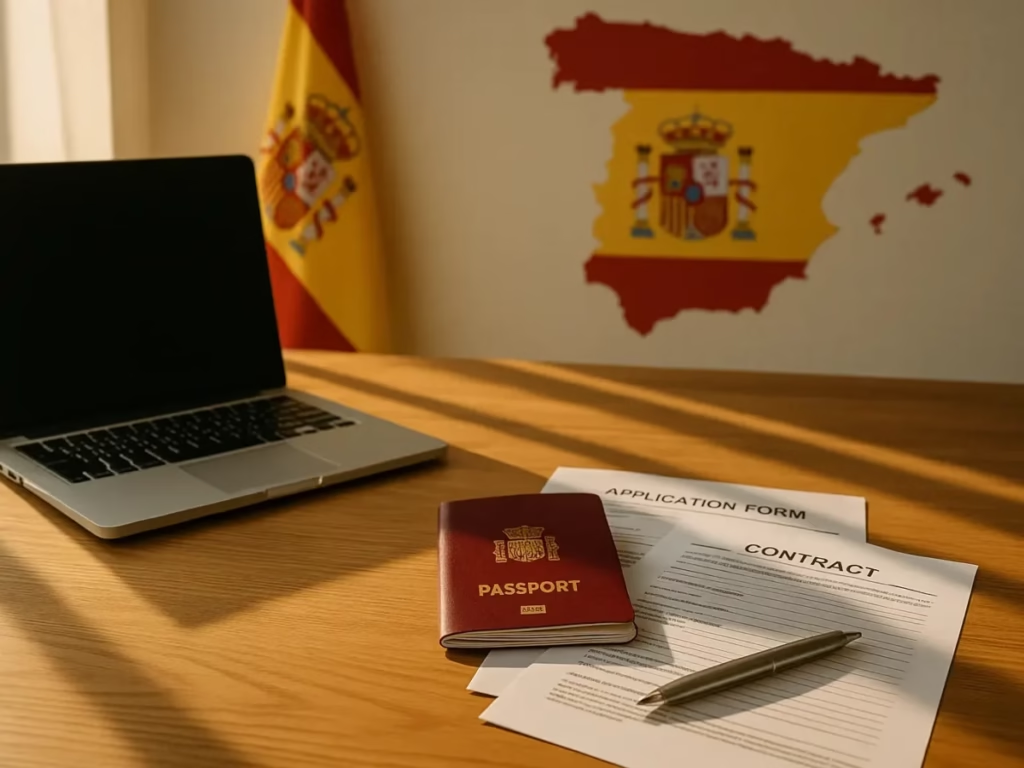
The spain nomad visa is mainly for non-EU citizens who work remotely for foreign companies or international clients. Applicants may be employees, freelancers, business owners, or self-employed professionals, but the work must be suitable for remote delivery.
Spain looks for applicants who can prove they are not simply trying to move to Spain without work. They need to show a real professional relationship, a stable source of income, and the ability to perform their job remotely.
Common eligible applicants include:
- Remote employees working for a company outside Spain
- Freelancers with mostly foreign clients
- Consultants, developers, designers, writers, marketers, and tech workers
- Business owners who manage foreign-based activity remotely
- Highly skilled professionals with digital or remote-friendly roles
A key rule is that the worker’s income should mainly come from outside Spain. Some Spanish-source work may be allowed for freelancers, but it is generally limited, often discussed as no more than 20% of total professional activity.
Main Eligibility Requirements
The spain nomad visa has several practical requirements. These are designed to show that the applicant is qualified, financially stable, and genuinely working remotely.
Spain’s official portal for international teleworkers lists requirements such as professional qualifications or at least three years of professional experience, proof that the company has real and continuous activity, and evidence that the work can be done remotely.
Applicants usually need to show:
- A valid passport
- Proof of remote work
- Employment contract or client contracts
- Company authorization to work from Spain
- Proof of income
- Health insurance or valid coverage
- Criminal record certificate
- Professional qualification or experience
- Proof that the company or client relationship is real
For employees, the employer should usually confirm that the worker is allowed to work remotely from Spain. For freelancers, contracts and client letters can help prove ongoing professional activity.
The spain nomad visa also requires careful document preparation. Foreign documents often need official translation into Spanish and apostille or legalization, depending on the country where they were issued.
Income Rules and Financial Proof
Income is one of the most important parts of the spain nomad visa application. Spain wants to see that the applicant can support themselves without relying on local public assistance.
Official consular guidance states that the main applicant must show income equal to 200% of Spain’s minimum wage benchmark, with extra amounts for family members. One Spanish consular page lists 200% for the main teleworker, 75% for the first family member, and 25% for each additional family member.
Because the benchmark can change, applicants should always check the latest amount with the Spanish consulate or immigration office before applying. Recent 2026 guidance from visa and relocation sources places the single-applicant monthly threshold around the high €2,000 range, but official confirmation is still essential before submitting documents.
Useful financial documents may include:
- Recent bank statements
- Employment contract showing salary
- Freelance client agreements
- Invoices and payment records
- Tax returns or business registration
- Company letter confirming income
The stronger the evidence, the better. A clear monthly income pattern is usually more convincing than one large deposit with no explanation.
Documents Applicants Usually Need
The spain nomad visa is paperwork-heavy, so applicants should prepare early. Missing, expired, or untranslated documents can delay the process.
The exact checklist may vary by consulate, but applicants commonly need a completed visa form, passport, passport photos, proof of legal residence in the consular area, proof of remote work, proof of income, health coverage, criminal record certificate, and payment of the visa fee.
Important documents often include:
- Passport valid for the required period
- Visa application form
- Passport-style photograph
- Criminal background certificate
- Proof of private or valid health coverage
- Employment or freelance contracts
- Employer or client authorization letter
- Proof of qualifications or three years of experience
- Proof of income and bank history
- Apostilled and translated foreign documents
Applicants should not rely only on general online checklists. Each Spanish consulate may ask for slightly different formatting, copies, translations, or fee payment methods.
How the Application Process Works
The spain nomad visa application process depends on where the applicant applies. A person outside Spain usually applies at the Spanish consulate in their country or region of legal residence. A person already legally inside Spain may apply for a residence authorization.
The process usually follows these steps:
- Check the correct Spanish consulate
- Confirm the latest document checklist
- Gather income, work, and identity documents
- Translate and apostille documents where required
- Book an appointment or follow the consulate’s submission method
- Submit the application and pay the fee
- Wait for a decision
- Travel to Spain if approved
- Complete residence card steps after arrival, if required
The spain nomad visa should be treated like a legal residency file, not a casual travel application. Every document should support the same story: the applicant is a qualified international remote worker with stable foreign income.
Applying From Inside Spain
Some remote workers enter Spain legally and then apply from within the country. This can be attractive because the residence authorization may be granted for a longer initial period than the consular visa route.
Official guidance states that foreigners who are legally in Spain can apply directly for a telework residence permit without first needing a prior telework visa, and that the residence permit can be valid for a maximum of three years.
This route can work for people who are legally present in Spain under a valid stay. However, timing matters. Applicants should not wait until the last moment of their legal stay to prepare documents.
For many applicants, the inside-Spain route may feel more practical. Still, it requires the same serious evidence: remote work, income, professional background, and clean records.
Benefits for Remote Workers
The spain nomad visa offers more than permission to live in Spain. It gives remote professionals a structured way to settle, rent a home, work legally, and plan beyond short tourist limits.
Key benefits include:
- Legal residence in Spain
- Ability to work remotely for foreign companies or clients
- Potential residence pathway for several years
- Family members may be included
- Access to Spain’s lifestyle, transport, and cities
- More stability than Schengen tourist stays
- Possible access to a special tax regime if eligible
Spain is attractive because it offers major cities like Madrid and Barcelona, coastal hubs like Valencia and Málaga, and quieter towns with lower living costs. Remote workers can choose the lifestyle that fits their work schedule and budget.
The spain nomad visa is also helpful for people who need predictable legal status. Instead of leaving the Schengen Area after 90 days, approved applicants can build a more stable routine.
Tax Points to Understand
Tax is one of the most important topics for anyone considering the spain nomad visa. Living in Spain for a significant part of the year may create tax residence issues.
Some digital nomad visa holders may be eligible for Spain’s special impatriate tax regime, often called the Beckham Law. This regime can offer a flat tax treatment for qualifying workers, but it is not automatic and depends on personal circumstances.
Applicants should speak with a Spanish tax adviser before moving. Tax outcomes can depend on where the income comes from, how long the person stays in Spain, whether they are employed or self-employed, and whether their home country has a tax treaty with Spain.
The safest approach is simple: handle tax planning before arrival, not after the first tax deadline.
Common Mistakes to Avoid
Many spain nomad visa problems come from weak documentation rather than lack of eligibility. Applicants often underestimate how detailed the file needs to be.
Common mistakes include:
- Submitting documents without required translation
- Not apostilling foreign records
- Providing unclear income evidence
- Using vague client letters
- Applying with expired certificates
- Ignoring consulate-specific instructions
- Assuming tourist rules and residence rules are the same
- Forgetting tax and social security planning
Another common mistake is relying on old income figures. Since financial thresholds are tied to Spanish wage benchmarks, the required amount can change. Always check the latest requirement before applying.
A clean, consistent file gives the application a stronger chance. Every document should support the same professional and financial profile.
Family Members and Dependents
The spain nomad visa may allow close family members to join the main applicant. This can include a spouse or registered partner, dependent children, and in some cases dependent relatives in the ascending line.
Official guidance says family members of the teleworker may also obtain a family visa, including a spouse or unmarried partner, children and dependent adult children, and relatives in the ascending line under the worker’s care.
Family applications require extra income proof. The main applicant must show enough funds not only for themselves but also for each dependent.
Families should prepare documents such as marriage certificates, birth certificates, dependency evidence, and translated legal records where required. As with the main applicant, formatting and legalization rules matter.
Who This Visa Suits Best

The spain nomad visa suits remote professionals who already have stable work and want a serious base in Europe. It is not ideal for people still looking for income, testing freelance work for the first time, or planning to work mainly for Spanish employers.
It is best for:
- Remote employees with employer approval
- Freelancers with steady foreign clients
- Professionals with strong income records
- Families seeking a legal residence route
- Workers who want Spain as a long-term base
- Applicants comfortable with paperwork and tax planning
The visa may not suit people who cannot prove stable income, lack remote work authorization, or need to earn mainly from Spanish clients.
A Smart Route Into Spain
The spain nomad visa gives remote workers a practical way to live in Spain while keeping their international careers active. It combines legal residence, work flexibility, family options, and access to one of Europe’s most appealing lifestyles.
The key is preparation. Applicants should verify the latest income threshold, collect strong work evidence, translate and legalize documents correctly, and get tax advice before making the move.
For qualified remote workers, the spain nomad visa can be more than a permit. It can be the start of a stable, well-planned life in Spain.