
Wall Street took a hard hit Wednesday, and the pressure only grew as the day wore on. Stocks slid after the Federal Reserve left interest rates unchanged, wholesale inflation came in hotter than expected, and surging oil prices added a fresh layer of fear to an already uneasy market. By the closing bell, investors were staring at a sharp repricing across equities, bonds, and commodities.
Fed Decision Deepens Market Anxiety
:max_bytes(150000):strip_icc()/GettyImages-2268627564-23519ecdd0874f198031420f90fefc9f.jpg)
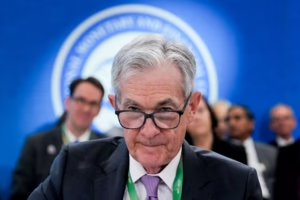
The Federal Reserve held rates steady after its two day policy meeting, but the market reaction turned uglier once Chair Jerome Powell began speaking. Traders had expected no change on rates. What they did not like was the message underneath it.
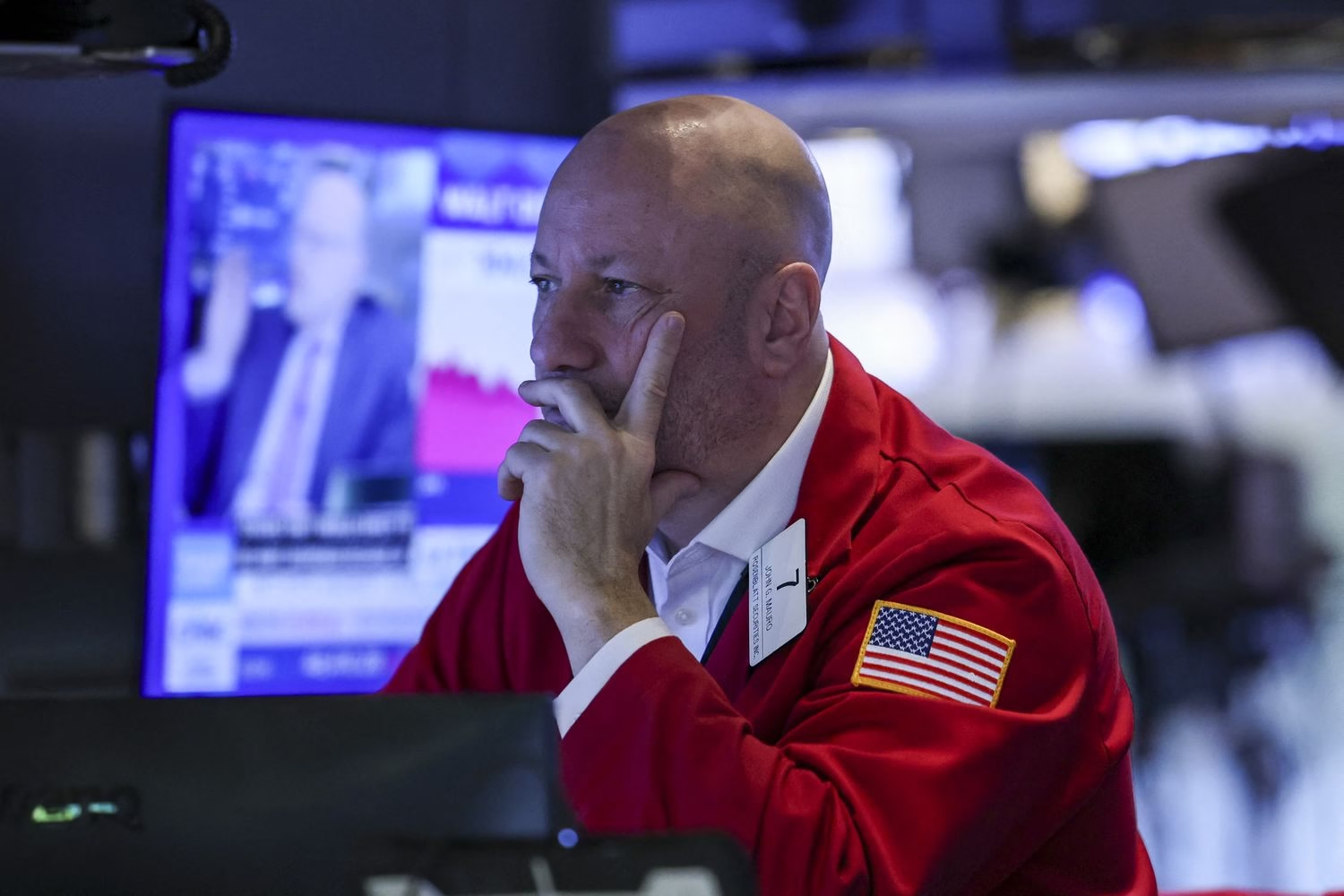
The Dow Jones Industrial Average fell roughly 1.6%, shedding more than 750 points and surrendering its gains for the week. The S&P 500 dropped about 1.4% and flirted with a four month low. The Nasdaq Composite also sank roughly 1.4% to 1.5%, as growth stocks remained under pressure.
Only one Fed voter broke ranks. Governor Stephen Miran favored a quarter point cut, leaving the decision at 11 to 1 to keep rates unchanged.
Powell made clear the path to lower rates is far from certain. “The forecast is that we will be making progress on inflation, not as much as we had hoped, but some progress on inflation,” said Powell on Wednesday afternoon during a press conference. He then delivered the line investors were dreading: “If we don’t see that progress then you won’t see the rate cut.”
That was enough to send losses accelerating.
Powell’s Comments Tighten The Screws
Markets initially took the Fed statement in stride. Then came the press conference, and sentiment deteriorated fast.
Bond yields jumped, the dollar strengthened, and investors moved to price in tighter financial conditions. As one market update put it, “All of these moves suggest a further tightening of financial conditions and raise the pressure on risk assets. That is a real repricing, and not a friendly one for stocks.”
The 10 year Treasury yield moved higher, the 30 year yield pushed toward 4.88%, and the US dollar index climbed back above 100. The bond market continued to price in just one rate cut by December, reflecting growing skepticism that policymakers will ease soon if inflation stays sticky.
Powell also addressed his own future at the Fed while speaking to reporters. “I have no intention of leaving the board until the investigation is well and truly over with transparency and finality,” said Powell on Wednesday. He added that he has not yet decided whether he will remain a Fed governor after his term as chair ends.
Inflation Was Already Heating Up
The market had already been wobbling before the Fed spoke. Earlier Wednesday, fresh government data showed producer prices rose much faster than expected in February.
US producer prices climbed 0.7% month over month, more than double the 0.3% increase economists had expected. On a year over year basis, headline producer inflation accelerated to 3.4%.
The Bureau of Labor Statistics highlighted the role of energy costs in the jump. It said “nearly 30 percent of the February rise in the index for processed goods for intermediate demand can be traced to prices for diesel fuel, which increased 13.9 percent.” It also noted that “sixty percent of the February advance is attributable to a 5.5-percent jump in prices for processed energy goods.”
Even the underlying details carried a warning sign. “Intermediate” prices for business inputs rose sharply, led by energy goods and materials, suggesting inflation pressures were building even before the latest oil shock hit global markets.
Oil Prices Add Fuel To The Selloff

Then came energy.
Crude prices surged as the Middle East conflict intensified and supply fears spread through global markets. Brent crude rose above $104 a barrel on Wednesday and later climbed higher in follow on reports, while West Texas Intermediate traded near $98 before settling lower later in the day.
Oil has become the market’s central fear because it threatens to reignite inflation just as investors were hoping for lower rates. Powell acknowledged the uncertainty directly, saying, “We just don’t know,” when asked what will happen with oil prices and how long tariffs will take to filter through the system.
That uncertainty is now driving much of the market mood.
South Pars Strike Sends Shock Through Energy Markets
One of the biggest catalysts came from reports that Israel struck Iran’s South Pars gas field, a critical piece of global energy infrastructure. European natural gas prices jumped, adding to an already fierce rally in oil and gas markets.
Iran’s South Pars field accounts for roughly a third of the world’s largest natural gas formation. Iran shares that formation with Qatar, where it is known as the North Dome. The field matters enormously because Qatar’s LNG exports help supply both European and Asian buyers.
Regional tensions escalated further after Iran signaled possible retaliation against energy facilities across the Gulf. Iran’s military operational command, according to Fars, said: “We consider the targeting of the source country’s fuel, energy, and gas infrastructure to be a legitimate cause for us, and at the first opportunity, we will retaliate with utmost severity.”
Iran also issued evacuation warnings for several energy sites in Saudi Arabia, the UAE, and Qatar, saying they could be targeted “in the coming hours.”
White House Moves To Ease Domestic Pressure
Meanwhile, the White House tried to blunt the domestic blow from higher energy costs. President Trump issued a temporary waiver of the Jones Act, allowing foreign flagged vessels to move cargo between US ports for 60 days.
Defending the move, White House press secretary Karoline Leavitt said, “President Trump’s decision to issue a 60-day Jones Act waiver is just another step to mitigate the short-term disruptions to the oil market as the U.S. military continues meeting the objectives of Operation Epic Fury. The Administration remains committed to continuing to strengthen our critical supply chains.”
The waiver is aimed at lowering transport costs for energy products moving around the United States, especially refined fuels headed from Gulf Coast refineries to the East Coast.
Defensive Stocks Lose Their Safe Haven Status
Even the so called defensive corners of the market were not spared.
Food stocks, which had been a relative hiding place earlier this year, turned sharply lower. Consumer staples had been one of the best performing sectors in 2026, but intraday heat maps showed red across the food industry.
General Mills came under pressure after reaffirming guidance into soft demand. Unilever also weakened as investors weighed a possible separation of its food business. Names such as Kraft Heinz, Mondelez, Coca Cola, and PepsiCo also traded lower, a sign that investors were broadly backing away from the sector.
The shift suggests Wall Street is growing less interested in expensive safe havens and more concerned about weak volumes, earnings pressure, and private label competition.
Gold Breaks Below A Key Level
Gold also cracked under the pressure.
After holding above $5,000 for about a month, gold lost that floor and briefly plunged toward $4,850. That drop pushed the metal below its 50 day moving average, a level that had held since last August.
It was a sharp reversal for one of the year’s hottest trades and showed just how much volatility was spreading across asset classes.
Energy Leads, Tech Splits, And Nvidia Keeps The AI Story Alive
There were still isolated pockets of strength, though they did little to change the tone of the broader market.
Energy names continued to dominate the list of fresh 52 week highs, with companies such as ConocoPhillips, Canadian Natural Resources, Equinor, EOG Resources, Valero, and Marathon Petroleum posting strong gains this year. Smaller names ran even hotter. Liberty Energy rose more than 70% in 2026, while Solaris Energy Infrastructure more than quadrupled from its April 2025 low.
Outside energy, the list of winners looked narrow. DigitalOcean, nVent, and Quanta Services were among the few names still grinding higher.
Chip stocks offered a more mixed picture. Nvidia remained in focus after CEO Jensen Huang said the company expects AI chip sales to top $1 trillion by 2027, excluding its latest product lineup. AMD rose after announcing a memorandum of understanding with Samsung to deepen their memory chip partnership.
Micron, however, stole the spotlight after the close.
Micron Delivers A Blowout Quarter
Micron reported second quarter earnings that easily topped Wall Street’s expectations and issued stronger than expected guidance for the current quarter.
The company posted earnings per share of $12.20 on revenue of $23.86 billion. Analysts had been looking for EPS of $9.00 on revenue of $19.7 billion. The results underscored how powerful AI driven demand has become in memory markets.
Even so, Micron shares had fallen during regular trading before ticking higher after hours, a reminder that investors are becoming harder to impress in this market.
Macy’s Beats, But Outlook Stays Careful
Retail offered another split screen.
Macy’s beat Wall Street’s low expectations for the holiday quarter, with adjusted EPS of $1.84 and revenue of $7.6 billion. Same store sales rose 1.8%, better than forecasts for a slight decline.
Bloomingdale’s stood out as a bright spot. CEO Tony Spring said the performance “underscores its ability to elevate the customer experience and capture demand across premium contemporary to luxury businesses” in the release.
Spring also struck an optimistic tone about Macy’s broader turnaround effort, saying, “At Macy’s, we are offering more relevant brands, stronger storytelling and investing in our colleagues so we can better serve the customer … looking to 2026 and beyond, we are ready to build on our progress.”
Still, Macy’s guidance for the coming fiscal year came in on the cautious side, showing that even better results are being greeted with restraint.
Why Investors Are Still Not Calling It A Crash
For all the turbulence, some strategists say this is not a classic panic selloff.
As one market note put it, “The market isn’t crashing, and that’s one reason why it’s not crashing.” The logic is that investors had bought protection for a fast, violent drop. Instead, stocks have mostly drifted lower in a grinding decline. In that kind of move, crash hedges lose value over time, and unwinding them can actually reduce selling pressure.
In other words, the market is being squeezed, but not yet spiraling.
Still, Wednesday’s action showed how fragile sentiment has become. Rising oil, hotter inflation, and a Fed unwilling to promise quick relief are a punishing mix for stocks.
Global Markets Feel The Heat
The pressure was not limited to Wall Street.
Canadian and US stocks both fell after the Bank of Canada and the Federal Reserve held rates steady while flagging inflation risks tied to the Middle East conflict. Ashish Utarid, assistant vice president of investment strategy with IG Wealth Management, said, “It’s exactly what was expected, both the Bank of Canada and the Federal Reserve paused today … a lot of that is back to the uncertainty question — what is the impact of this war going to be on inflation in the near term?”
He added, “If there’s an off-ramp that is in a few weeks, this will just be a tiny blip on the year-over-year inflation numbers,” but warned that prolonged high oil prices would eventually damage demand.
Asian markets also retreated Thursday after Brent crude topped $111 a barrel. The Nikkei, Kospi, Hang Seng, and Shanghai Composite all moved lower as the oil shock rippled across global equities.
Wall Street’s New Reality
The big story is no longer just rates. It is the collision of rates, inflation, and geopolitics.
Stocks had hoped the Fed would soon step in with cuts. Instead, traders got a reminder that policymakers may stay on hold longer if oil driven inflation keeps heating up. That leaves markets exposed to more volatility, more repricing, and more uncomfortable questions.
For now, Wall Street has its answer. Lower rates are not coming quickly, and investors may have to live with that a while longer.