

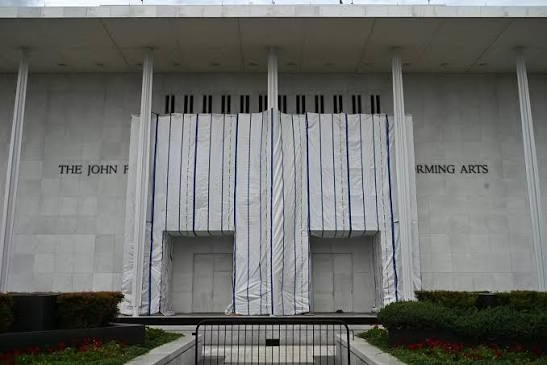
A federal appeals court has refused an emergency effort to halt the removal of Donald Trump’s name from the exterior of the Kennedy Center, delivering another setback to the venue’s leadership as workers prepared to take down the signage from one of Washington’s most recognizable cultural landmarks.
The ruling came after Justice Department attorneys, representing Trump and the Kennedy Center board appointed during his administration, sought urgent intervention to block a lower court order requiring the removal of the president’s name from the building.
The appeal was filed just hours before a court-imposed deadline, but judges declined to grant the requested pause, clearing the way for work to continue.
Workers Return As Crowd Gathers Outside
Friday evening brought renewed activity outside the performing arts center as construction crews in hard hats and safety vests assembled near the marble facade where Trump’s name had been installed.
Supporters of the removal effort gathered nearby and voiced their approval.
“Take it down!” they chanted.
Earlier in the day, workers had erected scaffolding around the section of the building bearing the president’s name. However, stormy weather temporarily interrupted operations, leaving the lettering untouched for several hours.
Heavy rain and thunder rolled across the capital, forcing crews to suspend work. Officials did not publicly explain the delay.
Judge Says Only Congress Can Change The Name
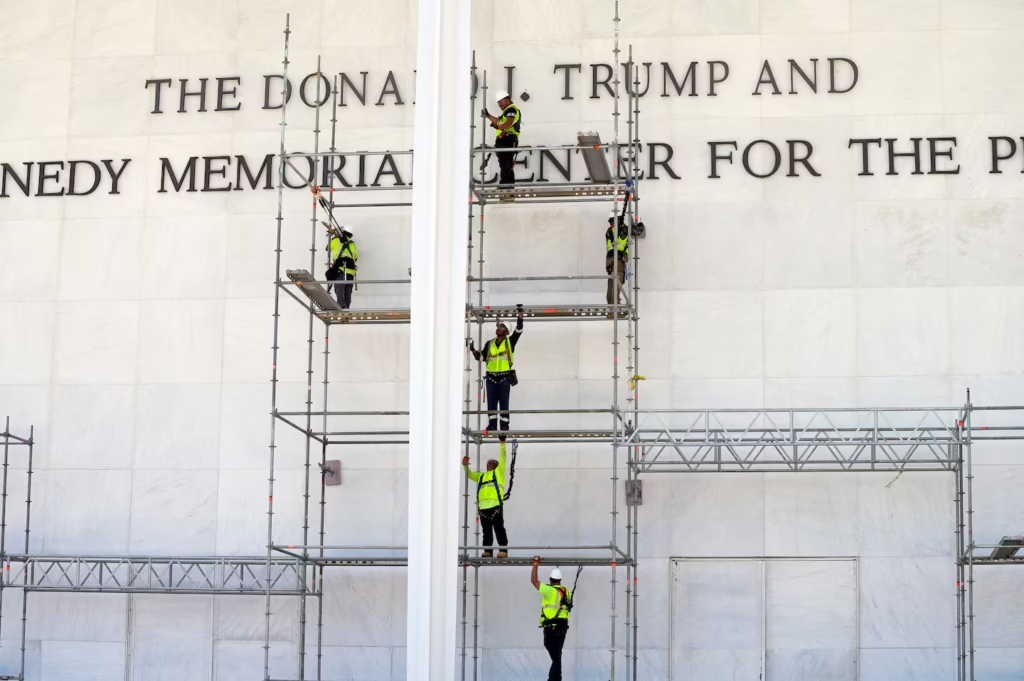
The legal battle stems from a ruling issued last month by U.S. District Judge Christopher Cooper, who concluded that adding Trump’s name to the institution violated federal law.
In a lengthy opinion, Cooper emphasized that the Kennedy Center’s identity was established by Congress and could not be altered through board action alone.
“Congress gave the Kennedy Center its name,” Cooper wrote in his 94-page opinion in May, “and only Congress can change it.”
The judge ordered the institution to remove Trump’s name from both physical signage and official branding within two weeks.
Kennedy Center Begins Compliance Effort
Following the ruling, Kennedy Center officials moved to comply with the court order.
An internal memorandum dated June 4 instructed employees to eliminate references to a “Trump Kennedy Center” and restore traditional branding associated with the institution.
“To comply with this order, you must immediately change email signatures, letterheads, and other documents to reflect the name such as ‘The John F Kennedy Center for the Performing Arts,’ or ‘Kennedy Center.’”
The memo also set deadlines for broader updates.
“Other changes, such as to templates and forms, signage, brochures and website pages, must be completed no later than Friday, June 12, 2026,” the memo added.
Earlier this week, the center removed Trump’s name from its website. Promotional communications sent to patrons also reverted to the traditional Kennedy Center branding.
Renovation Plans Also Impacted
Cooper’s ruling extended beyond signage.
The judge temporarily blocked a proposed $257 million renovation initiative that would have closed the Kennedy Center for roughly two years. Leadership at the venue had previously approved the large-scale modernization project as part of a broader redevelopment effort.
The dispute originated from a lawsuit filed by Joyce Beatty, an Ohio Democratic congresswoman and ex-officio member of the Kennedy Center board.
Beatty opposed the emergency request seeking to suspend Cooper’s decision and later appeared outside the center as workers assembled scaffolding.
Longtime Visitors Welcome The Decision
Among those watching the developments was Bonnie Berry, a retired higher education and events professional who said she had distanced herself from the venue following the rebranding effort.
Asked how she felt about the latest court decision, she replied: “Oh, lovely, because I can’t say his name. He’s Orange Man 47 to me.”
As work continued nearby, Berry reflected on the controversy and the future of the removed letters.
“It’s a bittersweet day because I want to make certain it goes down. I haven’t walked on this site for over a year since he put the sign up. I think they should actually auction off T-R-U-M-P and we’ll donate it back to the Kennedy Center to get the opera back and to pay the symphony and the people who got fired. I’d be all in favor of that.”
Meanwhile, a passing Washington bus sounded its horn as it approached the campus, drawing cheers from the crowd gathered outside.
How Trump’s Name Ended Up On The Building
The controversy traces back to December, when a Trump-aligned board of trustees unanimously approved renaming the institution “The Donald J Trump and the John F Kennedy Memorial Center for the Performing Arts.”
The move sparked criticism throughout Washington and among many members of the arts community.
During his first presidency, Trump rarely engaged with the venue and skipped its annual honors ceremony. However, after returning to office, he took a much more active role, replacing board members and installing allies in leadership positions.
Among them was Ric Grenell, who oversaw significant organizational changes before departing earlier this year. He was later succeeded by Matt Floca, the center’s vice president of operations.
Critics See Rebranding As Political Statement
For many Washington residents, the effort to place Trump’s name alongside Kennedy’s legacy became a symbol of broader concerns about political influence over public institutions.
One retired government employee, Carolyn, who declined to provide her last name, expressed frustration with the decision.
“Putting his name on everything is right out of the dictator playbook.”
She said the Kennedy Center holds personal significance because it honors President John F. Kennedy, whose birthday she shares.
“Of course it’s just a symbol – there’s so many other things that the president does that I disagree with – but I’m happy to be here and have this little splash of hope in the rain.”
As rain showers swept across the city and workers paused their efforts, many in attendance remained nearby, waiting for the eventual removal of the lettering that has fueled months of political and legal controversy.