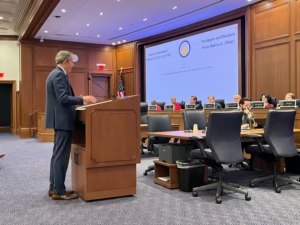

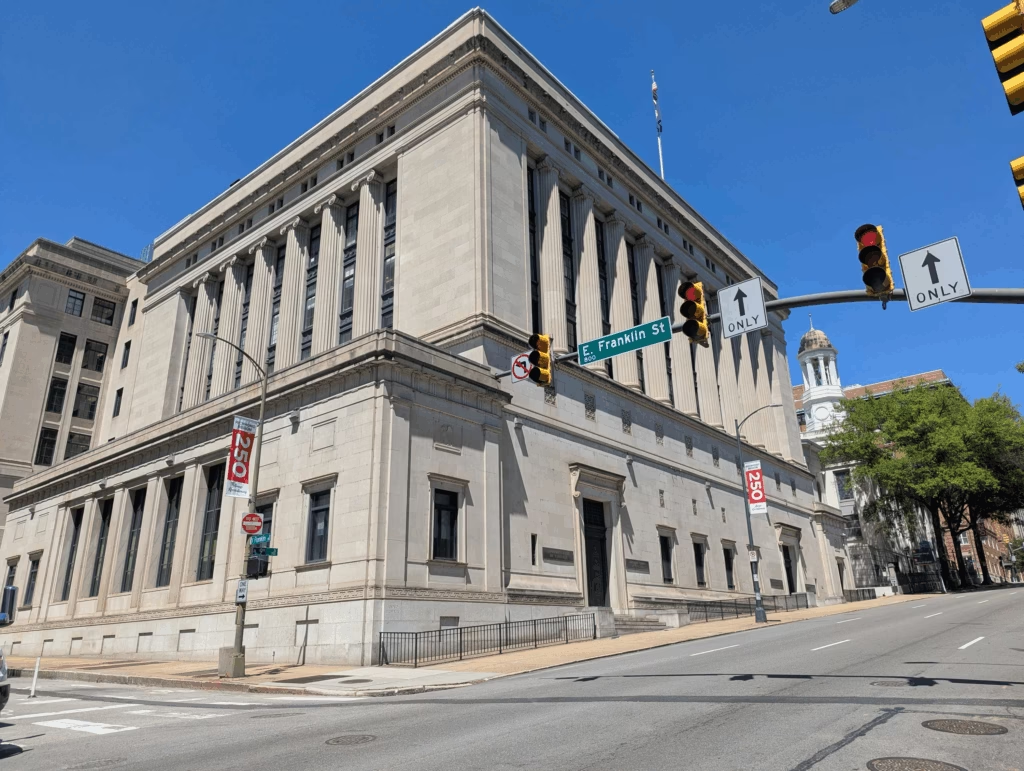
A high-stakes battle over congressional redistricting in Virginia took a dramatic turn Friday after the Virginia Supreme Court struck down a Democratic-backed congressional map that party leaders hoped would help flip control of the U.S. House.
The ruling instantly reshapes the political landscape ahead of November’s midterm elections. Republicans, already benefiting from favorable redistricting efforts in multiple states, now enter the cycle with even stronger momentum as they fight to protect their slim House majority.
The court found that Democratic lawmakers failed to follow the constitutional process required to place a redistricting amendment before voters earlier this year. That procedural failure, the justices concluded, invalidated the referendum entirely.
Court Says Constitutional Process Was Violated
 The dispute centered on whether Virginia Democrats properly followed the state’s constitutional amendment timeline before putting the redistricting proposal on the ballot in April.
Under Virginia law, lawmakers must approve a constitutional amendment during two consecutive legislative sessions, with an election occurring in between those sessions. Republicans argued Democrats missed that requirement because early voting had already started before the legislature initially passed the amendment in 2025.
Democrats countered that Election Day itself, not the start of early voting, should count as the official election date.
The court disagreed.
“This violation irreparably undermines the integrity of the resulting referendum vote and renders it null and void,” the court wrote in its order.
That language delivered a crushing setback for Democrats, who had hoped the new district lines could produce as many as four additional House seats.
GOP Sees Growing Redistricting Edge
The Virginia decision arrives as both parties aggressively battle over congressional maps nationwide. However, Republicans currently appear to hold the upper hand.
According to estimates tied to recent redistricting changes, Republicans could potentially gain up to 14 seats from new maps drawn across six states. Democrats, meanwhile, are projected to gain roughly six seats from their own redistricting efforts.
Still, political analysts caution that newly drawn districts do not automatically translate into guaranteed victories.
Democrats need a net gain of at least three seats this November to reclaim the House majority.
Meanwhile, the broader legal environment has also shifted in Republicans’ favor after the Supreme Court of the United States recently rolled back portions of Voting Rights Act protections tied to racial gerrymandering claims.
Together, those developments have intensified Democratic concerns about entering the midterms at a structural disadvantage.
Democrats Tried To Bypass Bipartisan Commission
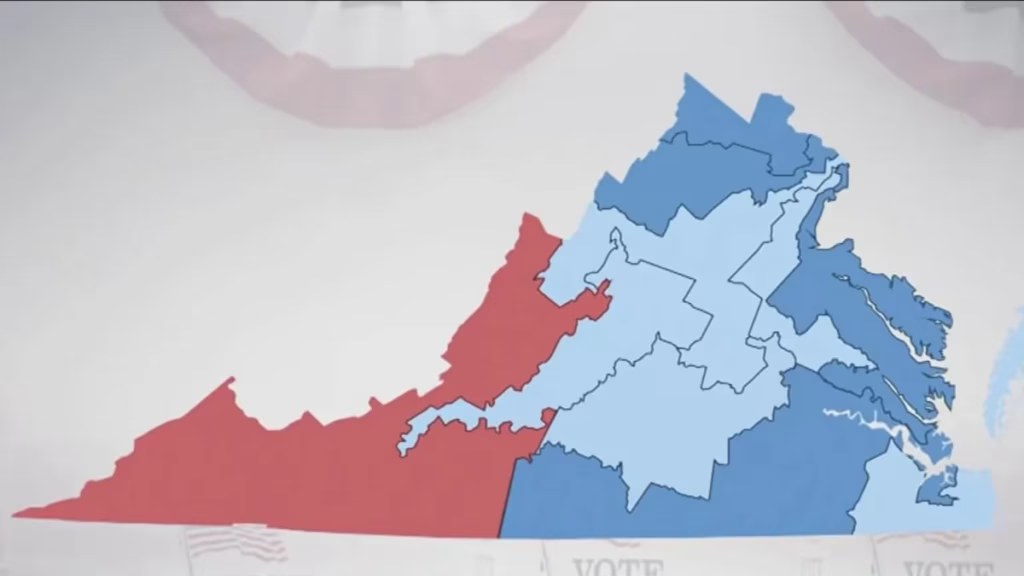
Virginia Democrats launched the redistricting push after repeated calls from Donald Trump encouraging Republican-led states to redraw congressional maps ahead of the 2026 elections.
To move forward, Democrats sought to bypass Virginia’s bipartisan redistricting commission, which voters approved in 2020. That commission was originally designed to reduce partisan map manipulation.
Instead, Democrats pursued a constitutional amendment that would allow lawmakers to advance a new congressional map more favorable to their party.
California Democrats employed a similar strategy last year while pursuing new district boundaries that could potentially help secure several additional House seats.
Justice Kelsey Rejects Democrats’ Early Voting Argument
Justice Arthur Kelsey sharply criticized Democrats’ legal reasoning in the court’s majority opinion.
“Under this thesis, early Virginia voters unknowingly forfeited their constitutionally protected opportunity to vote for or against delegates who favor or disfavor amending the Constitution by not anticipating a legislative vote on a constitutional amendment four days before the last day of voting,” the opinion said.
Kelsey also pushed back against state attorneys who argued the court should avoid intervening after voters had already approved the referendum.
The court had previously allowed the April special election to proceed while reserving the right to later determine whether the measure itself was lawful.
Virginia voters ultimately approved the referendum by a narrow 3-point margin.
Millions Spent On A Referendum Now Voided
The failed redistricting effort carried a steep financial and political cost.
Virginia spent roughly $5 million administering the special election. Tens of millions more poured into campaign advertising as both sides fought over the proposal.
More than 3 million Virginians cast ballots.
Following the ruling, the anti-redistricting group Virginians for Fair Maps celebrated the outcome.
“Virginians spoke loud and clear in 2020 that voters should pick their elected officials, not the other way around. Today, their voices were heard over the shamefully deceptive rhetoric and language of an unconstitutional effort by Richmond Democrats to carve up the state for themselves,” said group co-chairs Jason Miyares and Eric Cantor.
Trump also applauded the decision on Truth Social, calling it a “Huge win for the Republican Party, and America.”
Democratic Leaders Vow To Fight Back
Top Democrats reacted furiously to the ruling, warning that overturning a voter-approved referendum could set a dangerous precedent.
Hakeem Jeffries blasted the decision, saying, “The decision to overturn an entire election is an unprecedented and undemocratic action that cannot stand.”
“We are exploring all options to overturn this shocking decision,” he said in a statement.
At the state level, Don Scott struck a more measured tone while defending the broader effort.
“We respect the decision of the Supreme Court of Virginia,” Scott said.
“This was always about more than one election — it was about whether the voices of the people matter,” he said. “And no decision can erase what Virginians made clear at the ballot box.”
Current Congressional Map Remains In Place
With the ruling now in effect, Virginia’s 2026 midterm elections will proceed using the current congressional map.
Under those existing boundaries, Democrats currently hold six of Virginia’s 11 U.S. House districts.
The decision may ultimately ripple far beyond Virginia. As both parties intensify their national fight for House control, every district line now carries enormous political weight.