


As the United States marks 250 years since the Declaration of Independence, Americans are preparing for a summer filled with patriotic celebrations, historical remembrance, and national reflection. Yet another milestone looms just weeks later, one that carries a far different emotional weight.
The nation’s semiquincentennial festivities will soon give way to the 25th anniversary of the September 11 terrorist attacks, creating a rare period in which Americans will celebrate the ideals that founded the country and then mourn one of the darkest days in its history.
At the center of both anniversaries stands a common theme: freedom.
Freedom At The Heart Of America’s Story
The Declaration of Independence established a revolutionary idea that individual rights exist before governments themselves. Those principles were captured in one of the most famous passages in history:
“We hold these truths to be self-evident, that all men are created equal, that they are endowed by their Creator with certain unalienable Rights, that among these are Life, Liberty and the pursuit of Happiness. — That to secure these rights, Governments are instituted among Men, deriving their just powers from the consent of the governed, — That whenever any Form of Government becomes destructive of these ends, it is the Right of the People to alter or to abolish it, and to institute new Government, laying its foundation on such principles and organizing its powers in such form, as to them shall seem most likely to effect their Safety and Happiness.”
For many Americans, that statement remains the foundation of the nation’s identity. The Fourth of July is not merely a celebration of independence from Britain. It is a celebration of the freedoms and rights that generations have fought to preserve.
Remembering The Courage Of The Founders

The Declaration’s signers understood the risks they faced.
When colonial leaders approved the document in 1776, they challenged the most powerful empire on earth. Failure could have cost them everything, including their lives, fortunes, and families.
Their decision launched a long and brutal conflict that stretched from the first shots fired at Lexington and Concord in April 1775 to the signing of the Treaty of Paris in September 1783, formally recognizing American independence.
The struggle did not truly end there. Tensions with Britain continued into the War of 1812, with lasting peace arriving only after the ratification of the Treaty of Ghent in 1815.
Over four decades, Americans fought to secure the principles declared in 1776. The nation then spent generations working to expand those freedoms through constitutional amendments, civil rights legislation, and broader democratic reforms.
A Nation Constantly Expanding Liberty
America’s journey toward equality has never been simple.
While the Declaration articulated universal rights, the country spent centuries attempting to apply those ideals more fully to all citizens. The Civil War, constitutional amendments, and landmark legislation such as the Civil Rights Act of 1964 and the Voting Rights Act of 1965 became critical milestones in that effort.
The American constitutional system evolved around a structure designed to protect liberty through checks and balances. Federal and state governments share authority, while executive, legislative, and judicial branches operate independently.
Supporters of the system argue that these safeguards have helped make the United States a lasting example of governance rooted in law rather than individual rulers.
The Influence Of The Declaration Beyond America
The Declaration of Independence has inspired nations far beyond American shores.
Today, dozens of countries possess founding documents that mirror the language and aspirations of declarations of independence. The philosophical roots of those ideas stretch back centuries, drawing from traditions associated with Ancient Greece, Ancient Israel, and later developments in English constitutional history.
The signing of the Magna Carta in 1215 is often cited as a key milestone in the development of individual rights and limits on government power. Those concepts eventually influenced the U.S. Constitution and Bill of Rights.
Together, those documents created a framework intended to preserve freedom while maintaining the rule of law.
Religious Freedom As A Defining Principle
Among the rights protected in America is religious liberty.
The First Amendment prohibits the establishment of an official religion while simultaneously protecting the free exercise of faith.
That principle remains unusual in parts of the world where governments maintain official religions or favor particular faith groups. Yet advocates of religious liberty argue that America’s refusal to endorse a single belief system has become one of its defining characteristics.
The broader concept extends beyond religion. Freedom of speech, freedom of assembly, and freedom of conscience are often viewed as essential pillars of democratic society.
Defining The Modern West
The concept of “the West” remains a subject of debate, but many scholars and political thinkers associate it with expanding liberty, increasing literacy, representative government, and adherence to the rule of law.
Countries differ significantly in culture, religion, and political systems. However, nations that protect civil liberties, encourage free expression, and strengthen legal institutions are often seen as moving closer to those ideals.
America’s supporters contend that the nation’s 250-year experiment in self-government continues to serve as a benchmark for emerging democracies around the world.
From Celebration To Mourning
The nation’s summer commemorations will soon be followed by a somber reminder of freedom’s vulnerabilities.
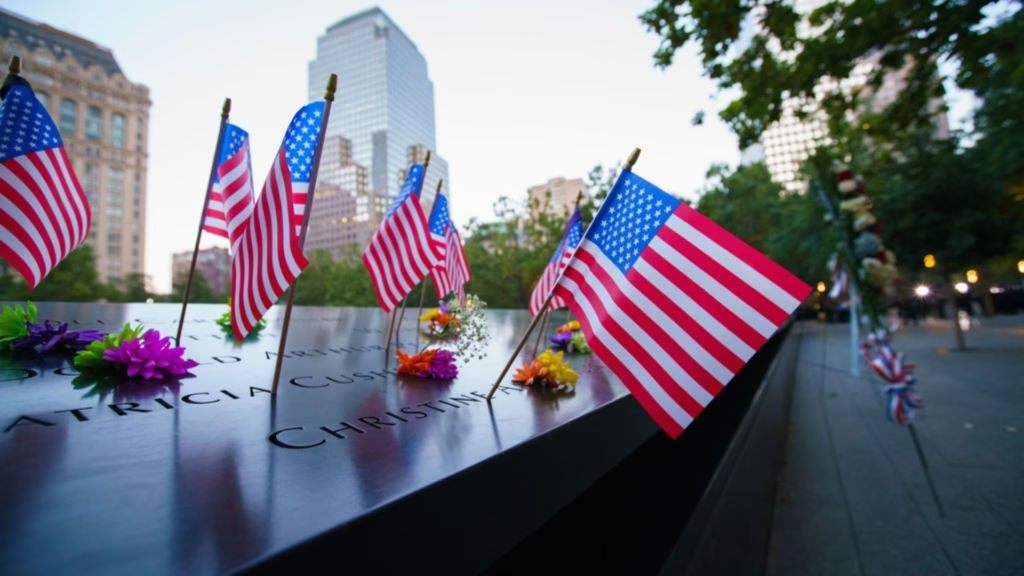
Only weeks after Independence Day celebrations and August observances marking the Declaration’s signing, Americans will remember the attacks of September 11, 2001.
The terrorist strikes claimed thousands of lives and shocked the world. For many, they also represented an assault on the very freedoms that define democratic societies.
The contrast between July’s celebration and September’s mourning highlights a central reality of American history: liberty has required both celebration and sacrifice.
New Challenges In A Changing World
As geopolitical tensions continue in regions ranging from Eastern Europe to the Middle East and the Indo-Pacific, debates about freedom, security, and national sovereignty remain at the forefront of international affairs.
Supporters of democratic governance frequently frame these conflicts as part of a broader contest between societies built around individual rights and governments that concentrate power in the hands of a few.
Whether viewed through military, political, or cultural lenses, the struggle between liberty and authoritarianism continues to shape global events.
Looking Toward America’s 300th Birthday
As the United States approaches its 250th anniversary, many Americans are already imagining what the nation might look like at its tricentennial in 2076.
The hope shared by many is that freedom, pluralism, and the rule of law continue expanding both at home and abroad. Supporters of those ideals envision a future in which more nations embrace individual rights, religious liberty, and democratic institutions.
The coming months offer a powerful reminder of both the achievements and sacrifices that have shaped the nation. One anniversary celebrates the birth of American liberty. The other recalls the cost of defending it.