
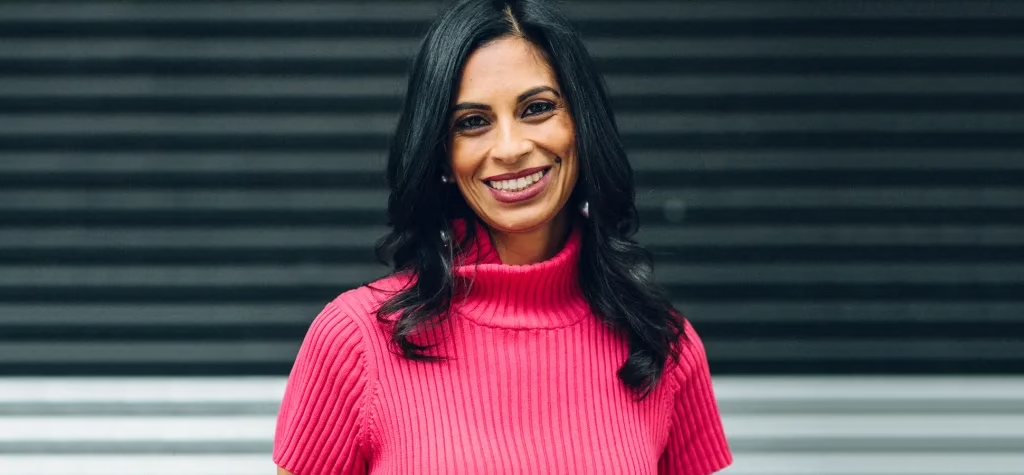
In a startup world long shaped by imbalance, Anu Duggal is quietly rewriting the rules. With a sharp eye for opportunity and a mission rooted in fairness, she has spent the past decade pushing female entrepreneurs into spaces that once overlooked them.
Before launching Female Founders Fund, Duggal made her mark in e-commerce, cofounding Exclusively.in in 2009. The business thrived, scaling to 150 employees and raising $20 million. But even as her company grew, one stark reality stood out: women were getting a fraction of venture funding.
Less than 2% of venture capital was going to female-led companies. For Duggal, that was not just a statistic, it was a call to act.
A Decade Of Progress, But More Work Ahead
Duggal’s fund, launched in the early 2010s, was built to do more than write checks. It aimed to create a support system, a network, and a new narrative for women in tech.
Reflecting on the past decade, Duggal points to meaningful progress, even if the journey is far from complete.
“Next year is our 10th anniversary. So, 10 years ago the percentage of venture dollars going toward female-funded companies was minuscule. I think there’s still a lot of work to be done, but I think it’s important to recognize the progress made along the way. In 2013 we started doing a report on the amount of series A rounds that were led by female founders, specifically in New York. Series A is typically the first point at which a large institutional fund will come into a company and join the board, which sends a strong signal to the market. In 2013 there was one Series A round led by a female founder, and fast-forward to 2022, there were 39 A rounds led by female founders. So when you think about capital distribution, if you don’t have a base of companies at the A, it’s tough to see them progress to IPO exit. Sure, we can say there hasn’t been much progress, but it’s important to recognize that going from one to nearly 40 is huge.”
That shift, from one deal to nearly 40, signals momentum. Still, Duggal remains clear-eyed about the distance yet to cover.
Why Women Still Struggle To Access Capital
 Despite gains, barriers remain deeply rooted. Duggal explains that venture capital, unlike traditional industries, lacks structured career pathways, which affects long-term diversity.
“First, the industry is relatively young. In contrast to more established fields like investment banking or law, there’s less infrastructure for career progression in venture, leading to fewer women staying. Venture lacks the structured analyst and associate classes found in other industries, resulting in less accountability and data tracking on female partner representation.”
Geography also plays a role. While cities like New York thrive on diversity, tech hubs often reflect narrower hiring patterns.
“When you look at New York City, for example, a diverse city, you have multiple industries represented. You have art, music, and fashion, which lends itself to a much stronger melting pot. In contrast, Silicon Valley is one industry with a homogenous hiring pattern—everyone hires people who look like them and whom they relate to. And so it’s very hard to shift an industry that’s kind of been built on that basis.”
Changing The System From The Top Down
Real change, Duggal argues, must come from those controlling the capital.
“To effect change, deliberate efforts must align with the world’s diversity. It takes a lot of intentionality to say we need to make significant changes. Otherwise, it just does not reflect the reality of the world around us. And a large part of that change often stems from the top of the venture food chain. So the way the food chain and venture works is you have startups at the bottom. You have the funds like ours, but then you also have institutional limited partners or endowments that fund us. Historically, they have not put much pressure on the fund managers around diversity. They’ve given some level of lip service to it, but ultimately, if you’re generating great returns, there’s not much pressure to change, so until the people at the top are asking for change, it’s very difficult.”
It is a blunt assessment, and one that highlights a systemic issue: incentives drive behavior, and without pressure, progress stalls.
Success Stories That Prove The Model Works
Despite the challenges, Duggal’s portfolio offers powerful proof points.
One standout is BentoBox, founded by Krystle Mobayeni. What started with 1,000 restaurant clients grew into a platform serving 18,000 by 2021. Duggal’s team helped connect the company with key investors, including DFJ and Goldman Sachs.
Another major success is Maven Clinic, founded by Kate Ryder. Built from a deeply personal insight, the company has grown into a billion-dollar business focused on women’s and family health.
“One standout is BentoBox, a company that [helps restaurants build top-of-the-line websites]. When we met the founder, Krystle Mobayeni, in 2015, she had around 1,000 restaurants using her platform. Fast-forward to 2021, and there were 18,000 restaurants on board, a remarkable growth. FFF played a pivotal role by introducing her to her Series B investor, DFJ, and later her Series C investor, Goldman Sachs. Despite having only a 1% ownership as seed investors, our introductions had a significant impact on her trajectory. Connecting a founder with the leaders of their next funding round is a substantial contribution.”
“Another notable example is Maven Clinic, where founder Kate Ryder addressed a personal need and expanded it into a solution for women’s health care. Maven’s telehealth platform addresses various aspects of women’s and family care, including pregnancy, fertility, and menopause. The company is now valued at $1.35 billion, and we anticipate it going public or achieving a significant exit in the coming years. This case exemplifies how a founder’s unique insight as the end customer can drive solutions to unmet needs.”
A Global Perspective Shapes Her Approach
Duggal’s worldview did not form in a single place. Moving frequently in her early years gave her a broader lens, one that continues to guide her decisions.
“I moved around a lot at a young age, which unknowingly gave me a broader worldview. Over time this has translated into a willingness to take risks. When I started Female Founders Fund, people assumed I had prior investment experience, but I didn’t. The same happened when I started a wine bar—people assumed I came from a hospitality background, but I didn’t. My exposure to various realities in different cities and gaining perspectives from that background instilled in me the belief that nothing is impossible.”
That mindset, risk-friendly and open, has become a defining trait of her leadership.
The Long-Term Mission Driving Change
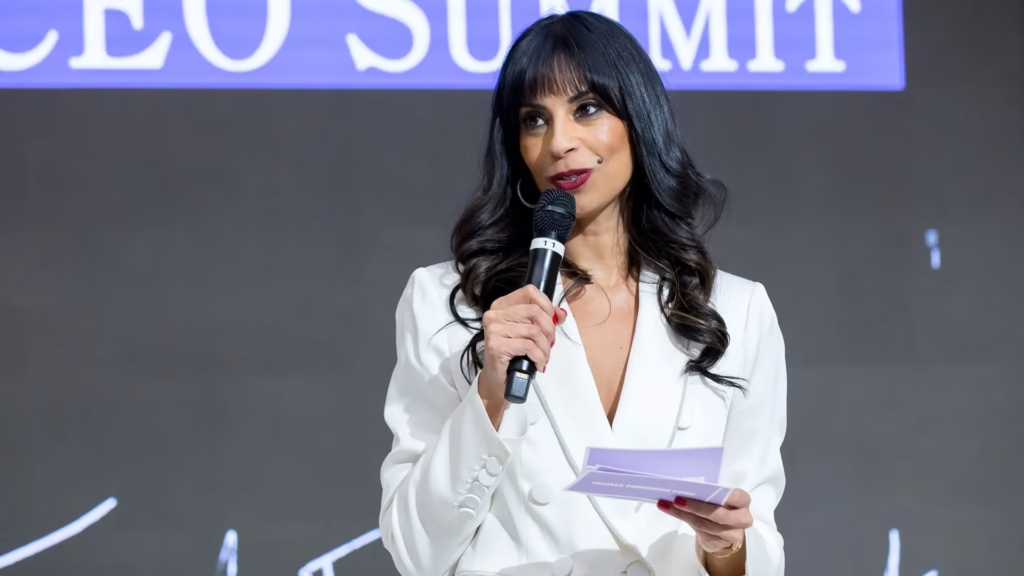 For Duggal, the mission is not symbolic. It is rooted in results.
“Our goal from the get-go has been very much around proving that you can generate great returns by investing in companies started by women. In this industry, financial returns are what truly drive the change. So the more we can demonstrate that our returns are top-tier, the more hopeful we are that this will lead the industry to expand its view of what a successful founder looks like.”
Inside Her Daily Routine And Mindset
Beyond boardrooms and funding rounds, Duggal’s daily routine reflects balance and clarity.
“Usually, two or three times a week, I’ll do a workout with a trainer or play tennis. If that doesn’t happen, especially in the spring, summer, and fall, I walk to work. I’ll grab my coffee and try to stroll through Madison Square Park, which is near our office in New York City. I’m really into gardening, so I like to keep track of what’s blooming and what new plants they’ve put in. It’s a nice little escape from everything and gives me 10 or 15 minutes to relax and clear my mind.”
Her recent reading pick also reveals a thoughtful side.
“The Covenant of Water by Abraham Verghese”
Handling Rejection And Building Confidence
In venture capital, rejection is constant. Duggal approaches it with perspective.
“Dealing with rejection is, unfortunately, a significant part of my job. Anyone involved in raising capital faces rejection quite frequently. For me, I try not to take it too personally and remind myself that to secure one yes, you often have to weather anywhere from 50 to 100 nos.”
And when it comes to confidence, her advice cuts through the noise.
“Well, it’s a great question. I think no one truly knows what they’re doing, and that’s something I remind myself all the time. Ultimately, it’s about how effectively you can convince people. I received a valuable piece of advice in one of my interviews, which was that when someone asks you a question, answer the question you want to answer rather than the one they’re asking. It’s not exactly the same, but there’s a part of it where, instead of responding directly, you can steer the conversation toward what you want to convey.”