

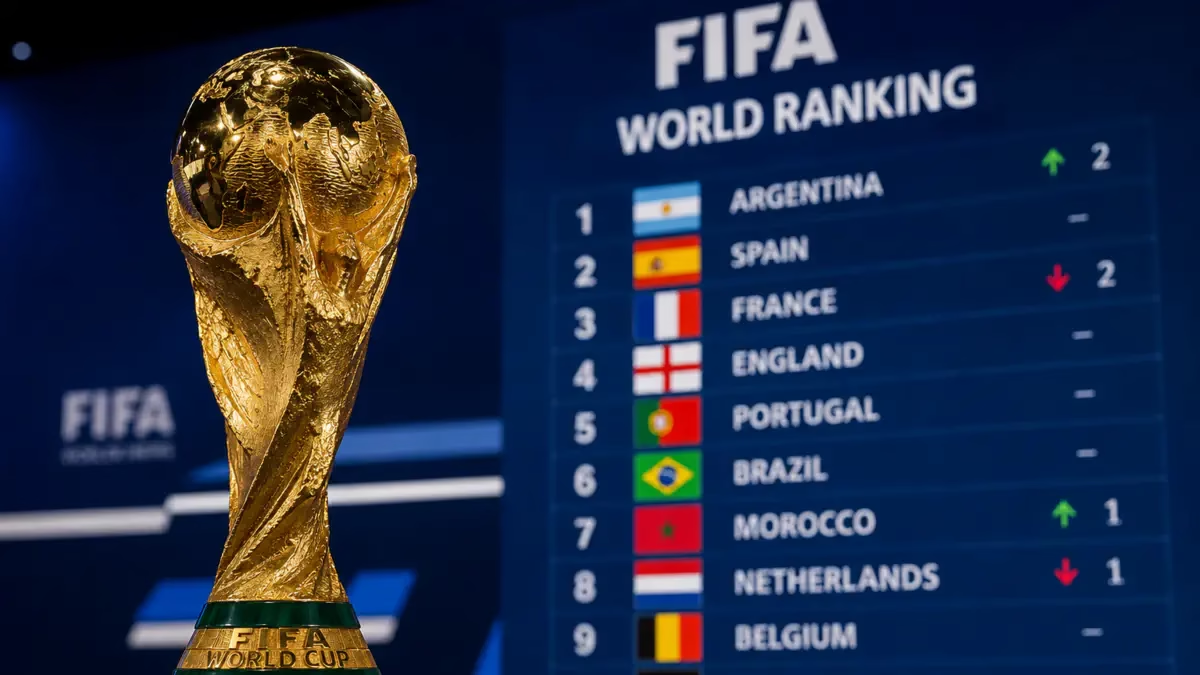
The FIFA Men’s World Rankings play a crucial role in international football, serving as the benchmark for measuring the strength of national teams across the globe. Beyond simple bragging rights, these rankings influence tournament seedings, World Cup draws, and the overall perception of a country’s standing in the sport.
Introduced in 1992, the rankings have evolved significantly over the years. Today, they rely on a sophisticated points-based formula designed to reward strong performances against quality opponents while taking into account the importance of each match.
Only a select group of footballing giants have ever occupied the number one spot. France currently sit atop the rankings, joining an elite list that includes Argentina, Belgium, Brazil, Germany, Italy, the Netherlands, and Spain.
How The FIFA World Rankings System Works
Since 2018, FIFA has used the Elo rating system, a method originally developed for chess competitions. The system updates a nation’s rating after every international match, ensuring rankings reflect recent performances rather than historical achievements alone.
The concept is straightforward: bigger matches and stronger opponents offer greater opportunities to gain points. Conversely, disappointing results against lower-ranked teams can lead to significant losses.
The formula FIFA applies is:
P = Pbefore + I(W – We)
Where:
- P = A nation’s ranking points after the match
- Pbefore = Ranking points before the match
- I = Importance coefficient of the match, ranging from 5 to 60
- W = Actual result achieved in the match
- We = Expected result based on the ratings difference between the two teams
Match importance plays a major role in determining point changes. World Cup fixtures carry far more weight than friendlies, meaning teams can climb or fall rapidly during major tournaments.
Why Opponent Strength Matters
Not every victory is treated equally.
A win over one of the world’s elite sides is worth considerably more than beating a lower-ranked nation. Likewise, losing to a team expected to be weaker can have a damaging effect on a country’s rating.
The Elo system attempts to predict the likely outcome before kickoff. Teams that outperform expectations receive a larger rankings boost, while those that underperform risk losing valuable points.
As a result, the rankings aim to provide a more accurate reflection of current form and competitive strength.
France Lead The World Ahead Of The Tournament
France enter the 2026 World Cup as the world’s highest-ranked men’s national team. Spain and Argentina round out the top three, while England hold fourth place heading into the tournament.
The top 10 ranked teams among World Cup participants are:
- France
- Spain
- Argentina
- England
- Portugal
- Brazil
- Netherlands
- Morocco
- Belgium
- Germany
Meanwhile, Croatia sit 11th globally and remain one of the highest-ranked nations outside the top 10.
Most Qualified Teams Are Among The World’s Best
The rankings highlight just how competitive the 2026 World Cup field is.
Of the 48 nations that secured qualification, 40 currently sit within FIFA’s top 48 rankings. All of the world’s top 11 teams qualified for the tournament, while 18 of the top 20 booked their place.
The notable absentees are Italy, ranked 12th, and Denmark, ranked 20th, both of whom failed to reach the finals.
Among the tournament hosts, Mexico rank 15th, the United States sit 16th, and Canada occupy 30th place.
Lowest-Ranked Teams Heading To The World Cup
Several nations will arrive at the tournament looking to prove the rankings wrong.
New Zealand enter as the lowest-ranked team in the competition at 85th in the world. Fellow outsiders Curacao, ranked 82nd, and Haiti, ranked 83rd, are also positioned outside the global top 80.
Their presence underlines the expanded nature of the 48-team World Cup and provides opportunities for emerging football nations to challenge established powers on the biggest stage.
Rankings Remain Key To International Football
While rankings are often debated by fans and analysts, they remain one of FIFA’s most important tools for evaluating national team performance.
From determining tournament seedings to measuring progress over time, the system rewards consistency, strong results, and success against elite opposition.
As the 2026 World Cup unfolds, every result will not only shape the race for football’s biggest prize but also influence where nations stand in the global rankings hierarchy.