

International Business Machines Corp. is preparing to step up its push into artificial intelligence, with Chief Executive Officer Arvind Krishna signaling a more open path for dealmaking as regulatory pressures ease.
Speaking shortly after IBM finalized its major acquisition, Krishna pointed to a shifting environment that could accelerate the company’s expansion across AI and hybrid cloud technologies.
Faster Deals In A Changing Regulatory Landscape
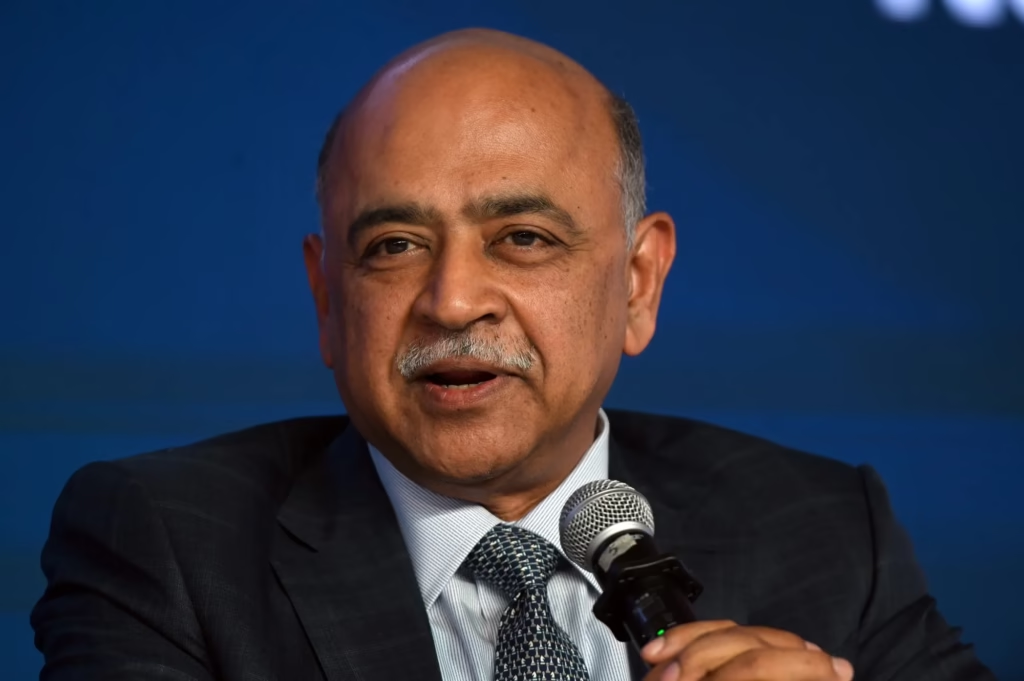
IBM recently closed its $11 billion acquisition of Confluent Inc., completing the transaction in under four months. That speed, Krishna suggested, reflects a broader change in how regulators are approaching large-scale tech deals.
“The regulatory environment is definitely friendlier,” Krishna said. “It used to take a lot longer a few years back.”
That shift is already shaping IBM’s next moves. The company is now eyeing additional acquisitions, particularly in artificial intelligence and hybrid cloud, where demand continues to grow.
AI And Hybrid Cloud Drive Future Strategy
Krishna made it clear that IBM’s focus is not just on standalone AI investments, but on the convergence of AI with hybrid cloud infrastructure. This combination, which blends on-site systems with remote computing networks, is becoming central to enterprise technology strategies.
He hinted that more deals could be on the horizon, especially where these two areas intersect.
“Watch this space,” he said.
The message is straightforward: IBM sees AI not as a side project, but as a core engine for growth and transformation across its business.
Middle East Conflict Creates Operational Challenges

Still, not everything is moving smoothly. Ongoing tensions in the Middle East are beginning to weigh on operations, albeit modestly.
Krishna acknowledged that the conflict could become a “slight headwind” if it drags on.
“We have thousands of employees in that region,” he said. “The vast majority are reasonably stable, getting their work done. There are about 20% of people in the Middle East who are disrupted, not able to get to their clients, not able to get their work done.”
While most of IBM’s workforce remains unaffected, disruptions for a significant minority highlight the broader risks tied to geopolitical instability.
Consulting Business Faces Short-Term Slowdown
Meanwhile, IBM’s consulting division has struggled to maintain momentum in recent quarters. Growth has been slower than expected, raising questions about near-term performance.
However, Krishna remains confident that the situation will improve.
He expects consulting activity to pick up pace in the second half of the year, suggesting that demand could rebound as businesses continue investing in digital transformation and AI-driven solutions.
A Company Positioning For Its Next Phase
Taken together, IBM’s strategy is becoming clearer. The company is leaning into AI, accelerating dealmaking, and betting on hybrid cloud as a long-term growth driver.
At the same time, it is navigating global uncertainties and short-term business challenges. The balance between opportunity and risk will define how quickly IBM can capitalize on what Krishna sees as a more favorable environment.