
A controversial decision by a museum in Japan has reignited long-standing disputes over the nation’s wartime history, with critics accusing officials of attempting to soften the record of Imperial Japan’s actions in China during World War II.
The debate centers on the Nagasaki Atomic Bomb Museum, where proposed exhibit revisions would replace references to the Nanking massacre with the term “incident,” a move that has drawn sharp criticism from historians, scholars and civic groups across the region.
Museum Changes Trigger Fresh Controversy
The Nagasaki Atomic Bomb Museum, which opened in 1996, recently unveiled proposed updates to its exhibits following discussions within its operations council. While some revisions continue to describe Japan’s military campaign in China as an “invasion” and refer to military “aggression,” the replacement of the word massacre has become the focal point of public outrage.
Critics argue that the terminology shift minimizes one of the most infamous episodes of Japan’s wartime conduct and raises questions about how future generations will understand the past.
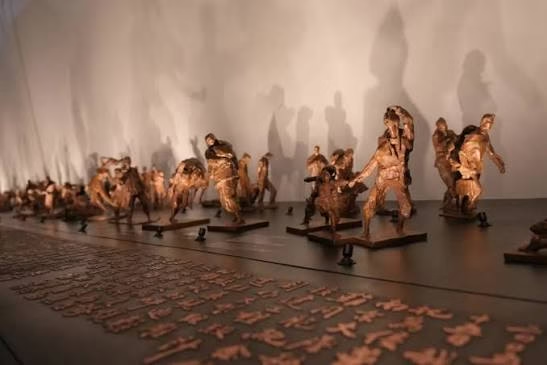
The events in question occurred in the city now known as Nanjing after Japanese forces captured it on December 13, 1937. The violence unfolded over roughly six weeks and remains one of the most debated chapters of East Asian history.
Estimates of the death toll vary significantly. The International Military Tribunal for the Far East concluded in 1946 that more than 200,000 Chinese civilians were killed. China maintains that more than 300,000 people died, citing findings from the Nanjing War Crimes Tribunal in 1947. Some estimates within Japan place the number considerably lower.
Scholars Accuse Revisionists Of Distorting History
Among the strongest critics of the museum’s proposed changes is Yuji Hosaka, a political-science professor at Korea University in South Korea.
“They are rewriting history,” said Hosaka.
According to Hosaka, efforts to reinterpret Japan’s wartime history gained momentum after the 1993 Kono Statement, which acknowledged that women had been forced into military brothels during the war.
“The campaign to revise history can be traced back to 1993, when the then chief cabinet secretary, Yohei Kono, released what became known as the Kono Statement and concluded that the Japanese military had forced women to work in military brothels during the war,” said Hosaka.
He said the declaration angered nationalist groups in Japan.
“He said the 1993 declaration infuriated Japan’s far-right, which immediately ‘decided to rewrite their version of the history of the Pacific war, creating a false history’.”
Hosaka argued that younger generations in Japan often receive an incomplete picture of the country’s expansion across Asia before and during World War II.
He said most Japanese “know virtually nothing about the invasion of Asia” as the government had “twisted history to their point of view”.
“And if you look at television, there are no historical dramas set in that time that give an alternative viewpoint,” Hosaka said. “Most Japanese do not know and it has become easier for the government to control them.”
Revisionist Campaign Defends Position
 Supporters of the exhibit changes reject claims that the museum is erasing history.
During discussions with museum officials, revisionist campaign leader Masamitsu Watanabe questioned the historical basis of the massacre.
“There is no evidence. It is a fabrication.”
Some members of the museum’s operations council pushed back against that argument, insisting that visitors should understand the broader wartime context surrounding the atomic bombing of Nagasaki.
However, another representative from Watanabe’s organization argued that the museum’s mission should focus narrowly on nuclear weapons.
“a facility meant to convey the message that nuclear weapons must never be used does not need to include exhibits on the history of the Japanese military”.
Wider Pattern Seen Across Japan
The dispute has also highlighted broader concerns about how wartime history is presented in public institutions throughout Japan.
In recent years, several museums and memorial sites have faced criticism for removing or reducing references to Japan’s military actions during the war. Observers point to changes at the Osaka International Peace Centre and the removal of a memorial dedicated to Korean wartime laborers in Gunma Prefecture as examples of a broader trend.
According to Jeff Kingston, the latest controversy fits into a larger effort to soften public understanding of wartime events.
“This is all part of the revisionists’ plan to downplay and minimise what Japan inflicted on the rest of Asia during the so-called liberation struggle from European colonial powers,” said Kingston.
“When they say the Nanking ‘incident’, it’s a euphemistic way of referring to the tens of thousands of Chinese civilians who were rounded up by the Japanese military and simply slaughtered,” he said. “The revisionists want to sanitise that.”
International Repercussions Loom
Kingston noted that the Nagasaki museum had previously addressed sensitive topics including wartime sexual slavery, forced labor and prisoners of war in a direct manner.
Kingston, who has visited the Nagasaki museum, said it was “very forthright” on issues such as “comfort women” – a euphemism for wartime sexual slaves – forced labour and prisoners of war. But he said “it looks like that is changing”.
Rather than helping revisionists achieve their goals, Kingston believes the controversy has only intensified international scrutiny.
He described the revisionists’ push as “just another epic own-goal” because it drew attention to what they were doing.
Though the move would enthuse conservatives, “it just appears to an international audience that they keep shirking the burden of the issue”, Kingston added. “It just leaves Japan with egg on its face.”
The debate arrives amid growing regional tensions and renewed discussions about historical memory across East Asia. Analysts warn that disputes over wartime history continue to influence diplomatic relations between Japan, China and South Korea.
Kingston noted that Japan had undergone “a dramatic shift in its centre of political gravity”, significantly “receding the prospect of reconciliation with former enemies”.
“And this sort of thing just adds fuel to the fire because we know that China is not above playing the history card when it suits them,” he said.
“Japan complains that China and South Korea constantly hammer it on the anvil of history and that is true. But Japanese revisionists just keep handing them the hammer with which to do it.”