
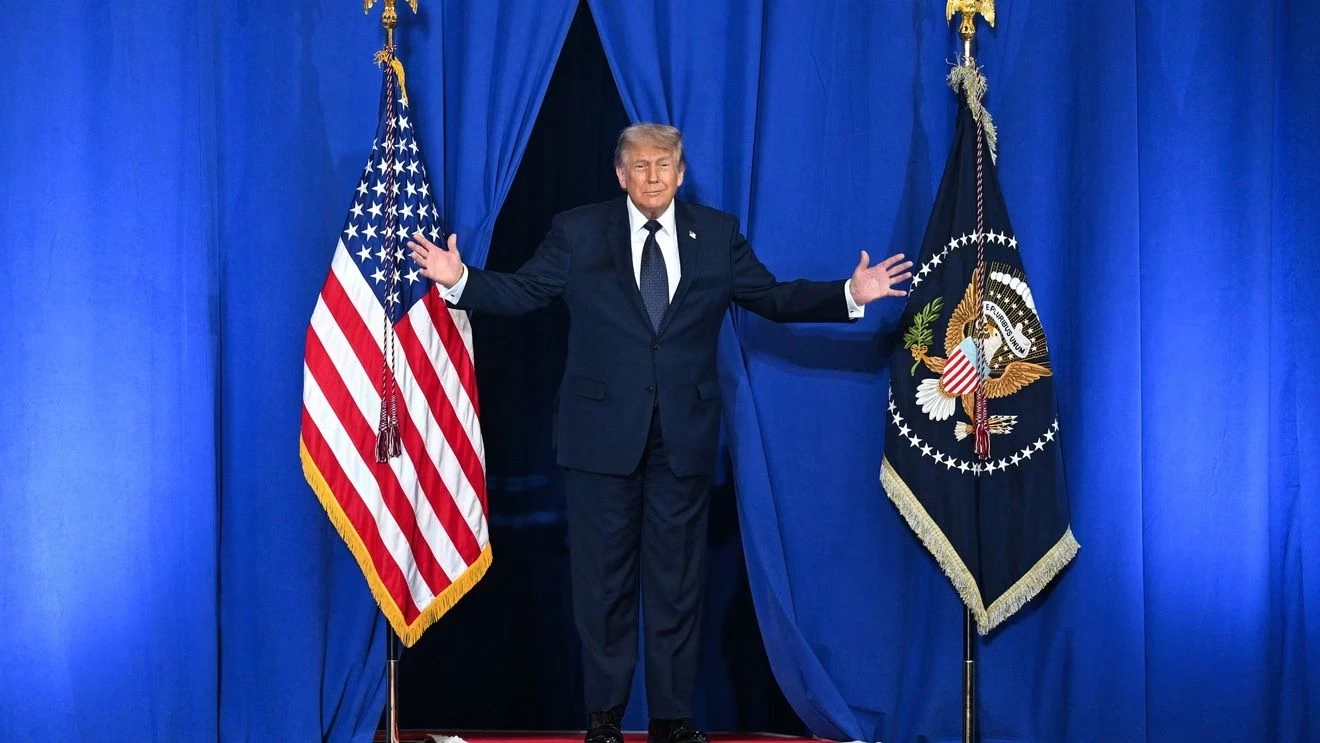
President Donald Trump has expressed confidence that a breakthrough agreement involving Iran and Israel is close, suggesting that a deal could be finalized within days and lead to the reopening of the strategically vital Strait of Hormuz.
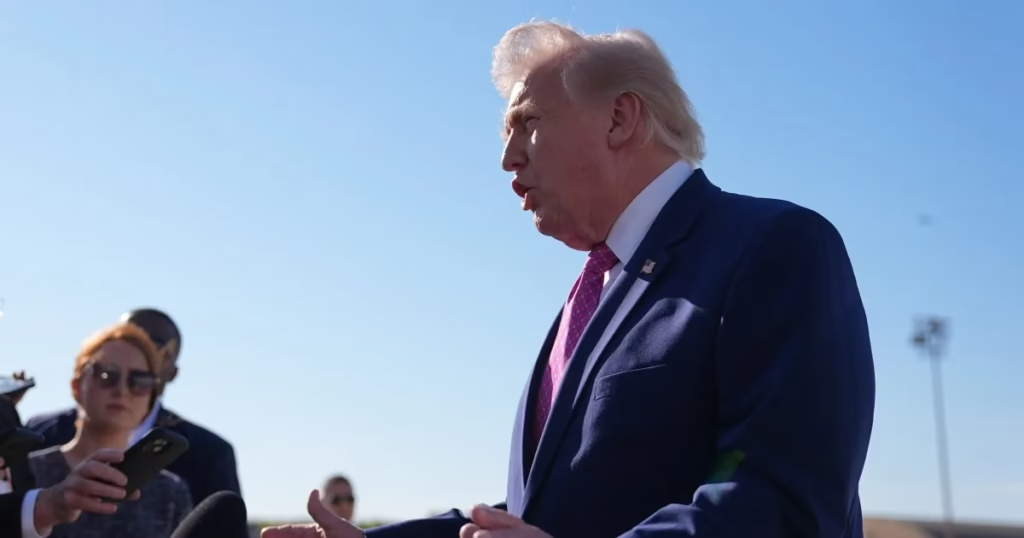
Speaking to reporters late Monday, Trump signaled optimism about ongoing diplomatic efforts, even as tensions remain high across the region following recent military exchanges.
According to Trump, negotiations have reached a critical stage, raising hopes that a fragile period of conflict could give way to a broader understanding between the two longtime adversaries.
Trump Predicts Imminent Agreement
Trump described the negotiations in highly positive terms, saying the United States was “in the final throes of what will be a very, very good deal”.
He also predicted a rapid reopening of the Strait of Hormuz, one of the world’s most important energy shipping routes.
Trump said the waterway would open “immediately upon signing”, which he said could be in two or three days.
The president argued that economic and naval pressure had proven more effective than extended military operations.
“If we go and bomb, which we can do very easily, if we want, and we spend another two or three weeks bombing, [Iran will] have nothing left whatsoever, but you won’t have the Strait open for months,” Trump said, claiming that the US naval blockade on Iran “turned out to be much stronger than bombing” in making Iran want a deal.
Warning Delivered To Netanyahu
As diplomatic efforts intensified, Trump also revealed details of a conversation with Israeli Prime Minister Benjamin Netanyahu.
Reports have suggested growing frustration in Washington over continued military actions that could jeopardize ongoing negotiations.
Trump told Axios that he had personally cautioned Netanyahu about the potential consequences of prolonging the conflict.
“I said, ‘Bibi, you better be careful, or you will be on your own very soon’,” Trump said.
Meanwhile, Trump urged both sides to halt hostilities in a message posted on Truth Social, calling for an end to “shooting” and stressing that “final negotiations” towards peace would proceed “subject to ignorance or stupidity getting in its way”.
Fresh Fighting Tests Ceasefire Efforts
 The latest round of violence erupted after Israel launched a deadly strike on Beirut, Lebanon’s capital, on Sunday.
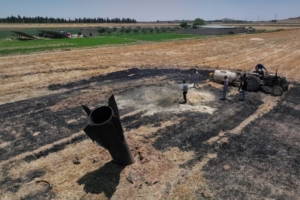
Iran responded with missile attacks targeting northern Israel, reigniting fears that the wider regional conflict could spiral further out of control.
Although both Israel and Iran later signaled a pause in attacks, military actions continued into Monday.
Israeli forces targeted Iranian air defense infrastructure and a petrochemical facility, while Iran struck a comparable facility in Haifa and launched attacks toward two Israeli airbases.
Despite the intensity of the exchanges, officials reported no fatalities on either side.
Netanyahu Defends Israel’s Actions
Addressing the situation publicly, Netanyahu maintained that Israel would continue acting against perceived threats.
For his part, Netanyahu said in a televised statement that he had told Trump that “Israel has a full right to self-defence, and we are exercising it as required”.
He also said, “Right now, the fire at the front is contained, because after we hit the terrorist regime in Tehran, it stopped attacking us.”
Netanyahu warned that any renewed aggression from Iran would trigger a strong response.
“should Iran make the mistake of resuming attacks against us, we will respond with full force”.
Israeli Ambassador Dismisses Rift Claims
Suggestions of friction between Washington and Jerusalem were downplayed by Israel’s ambassador to the United States.
Yechiel Leiter rejected speculation of a major dispute between Trump and Netanyahu.
“sometimes, lovers have a spat”.
He added that Netanyahu had “decided” to “lower the temperature” at Trump’s request and argued that the US president understands “full well” that Israel cannot “absorb ballistic missiles into our country without responding”.
Iran Blames Washington For Escalation
Iranian officials took a sharply different view, placing responsibility for the latest crisis squarely on the United States.
Foreign Ministry spokesperson Esmaeil Baghaei accused Washington of enabling instability across the region.
“The US is directly responsible,” he said. “They are party to the ceasefire negotiations. Therefore, any act in violation of the ceasefire, be it through the interception of vessels [in the Strait of Hormuz], the targeting of southern Lebanon by Israel, or any other event, will cause the United States to be directly responsible for the escalation in the region.”
Iran’s First Vice President Mohammad Reza Aref praised Tehran’s military response, saying the operation demonstrated “a new level of deterrence from mighty Iran” and that Israel had been “forced to beg once again” for a ceasefire.
Diplomatic Channels Remain Active
Even as military tensions persist, negotiations continue behind closed doors.
Iranian President Masoud Pezeshkian stated on social media that Tehran remained “at the negotiating table”.
At the United Nations, Iran’s ambassador Amir Saeid Iravani said Washington and Tehran were communicating indirectly through Pakistan.
According to Iravani, the two sides are “presenting and exchanging views” towards an agreement.
He also told The Associated Press that he was hopeful that “very soon” the parties would reach “a conclusion”.
Pakistan has continued its mediation efforts throughout the process.
Prime Minister Shehbaz Sharif said work toward a diplomatic breakthrough was ongoing “earnestly and painstakingly” and urged restraint, “especially when the final objective is just about to be achieved”.
Sharif further described the latest exchanges as a “reminder of the dangers associated with a tenuous ceasefire and the unbearable consequences it may lead to”.
Yemen And Lebanon Add New Pressure
The regional crisis widened further when Yemen’s Houthi movement launched missiles toward Israel and announced a complete ban on Israeli maritime navigation through the Red Sea.
The group warned that all Israeli maritime movements would be treated as “legitimate military targets”.
At the same time, violence persisted in Lebanon.
Lebanese health authorities reported that an Israeli strike in Tyre killed five people. Another attack in the Nabatieh district left seven dead, while a strike in Marwanieh killed two more people.
The continued violence underscores the fragile nature of ceasefire efforts and highlights the challenges facing negotiators as they work toward a broader regional agreement.