
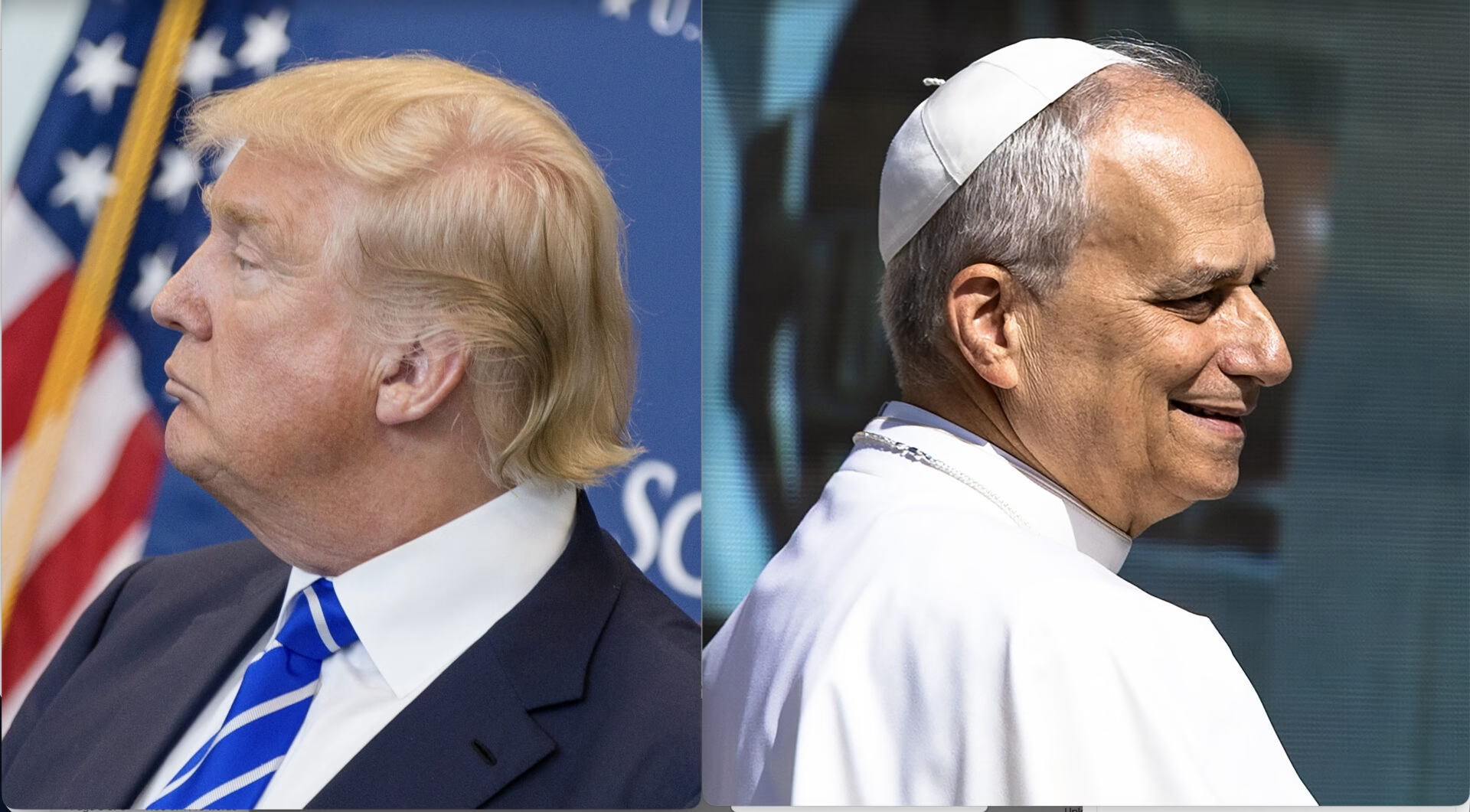
Donald Trump’s latest public attacks on Pope Leo have reignited questions about the long-running tension between the former president and the Catholic Church. But the roots of that hostility may stretch back far earlier than politics, all the way to the Manhattan church Trump attended as a boy.
As a young man, Trump worshipped at Marble Collegiate Church in New York City, where the influential pastor Norman Vincent Peale shaped generations of followers. Peale later officiated Trump’s first wedding and became one of the most recognizable Protestant ministers in America. Yet his legacy includes more than motivational sermons and bestselling self-help books.
He was also a fierce opponent of John F. Kennedy’s 1960 presidential campaign, largely because Kennedy was Catholic.
A Powerful Pastor With Political Reach
Peale is widely remembered as the author of The Power of Positive Thinking. However, during the 1960 election, he entered the national spotlight for a different reason.
According to a September 1960 report, Peale was described as “a longstanding Republican whose Protestant following rivals Billy Graham’s as the largest in the US”.
He became a leading figure among “150 Protestant clergymen and laymen, calling themselves the Citizens for Religious Freedom”, who gathered in Washington to challenge the idea that a Catholic should become president.
Peale chaired the meeting, where fears about religion and political power took center stage.
“Our American culture is at stake,” Peale warned attendees. “I don’t say it won’t survive, but it won’t be what it was.”
That statement captured the alarm spreading through parts of the Protestant establishment at the time.
The 1960 Manifesto Against Kennedy
Following the meeting, the group issued a lengthy declaration that sharply criticized Kennedy’s candidacy.
“At the close of their session,” one report noted, “they issued a 2,000-word manifesto that more than any other statement thus far in the campaign served to make religion the most emotional issue of the 1960 election.”
The document argued that Catholic leadership threatened the separation of church and state, a claim common in anti-Catholic circles during that era.
“Brotherhood in a pluralistic society like ours depends on a firm wall of separation between church and state. We feel that the American hierarchy of the Roman Catholic Church can only increase religious tensions and political-religious problems by attempting to break down this wall,” Peale’s group wrote. “Much depends upon strong support for this well tested wall of separation by Americans of all faiths.”
Kennedy’s Defiant Response
Kennedy answered the criticism head-on with a landmark speech in Houston before a gathering of Baptist ministers.
“I believe in an America where the separation of church and state is absolute; where no Catholic prelate would tell the President – should he be Catholic – how to act, and no Protestant minister would tell his parishioners for whom to vote; where no church or church school is granted any public funds or political preference, and where no man is denied public office merely because his religion differs from the President who might appoint him, or the people who might elect him,” Kennedy said in the address.
The speech is still seen as one of the defining moments of his campaign.
Older Anti-Catholic Fears in American Politics
The suspicion directed at Kennedy echoed earlier attacks against Al Smith, the first Catholic major-party nominee for president in 1928.
Historian Robert Slayton described how extremist groups mobilized against Smith.
“The Ku Klux Klan became actively involved in preventing a Catholic from ever getting near the White House, going all out to defeat Smith. One Klan leader mailed thousands of postcards after Democrats nominated the New Yorker, stating firmly, ‘We now face the darkest hour in American history. In a convention ruled by political Romanism, anti-Christ has won.’”
Those fears centered on a recurring conspiracy theory, that the pope would secretly control any Catholic president.
Trump Family History and Queens Unrest
The story also intersects with Trump family history. In 1927, Donald Trump’s father, Fred Trump, was arrested during unrest at a Memorial Day parade in Queens involving members of the Ku Klux Klan.
At the time, tensions reportedly centered on the city’s Irish Catholic police force.
A flyer circulated afterward carried the headline: “Americans Assaulted by Roman Catholic Police of New York City!”
The leaflet opened with another inflammatory line: “Native-born Protestant Americans clubbed and beaten when they exercise their rights in the country of their birth.”
Why It Matters Now
Trump’s recent feud with Pope Leo has sparked debate among American Catholics and political observers alike. While modern disputes focus on foreign policy and public rhetoric, the deeper cultural tensions may be far older.
Sometimes today’s political battles are not new at all. They are echoes.