

Virginia’s highest court has thrown out the results of a fiercely contested redistricting referendum, wiping away a narrow voter-approved measure that could have dramatically reshaped the state’s congressional map ahead of the midterm elections.
The ruling marks a stunning turn in one of the nation’s most closely watched political battles, one that drew millions in campaign spending, months of courtroom arguments, and accusations of partisan maneuvering from both sides.
The 4-3 decision effectively halts an effort backed by Democrats to redraw congressional districts in the middle of the decade, a move supporters argued was necessary to counter Republican gains in other states.
Court Says Amendment Process Violated Constitution
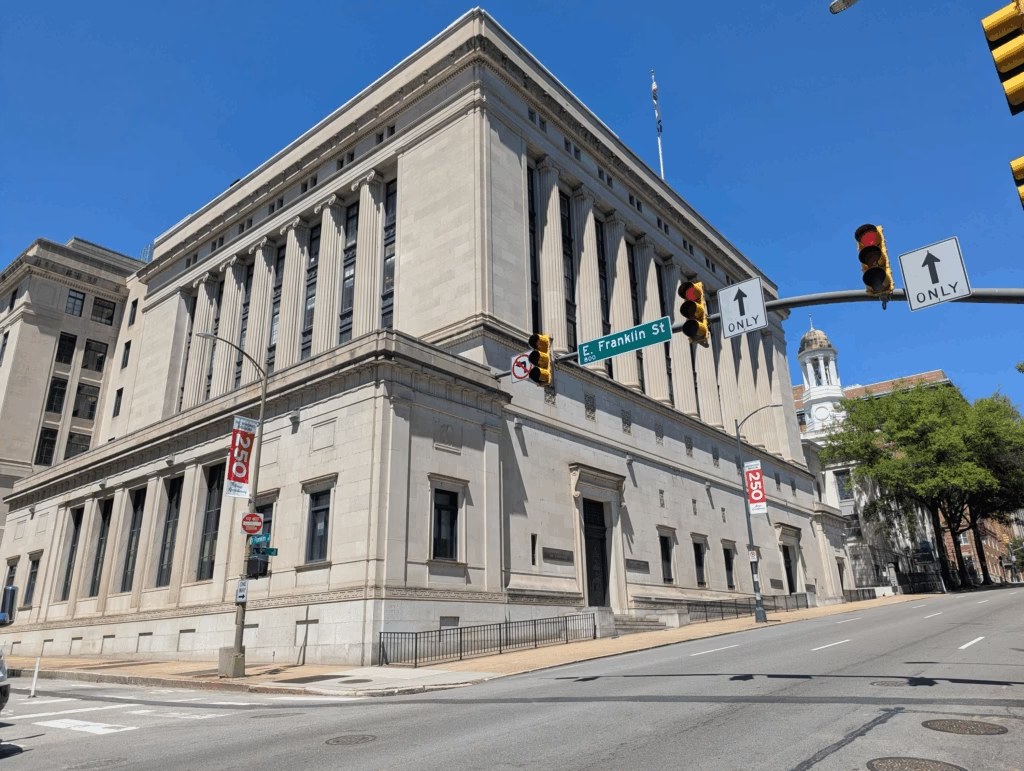 In its Friday ruling, the Virginia Supreme Court concluded that the referendum process violated the state constitution, invalidating the statewide vote despite voter approval last month.
At the center of the dispute was the constitutional definition of the “next general election,” a phrase that became the foundation of the legal challenge.
Under Virginia law, constitutional amendments must pass through two separate General Assembly sessions. One vote must occur before House elections and another after voters elect a new House of Delegates.
Republicans argued lawmakers improperly advanced the amendment because early voting for the 2025 House elections had already started. Democrats countered that the term “general election” referred only to Election Day in November.
The court sided with Republicans.
According to the ruling, Virginia’s “general election” includes the early voting period, not merely Election Day itself.
That violation, the court wrote, “incurably taints” the referendum and invalidates the vote.
Massive Political Stakes Behind The Fight
The referendum had enormous political implications for control of Congress.
Had the measure survived, the newly drawn congressional map would have taken effect during the November midterms. Analysts expected the changes to shift Virginia’s congressional delegation from a 6-5 Democratic advantage to a commanding 10-1 split.
That possibility fueled an intense political war.
Virginia reportedly spent $5.2 million on the special election tied to the referendum, while outside political organizations poured nearly $100 million into efforts to influence voters.
Democrats defended the push as a response to Republican-led states that redrew districts to strengthen GOP power in the narrowly divided U.S. House.
Republicans, meanwhile, repeatedly attacked the proposal as unconstitutional and openly partisan.
The legal challenge became one of the most significant state-level election disputes of the year.
Democrats React With Frustration
 Reaction from Democratic leaders was swift and divided between restraint and outrage.
Virginia House Speaker Don Scott said in a statement, “We respect the decision of the Supreme Court of Virginia.”
However, Jay Jones sharply criticized the ruling, accusing the court of acting with political motives.
Jones said the court placed “politics over the rule of law” and accused it of “silenc[ing] the voices” of Virginia voters.
He also said his office is examining “every legal pathway forward.”
That statement immediately raised speculation about whether Democrats could attempt an appeal to the U.S. Supreme Court.
Virginia Has Seen Similar Election Battles Before
While rare, the Virginia Supreme Court overturning the outcome of a public vote is not unprecedented.
A similar situation occurred in the 1950s when the court struck down a voter-approved measure involving Arlington residents.
In that case, the court ruled the law approved in 1956 was unconstitutional and invalidated the election results two years later.
Virginia election disputes have also landed before the nation’s highest court in recent years.
In 2024, former Attorney General Jason Miyares secured an emergency U.S. Supreme Court ruling allowing the state to resume its voter purge program just days before Election Day.
Now, with congressional control once again hanging in the balance, Virginia’s political map remains locked in place, at least for the moment.