

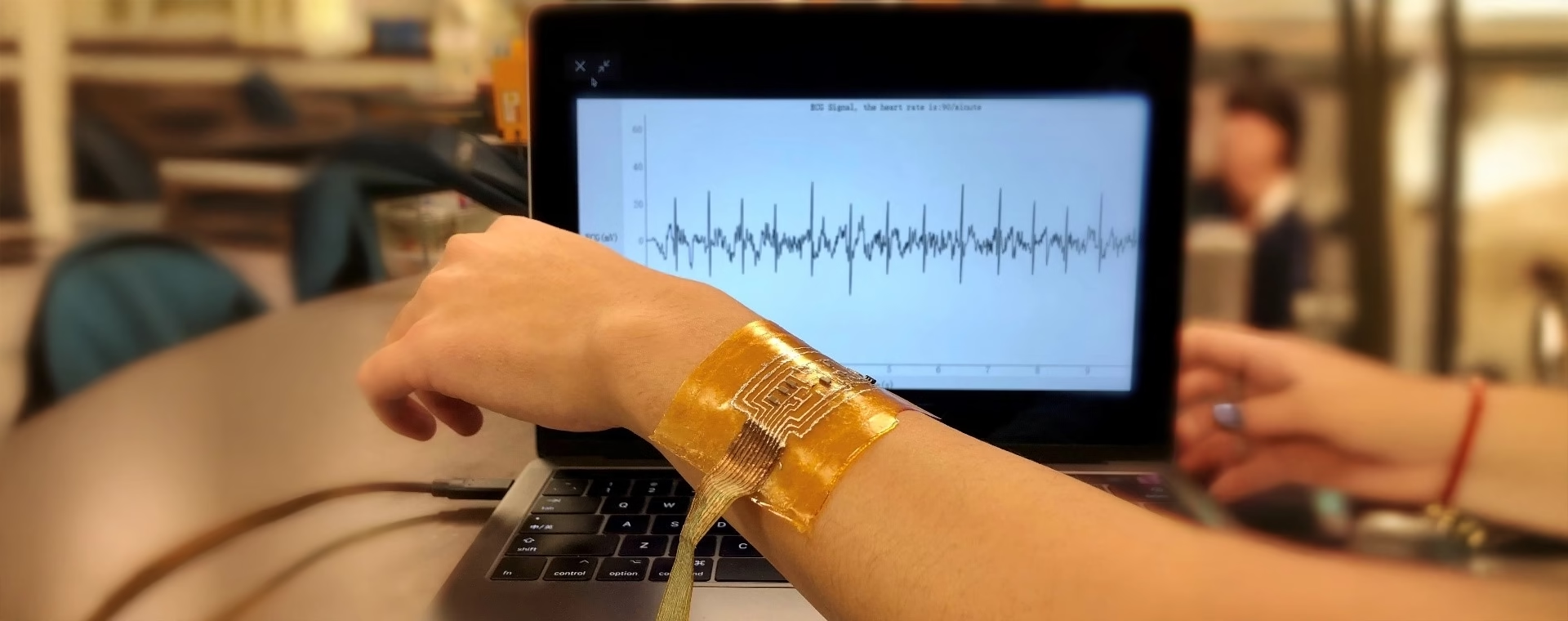
The world is moving into a period where major change will come less from one single invention and more from several powerful innovations growing at the same time. Future Technologies are already starting to affect how people work, travel, communicate, stay healthy, and use energy. Some are still in research labs, while others are entering businesses, hospitals, factories, and homes right now. Reports from the World Economic Forum and McKinsey both point to artificial intelligence, robotics, digital infrastructure, clean energy systems, and next-generation computing as some of the biggest forces shaping the next decade. The reason these changes matter is simple. Technology no longer sits in one corner of life. It now influences economies, governments, education, healthcare, manufacturing, and climate strategy. The most important Future Technologies will not just make tasks faster. They will change what people and organizations are able to do in the first place. That is why this topic is becoming more important every year.
Why Future Technologies Matter Most
Future Technologies matter because they shape daily life at both a personal and global level. They can improve medical treatment, support cleaner energy, help businesses make better decisions, and reduce waste across industries. At the same time, they also raise important questions about trust, safety, privacy, cost, and fairness.
In earlier decades, new tools often improved one industry at a time. Today, technologies spread much faster. A breakthrough in computing can improve medicine. A leap in artificial intelligence can speed up energy research. A better robot can support factories, hospitals, and logistics networks at once. This connected effect is what makes modern innovation different.
Future Technologies in Artificial Intelligence
Artificial intelligence is at the center of today’s technology shift. It is no longer used only for chatbots or basic automation. AI is now being built into research tools, design systems, forecasting models, customer support, manufacturing software, and business operations. McKinsey’s 2025 technology outlook places AI among the strongest forces shaping the market, while the IEA has also highlighted the growing role of AI in energy innovation.
One reason AI stands out among Future Technologies is that it acts like a multiplier. It improves the value of other tools. For example, AI can help doctors read medical images more efficiently, help factories detect machine faults earlier, and help energy systems predict demand more accurately. It can also support scientific discovery by sorting massive datasets much faster than human teams alone.
Still, AI’s growth also brings real concerns. Businesses and governments have to think carefully about:
- data privacy
- model bias
- misinformation
- energy use from large-scale computing
- safe use in healthcare, finance, and public services
This means AI will keep growing, but trust and governance will become just as important as speed and performance. That balance will decide how useful AI becomes in the long term.
Quantum Computing and Next-Level Processing
Quantum computing is one of the most talked-about Future Technologies because it could solve certain problems that are far too complex for traditional computers. Instead of simply processing information in a standard binary way, quantum systems use quantum properties that can handle specific calculations very differently.
This technology is still developing, and experts continue to stress that useful large-scale quantum computing will require major advances in hardware, error correction, and algorithms. Nature noted in 2025 that fault-tolerant quantum computing remains demanding and still needs more efficient methods and stronger system design. MIT’s 2025 Quantum Index Report also shows that the field is advancing, but it remains a long-term build rather than an overnight shift.
Even so, the future impact could be huge in areas such as:
- drug discovery
- materials science
- logistics optimization
- advanced simulation
- cryptography and security
Quantum computing may not replace everyday laptops or phones. Instead, it could become a powerful specialist tool for research centers, governments, and large industries that need extreme problem-solving power. That makes it one of the most important Future Technologies to watch.
Robotics Moving Beyond Factories
Robotics has been important in manufacturing for years, but the next stage is much broader. New robots are moving into warehouses, hospitals, transport systems, public spaces, agriculture, and service environments. The International Federation of Robotics reports continued growth in service robotics and notes that the market now includes a wider range of professional and consumer applications.
This matters because robotics is becoming smarter, more mobile, and more adaptable. Older robots were often fixed in one place and designed for one task. Newer systems can use sensors, computer vision, and AI to work in changing environments. That opens the door for robots that help with delivery, inspection, cleaning, patient support, and dangerous industrial work.
Among all Future Technologies, robotics may create one of the most visible changes in everyday life. People are likely to see more autonomous machines in the background of normal services, not just in large factories. In the next few years, the biggest shift may not be fully human-like robots, but practical robots doing narrow jobs reliably and safely.
Gene Editing and Precision Medicine
Healthcare may be changed deeply by gene editing and precision medicine. The World Health Organization explains that human genome editing can be used to add, remove, or alter DNA in the genome, while the FDA has already approved the first CRISPR-based therapy, showing that this field is moving from theory toward real treatment.
This is why biotechnology stands among the most powerful Future Technologies. It has the potential to move medicine from broad treatment toward targeted treatment. Instead of treating symptoms alone, doctors may increasingly work with therapies designed around genes, biomarkers, and a patient’s specific condition.
Possible long-term effects include:
- better treatment for inherited diseases
- more personalized cancer care
- faster diagnosis with advanced biological data
- improved prevention strategies
- more effective drug development
At the same time, gene editing raises serious ethical questions. Safety, access, cost, and the limits of human intervention all matter here. The WHO has emphasized governance and ethical safeguards, which shows that medical progress in this field cannot be separated from public trust.
Clean Energy Systems and Storage
Energy is another area where Future Technologies could change the world in lasting ways. The future is not only about producing cleaner power. It is also about storing it, distributing it, and making energy systems more reliable and resilient.
The IEA’s recent analysis highlights the importance of grid-scale battery storage and wider energy innovation, including the role of AI, carbon dioxide removal technologies, and more resilient supply systems. Storage matters because solar and wind power are not always available at the same time people need electricity. Better batteries and long-duration storage can help close that gap.
This category of Future Technologies is especially important because it touches nearly everything else. Electric vehicles, smart buildings, factories, data centers, and digital services all depend on stronger energy infrastructure. In the future, the winning countries and companies may not simply be the ones that invent more tools. They may be the ones that build cleaner and more dependable systems around them.
Digital Twins and Smarter Infrastructure
Digital twins are becoming more important as cities, factories, buildings, and industrial systems become more connected. According to NIST, a digital twin is a computer model of a physical system that can support simulation, monitoring, optimization, and decision-making.
That idea may sound technical, but the impact is very practical. A digital twin can help an operator test changes before making them in the real world. It can support predictive maintenance, reduce downtime, improve safety, and help organizations use resources more efficiently.
This makes digital twins one of the quieter but highly useful Future Technologies. They may not grab as much public attention as AI or robotics, but they can improve roads, factories, hospitals, power systems, and supply chains behind the scenes. As NIST also notes, standardization and trust matter here, because fragmented systems can slow adoption.
What Could Slow Progress
Not every promising technology becomes successful at the same speed. Some ideas stay expensive for years. Others face regulation, weak infrastructure, public fear, or unclear business value. That is why excitement alone is never enough.
Several challenges could slow the rise of Future Technologies:
- high development costs
- limited skilled talent
- energy and hardware constraints
- cybersecurity risks
- ethical and legal concerns
- unequal access between countries and communities
These challenges do not mean progress will stop. They mean adoption will be uneven. Some industries will move fast, while others will take longer because the risks are higher or the systems are harder to change.
The Next Decade Starts Now
The most important thing about Future Technologies is that they are not only about the future anymore. Many of them are already shaping the present. Artificial intelligence is changing work. Robotics is moving into new settings. Gene editing is entering real treatment. Energy storage is becoming more important to modern infrastructure. Digital twins are helping organizations plan and operate with more precision.
The technologies that change the world will likely be the ones that solve real problems clearly, safely, and at scale. The next decade will not be defined by hype alone. It will be defined by which innovations earn trust, improve lives, and become useful enough to spread everywhere. That is why watching Future Technologies now is not just interesting. It is necessary.