
Plastic materials are everywhere, from food containers and phone casings to footwear and vehicle components. Yet many common plastics remain vulnerable to sudden impacts that can cause cracking, breaking, or permanent damage.
Now, researchers at the Massachusetts Institute of Technology have developed a new approach that could significantly strengthen some of the world’s most widely used polymers. By strategically introducing weaker molecular bonds into materials such as polystyrene and synthetic rubber, the team found they could dramatically improve resistance to high-speed impacts while increasing the amount of energy the materials can absorb.
The findings could eventually influence everything from consumer electronics and packaging to vehicle tires and protective equipment.
Weak Bonds Deliver Strong Results
The MIT research team discovered that incorporating specially designed weak cross-linking molecules into polymers can make them far more resilient under extreme stress.
Rather than reinforcing the materials with stronger connections, the scientists took a seemingly counterintuitive route. They inserted weaker bonds, known as mechanophores, throughout the polymer structure. When an impact occurs, these bonds selectively break, allowing the material to absorb and disperse energy more effectively.
The result was a substantial increase in toughness and ballistic impact resistance.
“These cross-linkers can substantially increase the amount of energy that the material absorbs under ballistic impact. You can imagine many applications of that, especially if this could be generalized to other polymers,” says Jeremiah Johnson, the A. Thomas Geurtin Professor of Chemistry at MIT and a member of the Koch Institute for Integrative Cancer Research.
Johnson and Keith Nelson, the Haslam and Dewey Professor of Chemistry, served as senior authors of the study, which was published in Nature.
Building Tougher Everyday Plastics
Polystyrene remains one of the most common plastics in daily life. It is widely used in disposable cutlery, bottles, mugs, electronic coatings, and foam packaging products.
Despite its versatility, traditional polystyrene is known for being brittle under certain conditions. The MIT team sought to change that by integrating mechanophores directly into the material.
The strategy builds on earlier work published in 2023, when researchers demonstrated that weak molecular linkages could improve resistance to slow tearing. This latest study focused instead on rapid deformation caused by sudden impacts.
“As a crack starts to propagate through the material, these mechanophores split in two, which helps to dissipate energy and redirect where the crack goes. That means you have to put in more energy to tear the material,” Johnson says.
High-Speed Testing Reveals Major Gains
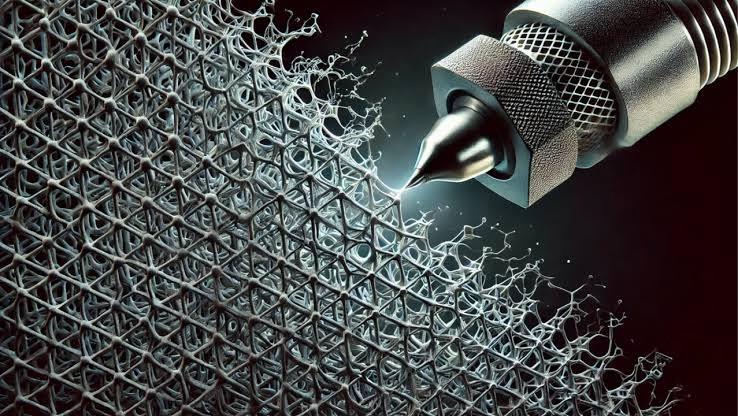 To evaluate the new materials, the researchers employed a sophisticated testing platform known as laser-induced microprojectile impact testing, or LIPIT.
The system launches microscopic silica particles, roughly 10 microns in diameter, at speeds approaching 750 meters per second, more than 1,600 miles per hour. Scientists then measure how much energy the material absorbs by analyzing the particles’ velocity before and after penetration.
The setup allowed researchers to recreate the kinds of forces experienced during real-world impacts, such as dropping a smartphone or striking a plastic object.
“We first developed this method to study microparticle impact and penetration into bulk polymer samples, where we would monitor particle propagation through about 100 microns of material and analyze after impact how polymer morphology had changed,” Nelson says.
“Our new measurements show how much additional information can be extracted from particle velocities before and after penetration through a thin layer. They also show deeply informative deformation patterns both during particle impact and afterward.”
The tests revealed that mechanophore-enhanced polystyrene absorbed significantly more energy than both conventional polystyrene and traditionally cross-linked alternatives.
“It turned out that the mechanophore leads to substantial increases in energy dissipation compared to both uncross-linked and conventionally cross-linked polystyrene, a behavior that had not been observed in related previous work,” Johnson says.
How The Materials Absorb Impact
To understand why the modified plastics performed so well, MIT collaborated with researchers from Purdue University, Northwestern University, and Duke University.
Their experiments and simulations showed that high-speed impacts generate localized heat at the point of contact. This creates a temporary mobile zone within the material.
Inside that zone, mechanophore bonds break in a controlled manner, opening pathways that absorb and dissipate energy while preserving the surrounding structure.
This selective response helps contain damage and prevents cracks from spreading as easily through the material.
“What is particularly attractive about this approach is the ability to bestow these properties upon ‘off-the-shelf’ commodity plastics, both glassy and elastomeric, with minimal chemistry which makes it in principle quite scalable and relevant. This study combines an elegant approach while providing an in-depth mechanical analysis of the failure mechanism,” says Yoan Simon, an associate professor in the School of Molecular Sciences at Arizona State University, who was not involved in the research.
Beyond Plastics: Potential Tire Applications
The technology has already shown promise beyond polystyrene.
Researchers successfully incorporated the same mechanophore strategy into styrene-butadiene-styrene rubber, a material commonly used in shoe soles, asphalt products, and roofing applications.
The team is now examining whether the approach can be adapted to styrene-butadiene rubber, one of the primary materials used in automobile tires.
If the concept proves effective, it could lead to longer-lasting tires with improved durability. It may also help reduce the growing environmental issue of tire-generated microplastics, which researchers estimate contribute at least 10 percent of microplastic pollution found in the environment.
Future Uses Could Extend Across Industries
The researchers believe the technology could eventually support a wide range of consumer and industrial products that require greater durability and impact protection.
Applications could include more resilient electronic device cases, safer transportation materials, and components capable of withstanding extreme mechanical stress without catastrophic failure.
“Materials with energy-absorbing mechanophores could one day help keep your vehicle’s tires from blowing out on the highway or provide more protective cases for personal electronics,” says Katharine Covert, program director of the U.S. National Science Foundation Centers for Chemical Innovation, which invested in the team’s research. “This work really demonstrates how valuable new insights can be rapidly generated by bringing together researchers with different areas of expertise.”
The project received support from the National Science Foundation Center for the Chemistry of Molecularly Optimized Networks, the U.S. Army Research Office through MIT’s Institute for Soldier Nanotechnologies, a Schmidt Science Postdoctoral Fellowship, and the U.S. Air Force Office of Scientific Research.