

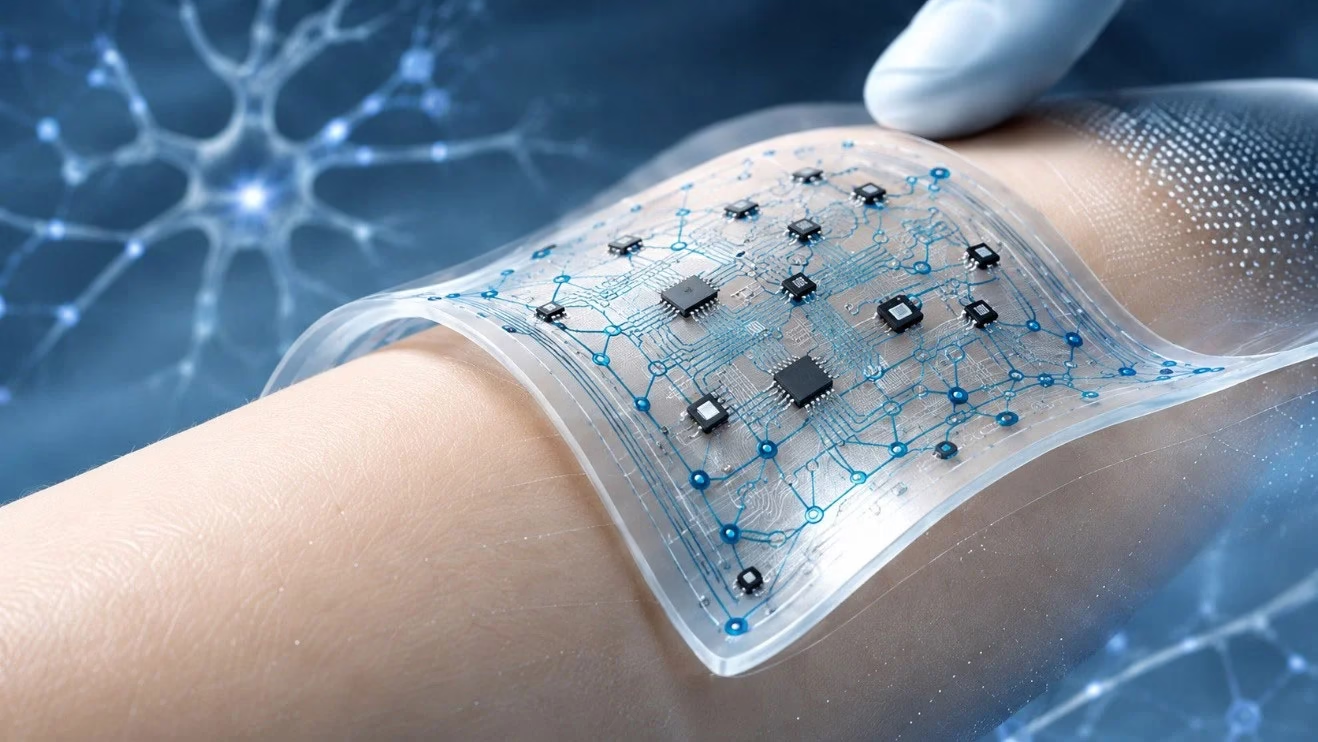
Artificial intelligence has become remarkably powerful, handling everything from image recognition to complex medical analysis. Yet one major challenge remains unresolved: integrating advanced computing systems directly with the human body.
Traditional electronics were never designed to move like living tissue. Silicon chips are rigid, while muscles, skin, organs, and joints constantly stretch, flex, and shift. As a result, devices attached to the body often struggle to maintain long-term performance and comfort.
Now, scientists are developing a new generation of stretchable neuromorphic electronics, technology designed to mimic both the learning ability of the brain and the flexibility of human tissue. The breakthrough could pave the way for smarter wearable devices, electronic skin, and long-term human-machine integration.
Electronics Inspired By Biological Intelligence
Researchers highlighted the growing field of soft neuromorphic electronics in a review published in the International Journal of Extreme Manufacturing.
Unlike conventional electronic systems that depend entirely on electrons moving through metallic circuits, these new devices use soft materials including flexible polymers and gel-like ionogels. These materials can transport both electrons and ions, creating behavior that more closely resembles the electrochemical communication used by the human nervous system.
The process, known as organic mixed ionic-electronic conduction, allows materials to absorb and release ions from their environment. This constant interaction changes their electrical properties over time, creating a system capable of adapting in ways similar to biological networks.
Because of this capability, a single soft transistor can imitate synaptic plasticity, the mechanism that enables brain cells to strengthen or weaken connections as learning occurs. In practical terms, the hardware itself can demonstrate learning-like behavior rather than simply executing programmed instructions.
Devices That Stretch Like Human Skin
One of the most significant advances involves flexibility.
Recent developments in materials science have produced components capable of stretching to as much as 140% of their original length. That level of elasticity exceeds the natural stretchability of human skin, allowing devices to remain functional even on highly mobile areas of the body.
This flexibility could help solve one of the biggest barriers facing wearable and implantable electronics. Instead of resisting movement, future devices may move seamlessly with muscles, joints, and organs.
Researchers believe this approach could dramatically improve long-term compatibility between electronics and living tissue while reducing irritation and mechanical failure.
Low Power Consumption Offers Major Advantages
Beyond flexibility, the technology operates with exceptionally low energy requirements.
Rather than relying on large electrical currents, these systems use efficient electrochemical processes to perform advanced tasks. Researchers have already demonstrated functions such as heart rhythm classification using operating voltages below 0.5 volts.
Lower voltage operation provides several benefits. It reduces heat generation, limits electrical stress on surrounding tissues, and improves safety for devices that may remain in constant contact with the body for extended periods.
These characteristics make the technology particularly attractive for future medical monitoring systems and wearable health applications.
Future Electronic Skin And Smart Wearables
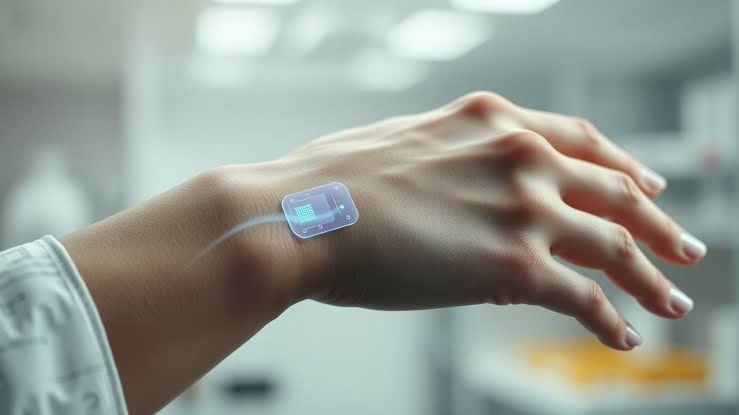 The potential applications extend far beyond healthcare.
Current wearable technology typically combines rigid electronic components with flexible materials. However, future manufacturing techniques may allow engineers to print fully integrated soft computing systems directly into stretchable materials.
Such systems could merge sensing, memory, and data processing into a single structure.
This could lead to advanced electronic skin capable of interpreting touch, pressure, and movement without constantly transmitting data to an external processor. Similarly, soft robotic limbs could process information locally, improving responsiveness and efficiency.
The result would be wearable devices that are lighter, more adaptable, and better suited to continuous interaction with the human body.
Key Challenges Still Need To Be Solved
Despite encouraging progress, researchers caution that several technical obstacles remain before the technology reaches widespread clinical use.
One major limitation involves memory retention. Many existing soft memory devices struggle to hold information for extended periods after receiving a signal, restricting their effectiveness for long-term applications.
To overcome this issue, scientists are exploring island-bridge architectures. These designs place permanent memory elements on tiny rigid sections protected from mechanical strain while connecting them through highly stretchable coiled structures.
Researchers believe this strategy may combine durability with flexibility, creating devices capable of maintaining reliable performance during continuous movement.
Path Toward Human-Integrated Intelligence
Scientists say the future of human-integrated computing may depend on combining stretchable designs with chemically stable and non-toxic materials.
If successful, these systems could eventually deliver electronics that not only think more like the brain but also physically behave more like the body itself.
The development represents a significant step toward a future where intelligent devices become seamless extensions of human biology rather than rigid tools attached to it.