
A strange Martian rock, tucked inside Perseverance’s growing cache of samples, is now stirring one of the biggest scientific questions of all time. Did life once exist on Mars? NASA says a newly analyzed specimen from Jezero Crater may hold the strongest hint yet.
The rock, nicknamed Cheyava Falls, carries unusual markings and chemical signatures that scientists say could point to ancient microbial activity. It is not proof, not yet. Still, after months of study and a new peer-reviewed paper, researchers say the case has become much harder to dismiss.
NASA Says The Sample Could Be A Major Clue
Scientists have spent more than a year examining a sample called Sapphire Canyon, which Perseverance collected from an arrowhead-shaped rock known as Cheyava Falls in July 2024. The rock came from the edge of the Neretva Vallis river valley, an area shaped by flowing water that once emptied into Jezero Crater more than 3 billion years ago.
That setting matters. Jezero is not just another dusty Martian landscape. It is an ancient lake bed, a place where water once pooled, sediment settled, and perhaps conditions aligned for life to take hold.
“After a year of review, they have come back and they said, listen, we can’t find another explanation,” said Acting NASA Administrator Sean Duffy. “So this very well could be the clearest sign of life that we’ve ever found on Mars, which is incredibly exciting.”
That is a striking statement, and NASA is still being careful. The agency is not declaring victory. It is saying the rock contains a potential biosignature, one that demands even deeper study.
Scientists Stress The Work Is Not Finished
Researchers say the discovery is promising, but not final. They want the world to understand both the excitement and the limits.
“The discovery of a potential biosignature, or a feature or signature that could be consistent with biological processes, but that requires further work and study to confirm a biological origin is something that we’re sharing with you all today that grows from years of hard work, dedication and collaboration between over 1,000 scientists and engineers here at the (NASA) Jet Propulsion Laboratory and our partner institutions around the country and internationally,” said Katie Stack Morgan, Perseverance project scientist at JPL, during a news conference Wednesday.
That caution is central to the announcement. Scientists are not saying life has been found. They are saying the evidence has grown more compelling, and the usual alternative explanations are not fitting as neatly as expected.
Meanwhile, the findings have now gone through peer review and appeared in the journal Nature, giving the broader scientific community a chance to weigh in.
Why Cheyava Falls Has Scientists So Intrigued
Cheyava Falls stood out almost immediately after Perseverance found it. Team members said it was the kind of rock they had been hoping to uncover from the start.
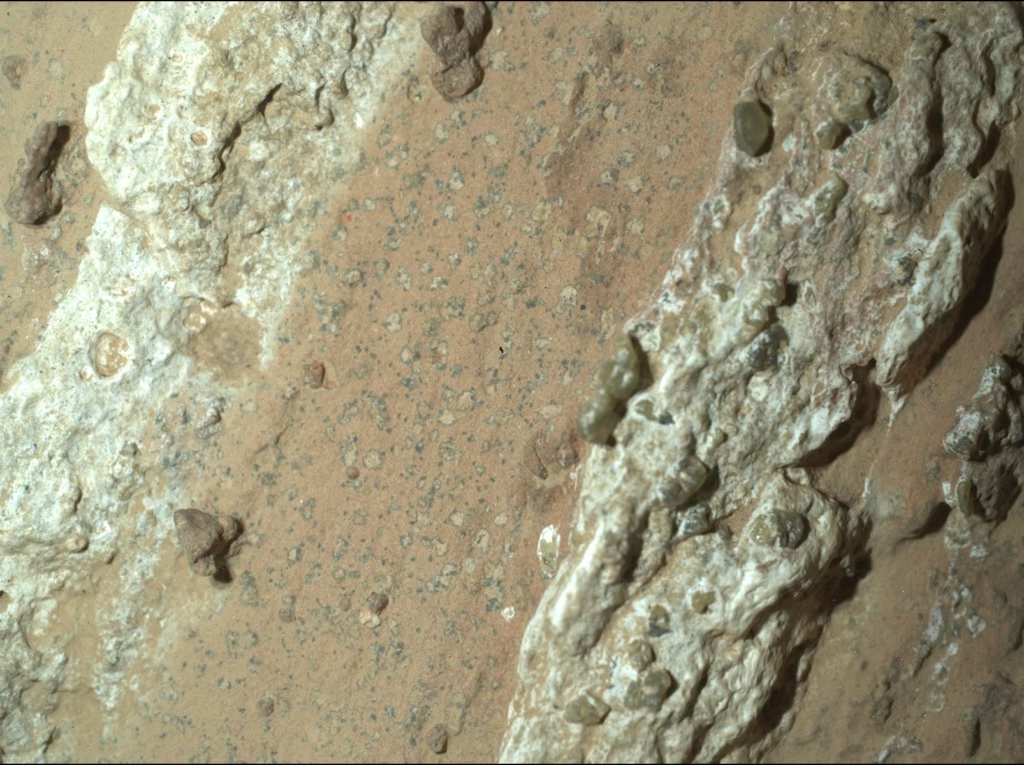
The rock contains small black spots the team nicknamed “poppy seeds,” along with larger features called leopard spots. These textures are not just visually striking. They may preserve a record of chemical reactions that happened long ago, when mud, water, and minerals interacted in Mars’ ancient environment.
“These textural features told us that something really interesting had happened in these rocks, some chemical reactions occurred at the time they were being deposited,” Hurowitz said.
The rover’s SHERLOC instrument also detected organic compounds in the rock. That detail grabbed immediate attention because organic compounds are carbon-based molecules that, on Earth, form the building blocks of life.
“The SHERLOC results were a “smoking gun indicator for the presence of organic matter in this mud,” Hurowitz said. Organic compounds were also found in a couple of other locations in the Bright Angel formation.
“This tells us that we had a rusty red mud that was deposited in the presence of organic matter,” Hurowitz said.
An Ancient Wet Environment Comes Into Focus
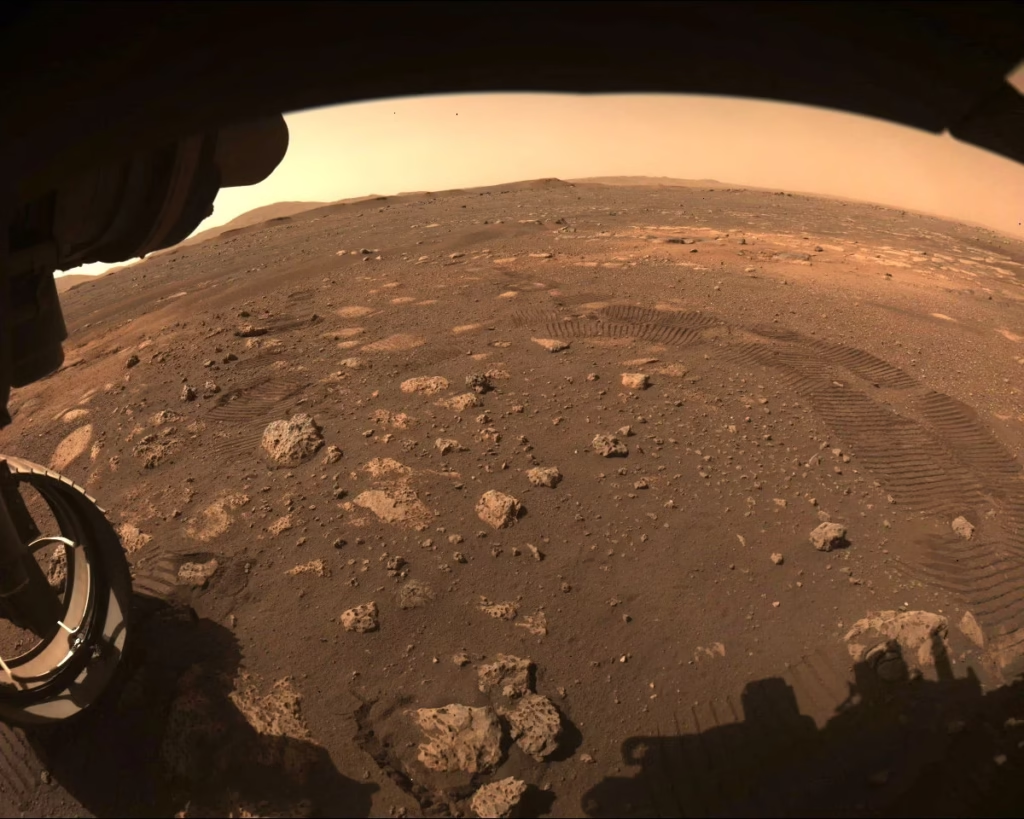
To understand why this matters, scientists looked beyond the rock itself and examined the wider landscape around it. More than 3.5 billion years ago, the Neretva Vallis region would have looked dramatically different from the cold, dry Mars seen today.
“Inside the crater, this kind of energetic setting was probably punctuated by periods of calm when water would have backed up, creating a relatively low energy lake environment,” she added.
When that water vanished, it left behind rocky outcrops that preserved clues from a potentially habitable environment.
“These really ancient rocks provide us the window into a period of time that’s not particularly well represented on our own planet Earth, but it’s a time when life was emergent on Earth, and could have been on Mars as well,” she added.
That is what makes Jezero Crater such a scientific prize. It offers a preserved window into an era when life was beginning to emerge on Earth and may, just may, have been possible on Mars too.
The Leopard Spots May Hold The Biggest Secret
Scientists say the leopard spots are especially important because of what they are made of and how they may have formed. White veins of calcium sulfate show that water once moved through the rock. Tests from the rover’s PIXL instrument also detected iron and phosphate inside the spots.
Researchers think the features may be linked to minerals such as vivianite and greigite, which usually form in low-temperature, watery environments. On Earth, similar settings can support microbial processes.
“On Earth, things like these sometimes form in sediments where microbes are eating organic matter and ‘breathing’ rust and sulfate,” said study coauthor Dr. Michael Tice, a geobiologist and astrobiologist in the department of geology and geophysics at Texas A&M University, in a statement. “Their presence on Mars raises the question: could similar processes have occurred there?”
That question now sits at the center of the debate. Could these markings have formed because ancient microbes were living in the mud of a Martian lake, feeding on organic matter and leaving behind a chemical fingerprint?
Scientists Are Testing Life Versus Chemistry
The new study explores two broad possibilities. One is biological, that ancient life helped produce the features. The other is nonbiological, that chemistry alone created them.
So far, the nonbiological explanation has not disappeared, but it has become more difficult to pin down. Some geochemical reactions can form similar features, though often at relatively high temperatures.
“All the ways we have of examining these rocks on the rover suggest that they were never heated in a way that could produce the leopard spots and poppy seeds,” Tice explained. “If that’s the case, we have to seriously consider the possibility that they were made by creatures like bacteria living in the mud in a Martian lake more than three billion years ago.”
That is a remarkable possibility. Still, scientists are careful not to leap past the evidence.
“What’s exciting about these finds, this sort of combination of mud and organic matter that has reacted to produce these minerals and these textures, is that when we see features like this are often the byproduct of microbial metabolisms that are consuming organic matter and making these minerals as a result of those reactions,” Hurowitz said.
Hurowitz also made clear that there are other ways the features could have formed.
“What we need to do from here is to continue to do additional research in laboratory settings here on Earth, and ultimately bring the sample from this rock back home to Earth, so that we can make the final determination for what process actually gave rise to these fantastic textures,” he said.
Bringing The Sample Back Is The Real Test
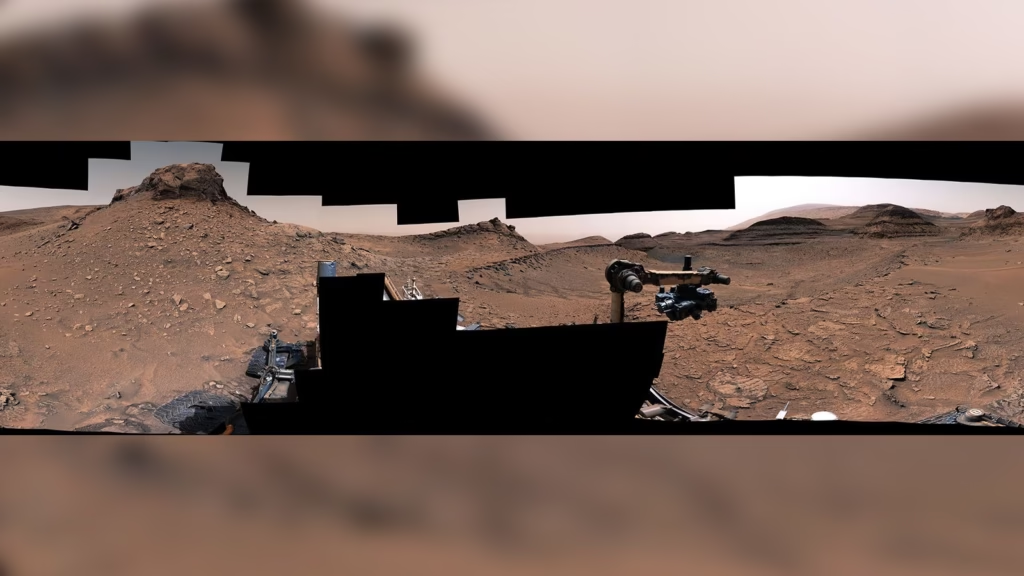
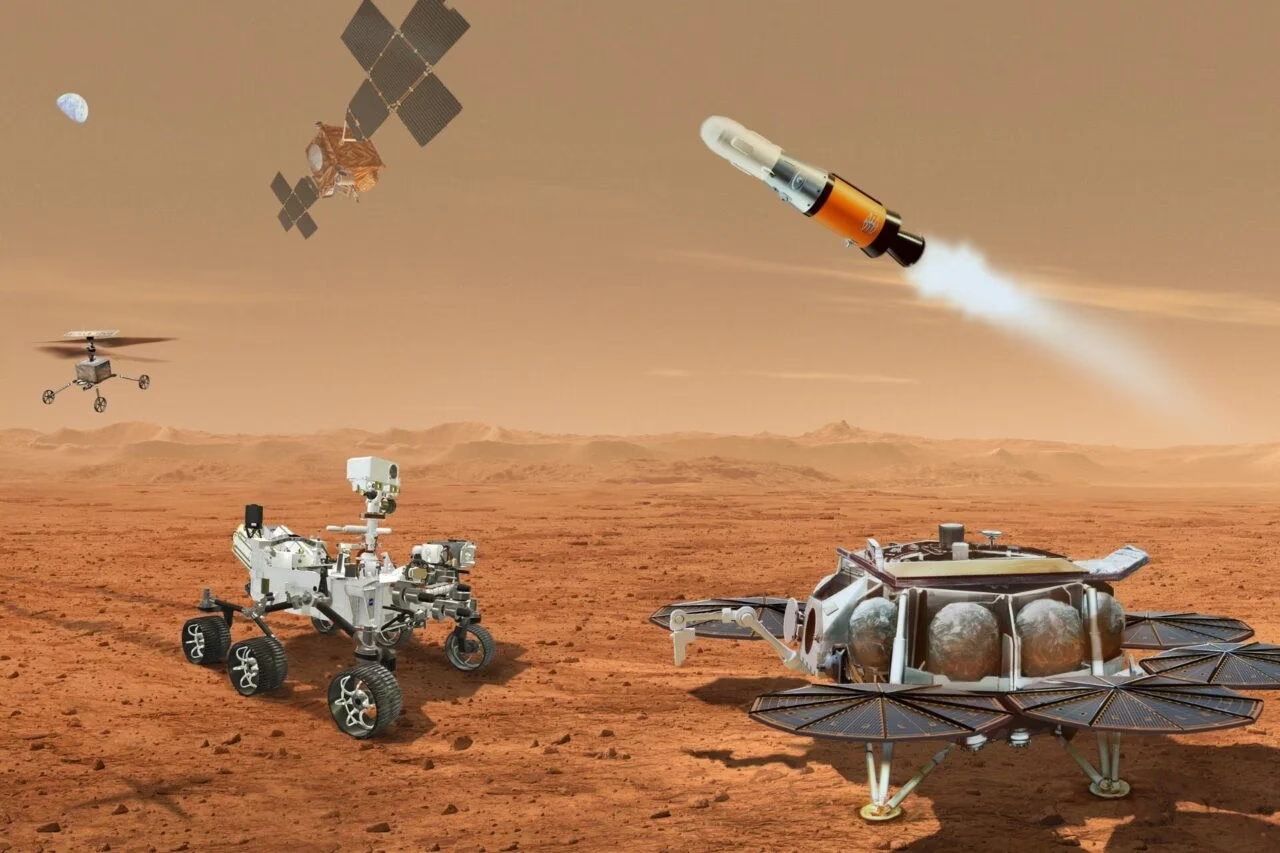
That is the next great hurdle. The sample remains sealed in a tube on Mars, millions of miles away, while NASA weighs how to return it to Earth.
“Hopefully, eventually this will be followed by the delivery of these samples back to Earth where they could be studied in terrestrial labs,” Hays added.
Scientists say the rover has already done nearly all it can with this particular rock on the Martian surface.
“While we were exploring the Bright Angel area, we basically threw the entire rover science payload at this rock, and so we’re pretty close to the limits of what the rover can do on the surface in terms of making progress on that particular question,” Stack Morgan said.
In other words, the next real leap forward may depend on getting the sample into labs on Earth, where far more advanced instruments can analyze it.
“Bringing this sample back to Earth would allow us to analyze it with instruments far more sensitive than anything we can send to Mars,” Tice said. “What’s fascinating is how life may have been making use of some of the same processes on Earth and Mars at around the same time. It’s a special and spectacular thing to be able to see them like this on another planet.”
NASA Faces Big Questions On How To Retrieve It
The science is electrifying, but the logistics are complicated. NASA is still working through how, when, and with what budget it might return Perseverance’s samples to Earth.
“We’re looking at how we get the sample back, or other samples back,” Duffy said. “What we’re going to do is look at our budgets, we look at our timing, and you know, how do we spend money better, and you know, what technology do we have to get samples back more quickly? And so that’s a current analysis that’s happening right now.”
That uncertainty hangs over the mission. Perseverance has spent years crossing Jezero Crater, drilling, collecting, and preserving samples that could answer one of humanity’s oldest questions. Yet until those tubes make it home, the final verdict may remain frustratingly out of reach.
One Step Closer To An Answer
For now, NASA says Cheyava Falls represents a major step, not the finish line. Scientists are continuing to study the geologic context of the rock, and more papers are expected over the coming year.
Still, the emotional weight of the find is hard to ignore. Mars has teased humanity for generations. Dry riverbeds, ancient deltas, buried minerals, all of it whispering that the planet was once very different. Now, this rock may be whispering something even bigger.
“Today, we are really showing you how we are kind of one step closer to answering humanity’s, one of their most profound questions, and that is, are we truly alone in the universe?” said Nicky Fox, associate administrator for NASA’s Science Mission Directorate.
It is not proof. Not yet. But it may be the closest Mars has come to answering back.