
The Middle East crisis took another sharp turn Sunday, with President Trump saying U.S. representatives are heading to Pakistan for another round of negotiations with Tehran, even as Iran insists the Strait of Hormuz will stay restricted unless Washington lifts its blockade.
The diplomatic push comes at a tense moment. A two-week ceasefire between the United States and Iran is nearing its deadline, shipping routes remain under threat, and cross-border violence tied to Lebanon and Hezbollah is still shaping the wider regional picture. The question now is simple, but massive: can diplomacy move fast enough before the next rupture hits?
U.S. Officials Head To Islamabad For Fresh Iran Talks
President Trump said government representatives were being sent to Islamabad for another round of negotiations with Iran, signaling that backchannel diplomacy is still alive despite the increasingly hostile rhetoric from both sides.
Sources familiar with the matter said Vice President JD Vance, special envoy Steve Witkoff and Jared Kushner are expected in Pakistan for talks set for Tuesday. The new effort follows an earlier round of direct talks in Islamabad that failed to produce an immediate breakthrough.
Trump had already hinted that Steve Witkoff was on his way, and said Jared Kushner would also be involved. By Sunday morning, officials familiar with the discussions said Vance would be part of the delegation as well.
The timing is critical. The current two-week ceasefire between Iran and the United States is set to expire Tuesday, leaving little room for delay and even less room for miscalculation.
Meanwhile, Pakistan visibly tightened security in Islamabad ahead of the expected meetings. Authorities announced road closures and traffic restrictions across the capital and nearby Rawalpindi, while armed guards and checkpoints appeared near the city’s most secure hotels.
Most routes leading to one of the key hotels used during the earlier talks were shut, with barricades, barbed wire and heavy security in place. A city official urged the public to comply, writing, “Citizens are earnestly requested to cooperate with the security agencies.”
Iran Says It Wants Peace, But Not On Washington’s Terms
Iran’s messaging Sunday was layered, and at times contradictory. On one hand, Tehran’s chief negotiator said the country wants “a lasting peace.” On the other, Iranian officials made clear they remain deeply distrustful of the United States and are not prepared to reopen the Strait of Hormuz without concessions.
Iran’s parliamentary speaker and chief negotiator, Mohammad Bagher Qalibaf, said, “What is fundamental for us is distrust of the United States.” He added, “At the same time, we have good intentions and seek a lasting peace — one that prevents the recurrence of war.”
Those comments landed just hours after he had struck a harder tone over the vital waterway.
“It is impossible for others to pass through the Strait of Hormuz while we cannot,” Qalibaf said.
He then tied the route’s future directly to U.S. policy, saying, “If the U.S. does not lift the blockade, traffic in the Strait of Hormuz will definitely be restricted.”
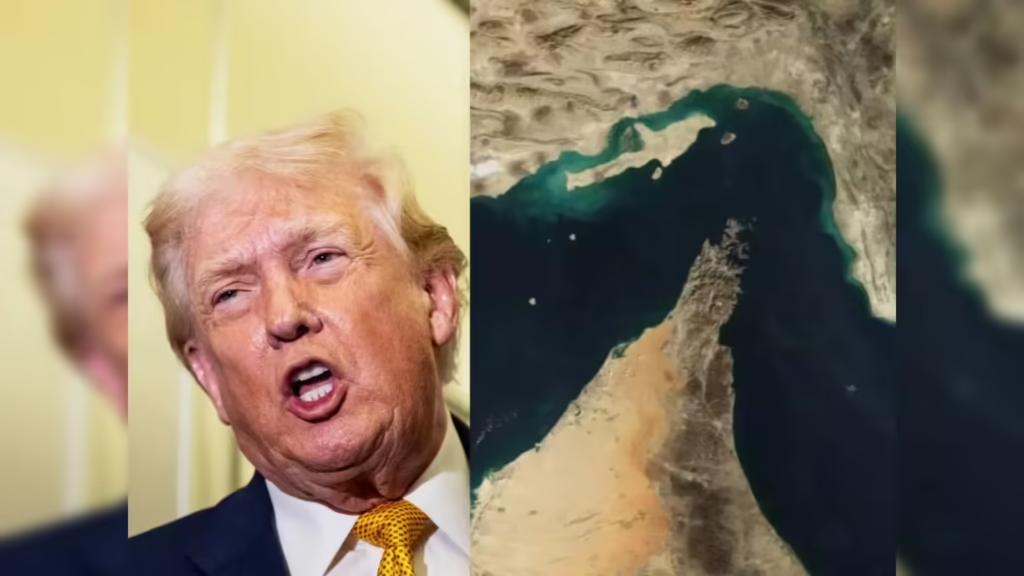
That followed an earlier warning from Iran that “With the continuation of the blockade, the Strait of Hormuz will not remain open,” and a late Saturday statement declaring that “the Strait of Hormuz is under Iran’s control.”
Iran also said it had “decisively confronted” American efforts to clear mines in the strait, a claim that appeared to clash with Trump’s earlier assertion that Iran, with U.S. help, “has removed, or is removing, all sea mines!”
Tehran’s internal debate over peace versus pressure was visible even before Sunday. On Saturday night, Qalibaf acknowledged movement in the talks, but cautioned that a final deal remained distant.
“We are still far from the final discussion,” he said, adding “we made progress in the negotiations, but there are many gaps and some fundamental points remain.”
Other Iranian officials were even more blunt. First Vice President Mohammad Reza Aref wrote, “Trump’s policies are a blend of delusion and contradictory rhetoric, and his tweets are worthless.” He added, “Our response, however, lies not in words, but in the ‘glory of the battlefield’; breaking the alleged maritime siege and a two- to threefold surge in oil exports in this very period are signs of Iran’s decisive victory.”
He concluded, “The authority of this nation will not be tarnished by ravings”
Another senior official said Iran was reviewing new proposals sent through Pakistani intermediaries and repeated that Tehran should “maintain oversight and control” over the Strait of Hormuz, collect “the payment of relevant fees for services related to security, safety, and environmental protection, along routes designated by Iran.”
He also warned, “Furthermore, as long as the enemy seeks to disrupt maritime traffic and employ measures such as a naval blockade, the Islamic Republic of Iran will consider this a violation of the ceasefire and will prevent the conditional and limited opening of the Strait of Hormuz.”
Trump Escalates Threats As He Accuses Iran Of Violating Ceasefire
Even as talks were being arranged, Trump ratcheted up the pressure.
On Sunday, he accused Iran of violating the ceasefire and again framed the U.S. blockade as the dominant reality in the Gulf. In one social media post, he wrote, “Iran recently announced that they were closing the Strait, which is strange, because our BLOCKADE has already closed it. They’re helping us without knowing, and they are the ones that lose with the closed passage, $500 Million Dollars a day!” He added, “The United States loses nothing.”
Trump also said that “many Ships are headed” to the U.S. to “load up” on oil and fuel.
But his harshest language came in a direct threat aimed at Iran’s civilian infrastructure.
“We’re offering a very fair and reasonable DEAL, and I hope they take it because, if they don’t, the United States is going to knock out every single Power Plant, and every single Bridge, in Iran,” he wrote.
Then came the line that left little doubt about the tone he wanted to set: “NO MORE MR. NICE GUY!”
Trump continued, “They’ll come down fast, they’ll come down easy and, if they don’t take the DEAL, it will be my Honor to do what has to be done, which should have been done to Iran, by other Presidents, for the last 47 years. IT’S TIME FOR THE IRAN KILLING MACHINE TO END!”
Earlier, he had also told a journalist that Iran had committed a “serious violation” of the ceasefire, but insisted a deal still remained possible. According to that account, Trump said peace “will happen. One way or another. The nice way or the hard way. It’s going to happen. You can quote me.”
That mix of optimism and menace has defined his public posture for days.
On Saturday morning, Trump said talks were “going very well” and declared, “It’s going very well.” He added that the U.S. is “taking a tough stand” and said, “We’re talking to them. They wanted to close up the strait again, as they’ve been doing for years, and they can’t blackmail us.”
He has also made sweeping claims about the broader negotiations, saying, “They have agreed to everything, they have agreed to everything. It’s a great deal. It’s a wonderful deal. They’ve agreed to everything.”
He separately said Iran had agreed to suspend its nuclear program indefinitely, and declared, “Most of the main points are finalized. It’ll go pretty quickly.”
At another point, discussing enriched uranium, he said, “Our people, together with the Iranians, are going to work together to go get it. And then we’ll take it to the United States.”
Pressed on whether U.S. troops would be involved, Trump replied, “No. No troops,” before adding, “We’ll go down and get it with them, and then we’ll take it. We’ll be getting it together because by that time, we’ll have an agreement and there’s no need for fighting when there’s an agreement. Nice right? That’s better. We would have done it the other way if we had to.”
He has also insisted, “No, we are not paying 10 cents,” and said, “The U.S.A. will get all Nuclear ‘Dust,’ created by our great B2 Bombers – No money will exchange hands in any way, shape, or form.”
On the Strait of Hormuz, Trump at one stage thanked Tehran after it appeared to reopen the route, writing, “IRAN HAS JUST ANNOUNCED THAT THE STRAIT OF IRAN IS FULLY OPEN AND READY FOR FULL PASSAGE. THANK YOU!,” then later declared, “Iran has agreed to never close the Strait of Hormuz again. It will no longer be used as a weapon against the World!”
He also said the shipping lane “is completely open and ready for business,” while warning, “THE NAVAL BLOCKADE WILL REMAIN IN FULL FORCE AND EFFECT AS IT PERTAINS TO IRAN, ONLY, UNTIL SUCH TIME AS OUR TRANSACTION WITH IRAN IS 100% COMPLETE.” He added, “THIS PROCESS SHOULD GO VERY QUICKLY IN THAT MOST OF THE POINTS ARE ALREADY NEGOTIATED.”
When asked whether the ceasefire itself might expire, Trump signaled flexibility and danger at once: “Maybe I won’t extend it,” he said. “But the blockade is going to remain. But maybe I won’t extend it, so you have a blockade, and unfortunately, we’ll have to start dropping bombs again.”
Shipping In The Strait Remains At The Center Of The Standoff
The Strait of Hormuz remains the most dangerous flashpoint in the crisis. Iran reopened it briefly for commercial shipping, then quickly reversed course after the U.S. said its blockade would remain.
Iran had initially announced, “In line with the ceasefire in Lebanon, the passage for all commercial vessels through Strait of Hormuz is declared completely open for the remaining period of ceasefire, on the coordinated route”
That came with extra conditions. Iranian authorities had previously said, “Only non-military vessels are permitted to transit, and strictly along designated routes with authorization from the IRGC Navy,” while warning that “the passage of military vessels through the Strait of Hormuz remains prohibited.”
Trump responded positively at first, but the situation deteriorated almost immediately. By Saturday, Iran said control of the strait had “returned to its previous state … under strict management and control of the armed forces.”
Several maritime incidents followed.
Indian officials said two Indian-flagged ships were targeted. In response, New Delhi said, “During the meeting, Foreign Secretary conveyed India’s deep concern at the shooting incident earlier today involving two Indian-flagged ships in the Strait of Hormuz.” The statement added, “He noted the importance that India attached to the safety of merchant shipping and mariners and recalled that Iran had earlier facilitated the safe passage of several ships bound for India.”
India’s foreign secretary also urged Iran to “resume at the earliest the process of facilitating India-bound ships across the Strait.”
The British military reported that Iranian gunboats fired on a tanker, while additional vessels later appeared to come under fire. One master reported “sighting a splash in close proximity of the vessel,” underscoring just how close commercial traffic is sailing to outright disaster.
On the U.S. side, military officials say the blockade is biting. CENTCOM said 21 ships had already turned around by Friday night, and by Saturday the number had grown further. According to one military exchange released publicly, a vessel acknowledged orders by saying, “Copy, sir. Thank you very much. Copy, copy sir. We are return to Iran. We are return to Iran. Thank you.”
The U.S. military has described the blockade as limited to Iran’s ports and coastline rather than the strait itself, but the effect has been severe enough to jam maritime traffic and drive global energy anxiety.
Iran also framed the route as a lever of sovereignty and resistance. One top politician thanked Pakistan for mediation while declaring, “The ceasefire was nothing but a result of Hezbollah’s steadfastness and the unity of the Axis of Resistance; and we will deal with this ceasefire with caution, and we will remain together until the full realization of victory.” He added, “I thank the mediating efforts of the State of Pakistan and General Asim Munir for endorsing this ceasefire. We are true to our pledge.”
Lebanon Ceasefire Holds Uneasily As Hezbollah Signals It Is Ready
Complicating everything is the Lebanon front, where a separate 10-day ceasefire between Israel and Lebanon took effect even as Israeli strikes and Hezbollah warnings continued.
A truce seemed to be holding for the most part, but only just. Lebanese officials reported violations, and Macron said the ceasefire “may already be undermined by ongoing military operations.”
Hezbollah has made clear it does not see the arrangement as a blank check for calm.
“The hands of these fighters will remain on the trigger, anticipating the enemy’s treachery and violation of promises,” the group said.
Later, Hezbollah leader Naim Qassem sharpened the message further: “A ceasefire means a complete cessation of all hostilities. Because we do not trust this enemy, the resistance fighters will remain in the field with their hands on the trigger, and they will respond to violations accordingly,” and, “There is no ceasefire from the side of the resistance only, it must be from both sides.”
Israel, meanwhile, said it had established a “Yellow Line” in southern Lebanon and warned it would continue acting against threats. The military said, “Over the past 24 hours, IDF forces operating south of the Yellow Line in southern Lebanon identified terrorists who violated the ceasefire understandings and approached the forces from north of the Yellow Line in a manner that posed an immediate threat,” adding, “Immediately after identification and in order to eliminate the threat … forces attacked the terrorists in several areas in southern Lebanon.”
Israeli officials later said, “The terrorists posed a threat to the troops, and in response the IDF eliminated them.”
Residents hoping to return home were warned away. One Israeli spokesman said, “With the entry of the ceasefire agreement into the implementation phase, the Israel Defense Forces continue to maintain their positions in southern Lebanon in the face of the ongoing terrorist activities of Hezbollah,” and added, “Out of concern for your safety and the safety of your families’ members — until further notice — you are requested not to move south of the Litani River.”
Still, some civilians spoke of returning anyway. One elderly man said he hoped to go home “hopefully soon.” A woman whose home had been destroyed said, “it doesn’t matter.” She added, “Houses can be rebuilt, and all is worthless compared to a drop of blood of a martyr.”
Another returning resident said, “We left [the town of Nabitiyeh] 25 days ago, and we are grateful for all those who helped with ending the war.” Asked whether the truce would last, he replied, “It will — thanks to those who imposed this one.”
Lebanon’s president said his aim now “is to consolidate the ceasefire, ensure the withdrawal of Israeli forces from occupied southern territories, secure the release of prisoners, and address outstanding border disputes.” He added, “The ceasefire is the gateway to moving forward with negotiations and is a path supported domestically and internationally,” and said, “Among its most notable signs is what U.S. President Donald Trump announced during yesterday’s phone call, expressing support for Lebanon, its sovereignty, independence, and territorial integrity, as well as the United States standing with the Lebanese people to end their suffering, restore recovery, and reactivate the economy, which has been negatively affected by the recent war.”
He also pledged that the army would “play a fundamental role after the withdrawal of Israeli forces by deploying up to the southern international border [with Israel], ending armed manifestations, and reassuring southerners returning to their villages and towns that no armed forces will be present except the army and legitimate security forces.”
And in perhaps the clearest warning of all, he told lawmakers, “The Lebanese people, who have endured much in recent years, now face a new reality supported by Arab and international backing. This opportunity must not be wasted, as it may not be repeated.”
Pope Leo, Macron And Other Global Voices Push For Diplomacy
Outside the direct combatants, world leaders are trying to hold the diplomatic line.
Pope Leo XIV called the Lebanon ceasefire “cause for hope” and said, “I encourage those who are working toward a diplomatic solution to continue peace talks, so that the cessation of hostilities throughout the Middle East may become permanent.”
He also said he was “deeply saddened by the recent escalation of attacks against Ukraine,” and called “for weapons to fall silent and for the path of dialogue to be pursued.”
His recent remarks have irritated Trump allies, but Vance tried to cool the temperature after the pope said he had no interest in sparring with the president. Leo said, “to debate” Trump was not his intent, explaining, “It was looked at as if I was trying to debate, again, the president, which is not in my interest at all.”
Vance replied, “I am grateful to Pope Leo for saying this,” and added, “While the media narrative constantly gins up conflict–and yes, real disagreements have happened and will happen–the reality is often much more complicated. Pope Leo preaches the gospel, as he should, and that will inevitably mean he offers his opinions on the moral issues of the day. The President–and the entire administration–work to apply those moral principles in a messy world. He will be in our prayers, and I hope that we’ll be in his.”
Leo, however, has not exactly softened his moral critique of war. Earlier this month, he wrote, “Anyone who is a disciple of Christ, the Prince of Peace, is never on the side of those who once wielded the sword and today drop bombs.”
When Trump pushed back, saying Leo is “wrong on the issues,” the pope answered that he has “no fear of the Trump administration, or speaking out loudly of the message of the Gospel, which is what I believe I am here to do, what the church is here to do.”
French President Emmanuel Macron has also taken a visible role, especially after a deadly attack on peacekeepers in Lebanon. He said, “Everything points to Hezbollah being responsible for this attack,” while urging Lebanese authorities to arrest those behind it.
Hezbollah rejected the accusation, saying, “Hezbollah denies any connection to the incident that occurred with UNIFIL forces in the Ghandouriyeh-Bint Jbeil area,” and urging “caution in making judgements and assigning responsibilities” while investigations continue.
In a separate statement, the group said, “Hezbollah denies any connection to the incident involving UNIFIL forces in the al-Ghandouriya-Bint Jbeil area, and calls for caution in assigning blame and responsibility pending the Lebanese Army’s investigation to fully determine the circumstances of the incident,”
Macron, for his part, had earlier said, “Everything suggests that responsibility for this attack lies with Hezbollah.”
Lebanese authorities responded by stressing that the country rejects violence against U.N. forces. According to an official statement, “[Aoun] stressed that Lebanon, which categorically rejects any attack on UNIFIL, is committed to ensuring the safety of these forces and creating the appropriate conditions for them to carry out their mission,” and, “He said he has issued instructions to the relevant agencies to conduct an immediate investigation into the incident and determine responsibility, underlining that Lebanon will not tolerate leniency in pursuing those involved and bringing them to justice.”
Oil, Markets And The Wider Global Fallout
The crisis is no longer just a military or diplomatic story. It is also an economic one.
The Strait of Hormuz handles a huge share of global crude flows, and every threat to it has rippled through oil prices, financial markets and international supply chains. At one point, optimism over a temporary reopening sent oil prices tumbling and stocks climbing. At another, renewed attacks on ships reversed that mood.
Ukraine has also tried to pull the moment into its own fight with Russia. Its ambassador to Washington said Moscow “must not be allowed to profit from the actions of its ally.” She added, “It is in our common interest to limit the funding Russia uses for its attack on Ukraine and for aiding U.S. adversaries,” and warned, “If Russia sees that destabilization and fanning the war are beneficial, new problems in the world will not be long in coming.”
The Trump administration, however, extended relief allowing certain purchases of Russian oil already at sea. Treasury defended the move by saying, “As negotiations accelerate, Treasury wants to ensure oil is available to those who need it.”
At the same time, Iran has endured an escalating domestic cost. NetBlocks said the country’s blackout had entered an “unprecedented” 50th day, adding, “Metrics show the measure, unprecedented for a connected society, continues to the detriment of most Iranians’ livelihoods and human rights.”
The Clock Is Ticking
For now, the entire crisis hangs on overlapping ceasefires, contradictory public statements and talks that may or may not deliver results before deadlines hit.
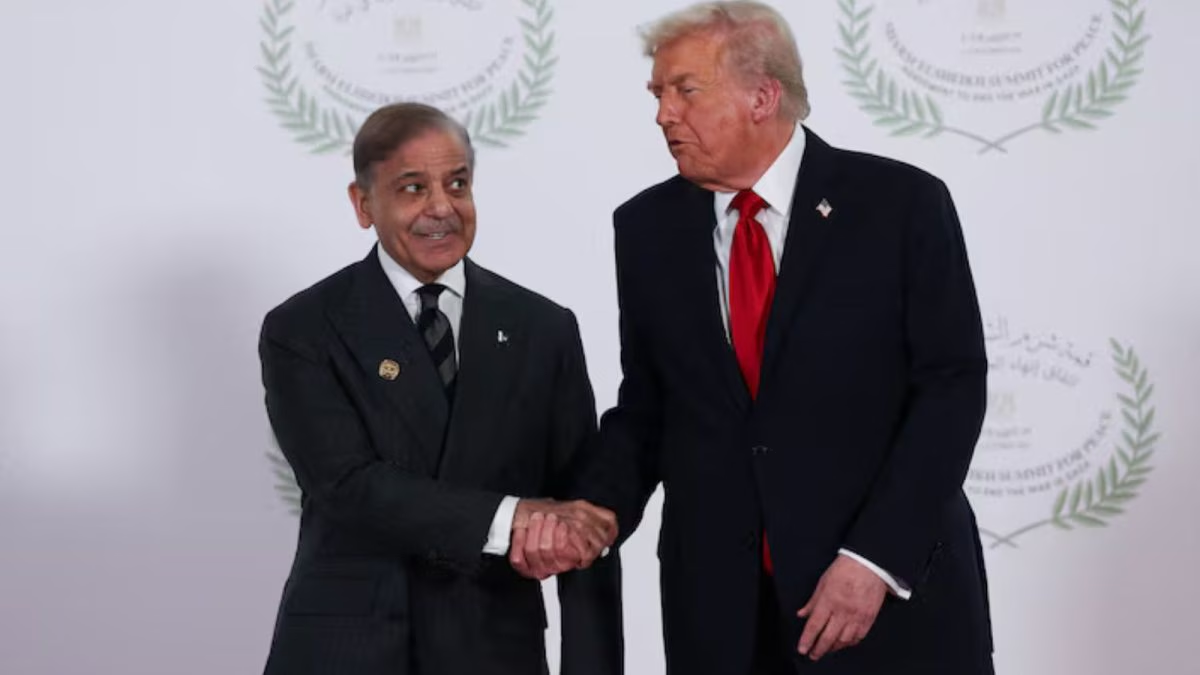
Pakistan’s prime minister has said he will keep backing diplomacy, declaring, “I welcome the announcement of a ceasefire in Lebanon, facilitated through bold and sagacious diplomatic efforts led by President Donald Trump, and express the hope that it will pave the way for sustainable peace.”
He added, “Pakistan reaffirms its unwavering support for the sovereignty and territorial integrity of Lebanon, and will continue to support all efforts aimed at lasting peace in the region.”
Egypt’s foreign minister also said mediators are working “very hard” toward “a final agreement between the United States and Iran,” adding that they hope to reach one “in the coming days.” He warned, “Not only us in the region, but the whole world is suffering from the continuation of this war,” and said mediators are “pushing very hard in order to move forward.”
Trump, true to form, has wrapped the uncertainty in bravado. He said the war in Iran is “going along swimmingly” and “should be ending pretty soon.” He added, “We’re “going to have victory very shortly,” and then, perhaps most honestly of all, said: “Let’s see what happens over the next week or so.”
That is where this stands now. Diplomats are headed to Pakistan. Iran says it wants peace, but keeps one hand on the choke point of global oil. Trump says a deal is near, while threatening to bomb power plants and bridges if it falls apart.
In other words, the region is again balancing on a razor’s edge.