
The White House is pushing a new strategy to ease the worsening energy crisis tied to the closure of the Strait of Hormuz. But traders, shipping executives, and analysts are signaling they are far from convinced.
Even after President Donald Trump unveiled “Project Freedom,” a military-backed effort aimed at restoring shipping access through one of the world’s most important oil chokepoints, markets reacted with skepticism instead of relief.
Oil prices surged higher. Gasoline futures climbed. And fresh attacks across the Middle East only deepened fears that the crisis could drag on far longer than hoped.
Why Markets Aren’t Convinced
The administration announced Monday that two US vessels had successfully moved through the Strait of Hormuz under the new initiative. Still, investors appeared unconvinced the effort would meaningfully restore oil flows.
Instead of falling, crude prices pushed further above the $100-per-barrel mark. Concerns intensified after renewed violence targeted ships and energy infrastructure in the region.
Gasoline futures also jumped sharply, signaling that drivers could soon face even steeper prices at the pump.
At the center of the concern is one major issue: markets do not believe Project Freedom can quickly reopen the strait or safely restore large-scale shipping traffic.
Project Freedom Stops Short Of Full Escort Operations
 The administration described Project Freedom as a mission to “restore freedom of navigation” through the Strait of Hormuz. According to US Central Command, the operation includes more than 100 land and sea-based aircraft alongside roughly 15,000 service members.
However, the mission has a key limitation.
“This will not be an escort mission,” a US official told CNN.
That distinction matters enormously to shipping companies already rattled by weeks of attacks, mines, and instability in the region.
Without direct military escorts, tanker owners may still consider the route too dangerous to risk.
Iran Pushes Back Against US Operation
Iran quickly condemned the new initiative, arguing that it violates the already fragile ceasefire with the United States.
Meanwhile, tensions escalated further Monday as military exchanges resumed in the region.
The US military reportedly destroyed small Iranian boats after attacks targeted American assets. At the same time, a South Korean-linked vessel suffered an explosion near the Strait of Hormuz, though the exact cause remains unclear.
Then came another major blow.
A significant fire erupted at the Fujairah Oil Industry Zone in the United Arab Emirates. Officials blamed Iranian drones for the attack. The facility plays a critical role because it serves as the endpoint of a pipeline designed specifically to bypass the Strait of Hormuz.
The attack underscored a harsh reality: even alternative oil routes are now vulnerable.
Shipping Industry Warns The Crisis Is Far From Over
Shipping executives say reopening the waterway requires cooperation from both sides, not simply unilateral military efforts.
“The US plan will not substantially raise shipping volume through the strait in the near term,” consulting firm Eurasia Group wrote in a report on Monday.
That warning echoed concerns from Bjørn Højgaard, CEO of ship manager Anglo-Eastern.
“It takes both sides to unblock — not just one,” Højgaard said. “Either party can signal that they are willing to let certain ships through, but unless the other side accepts that in practice, it doesn’t materially change the reality on the water.”
Those comments highlight the deep uncertainty hanging over global energy markets.
Oil And Gas Prices Continue To Surge
Crude prices initially dipped Sunday night after news of Project Freedom emerged. That optimism vanished quickly.
West Texas Intermediate crude, the US benchmark, climbed as high as $107.46 per barrel Monday before settling near $105, still up 3.5% for the session.
Brent crude, the international benchmark tied closely to gasoline prices, surged 5% to roughly $114 per barrel.
Meanwhile, gasoline futures rose another 4%, adding approximately 15 cents per gallon.
Retail gas prices across the United States have already reached painful levels. National averages hit $4.46 per gallon Monday, the highest reading in nearly four years.
Andy Lipow, president of Lipow Oil Associates, told CNN that prices could rise even higher if the crisis drags on.
“Gas prices will likely hit $5 a gallon if the Strait of Hormuz remains closed for another month.”
Massive Oil Supply Bottleneck Builds In The Gulf
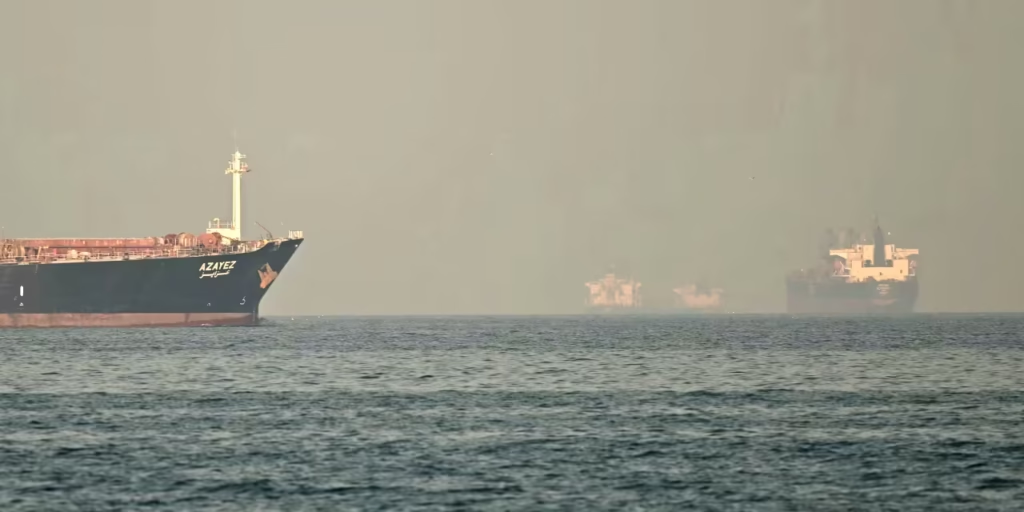 One of the biggest problems facing global markets is the enormous amount of oil trapped in the region.
According to Kpler, roughly 170 million barrels of crude oil, diesel, jet fuel, and refined petroleum products remain stranded aboard 166 tankers in the Middle East.
The sheer scale of the shipping jam has alarmed analysts.
“It could be a very laborious process to get laden tankers out of the Mideast Gulf – and empty ones in – given the traditional shipping lanes are not being used for fear of mines,” said Matt Smith, Kpler’s lead oil analyst.
Kpler estimates that even after the Strait of Hormuz fully reopens, clearing the backlog could take up to three months.
And the broader supply disruption is even larger.
Analysts estimate approximately 900 million barrels of oil have effectively been sidelined by the conflict, with losses growing each day the strait remains shut down.
Trump Officials Promise Relief Is Coming
Despite growing market fears, administration officials insist the strategy will eventually stabilize supplies.
“Help is on the way as of today,” Treasury Secretary Scott Bessent said Monday.
Bessent emphasized that some supertankers trapped in the region carry nearly 2 million barrels of oil each, and he argued Project Freedom could eventually help move that supply back into global markets.
“I think the market is going to be well supplied…I’m confident on the other side of this, the world’s going to be awash in oil,” Bessent said.
He also pointed to recent promises from OPEC to raise production levels.
Still, analysts note those production increases mean little if tankers remain unable to safely leave the region.
For now, the market appears focused less on promises and more on the reality unfolding across the Gulf: rising attacks, stalled shipments, and a global energy system under growing strain.