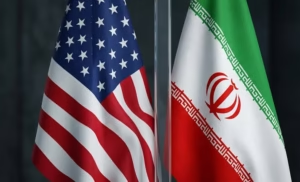

The United States and Iran sat down for direct talks in Islamabad on Saturday, a striking development after years of hostility, proxy maneuvering, and indirect diplomacy. The meeting, led by Vice President JD Vance for the American side and senior Iranian officials for Tehran, marks the most significant face-to-face engagement between the two countries in years. Yet even as negotiators gathered in Pakistan, the wider region remained on edge. Fighting in Lebanon continued, the Strait of Hormuz remained a flashpoint, and global markets were already feeling the pressure.
Talks Stretch Into The Night
Diplomacy is underway, but nobody is pretending this will be quick.
A Pakistani source said the negotiations are expected to continue late into the night and could spill into Sunday. Pakistan’s Prime Minister Shehbaz Sharif and army chief, Field Marshal Asim Munir, were said to be in the room as mediators worked to keep both sides at the table.
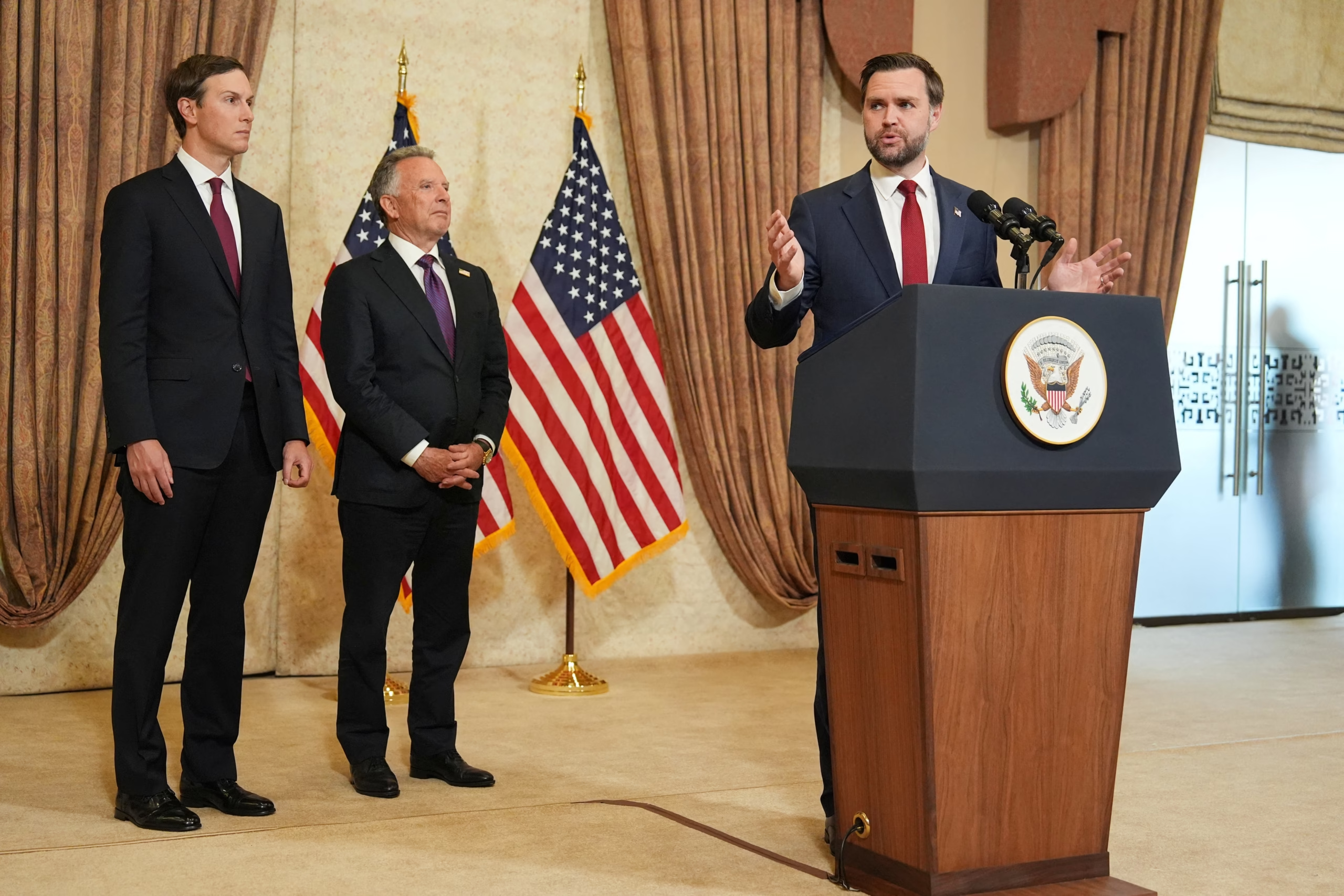
The trilateral format has placed Pakistan at the center of one of the most sensitive geopolitical moments of the year. On one side sits Washington, represented by Vance, special envoy Steve Witkoff, Jared Kushner, and a wider team of experts. On the other is a large Iranian delegation, reported to include negotiators, technical advisers, security personnel, and media staff.
Iranian state media described the delegation this way: “Given the complexity and high sensitivity of the negotiations between Iran and the United States, the Iranian delegation includes not only the main negotiators but also technical and expert committees for necessary consultations,” the report said.
That alone says plenty. These are not symbolic talks. Both sides came prepared for a long, difficult bargaining session.
Pakistan Emerges As A Key Broker
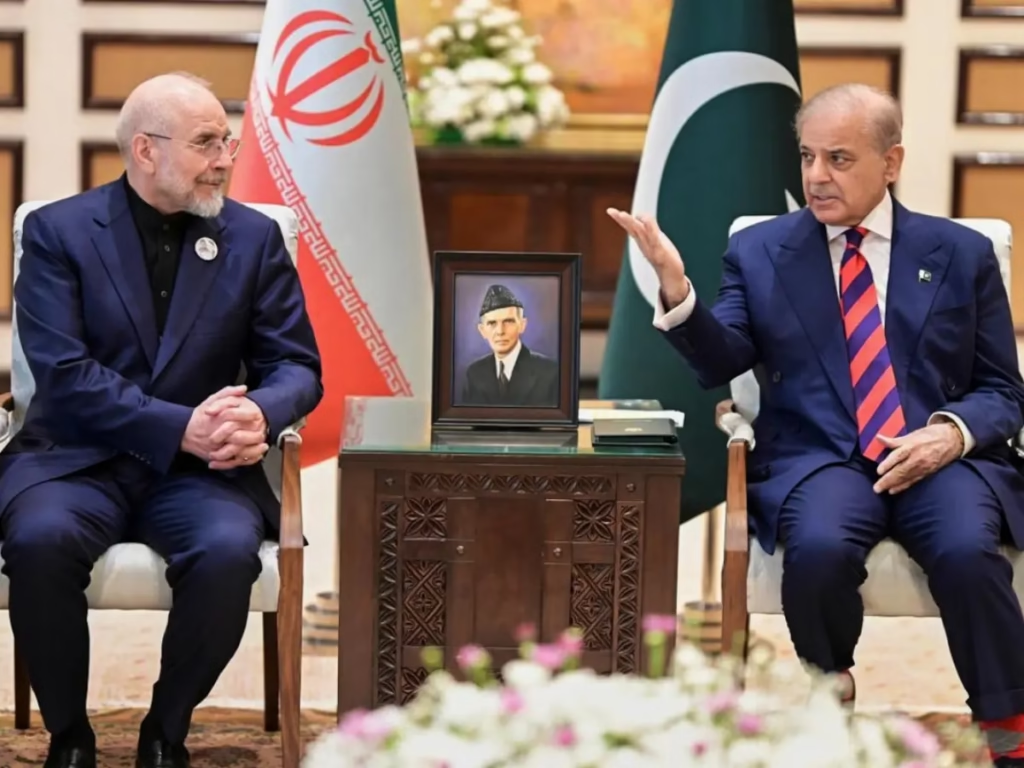
Islamabad’s role has grown rapidly as the crisis has deepened. Pakistani officials welcomed the US delegation with strong public backing for diplomacy and made clear they want to be seen as a bridge, not a bystander.
Pakistan praised the United States for its “commitment to achieving lasting regional and global peace” as the American delegation arrived. It also repeated its willingness to help facilitate “a lasting resolution and durable solution to the conflict,” according to its foreign ministry.
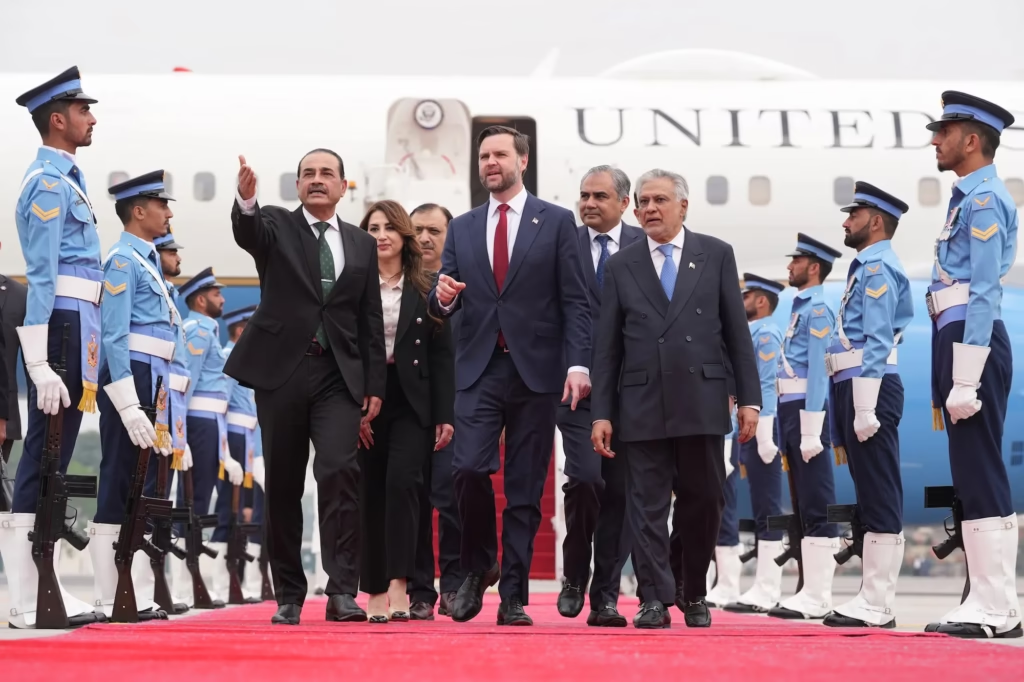
Vance, meanwhile, arrived to a reception that underlined how central Pakistan has become to the effort. He was greeted by Munir, the powerful army chief once described by Trump as his “favorite field marshal.” It was a remarkable image, and an even more remarkable turn for a country Trump had once accused of giving Washington “nothing but lies and deceit.”
Now Pakistan is hosting the room where the region’s future may be argued over.
A Direct Meeting, Not Just Shuttle Diplomacy
For years, the US and Iran mostly relied on intermediaries. Oman often played that role. This time, however, officials and regional sources said the talks in Islamabad are happening face to face.
That changes the temperature immediately.
Direct contact can cut through delays, mixed messages, and diplomatic theater. It can also raise the stakes. When rival powers sit in the same room, every sentence matters, every pause gets analyzed, and every public statement outside the room can land like a warning shot.
Iran’s team is being led by Parliament Speaker Mohammad Bagher Ghalibaf, with Foreign Minister Abbas Araghchi and Ali Bagheri Kani also playing major roles. The US side has assembled not only senior political figures but a broad team of subject-area specialists, suggesting the agenda goes well beyond one narrow issue.
The Strait Of Hormuz Hangs Over Everything
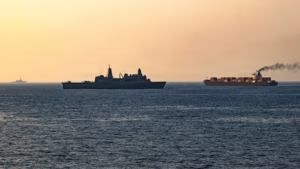
Even while the talks moved forward, the Strait of Hormuz remained one of the most explosive issues on the table.
President Donald Trump said the US is “clearing out” the Strait of Hormuz. Later, he expanded on that message in a social media post, writing: “We’re now starting the process of clearing out the Strait of Hormuz as a favor to Countries all over the World, including China, Japan, South Korea, France, Germany, and many others. Incredibly, they don’t have the Courage or Will to do this work themselves,” Trump posted on Truth Social shortly after arriving at his golf club in Virginia today.
He followed that with another line that drew fresh attention to the energy fallout: “Very interestingly, however, empty Oil carrying ships from many Nations are all heading to the United States of America to LOAD UP with Oil.”
The problem is that nobody has fully explained what “clearing out” actually means. That uncertainty matters because roughly one-fifth of the world’s oil typically passes through the waterway.
Still, there were signs of limited movement. Several ships, mostly Chinese tankers and bulk carriers, were reported passing through the strait. Traffic remains well below normal levels, but it is no longer frozen.
Trump had earlier blasted Tehran over delays in reopening the route, saying “Iran is doing a very poor job, dishonorable some would say, of allowing Oil to go through the Strait of Hormuz.”
He added: “That is not the agreement we have!”
Ceasefire Terms Are Still Deeply Contested
That line gets to the heart of the problem. Even now, the United States, Iran, Pakistan, and Israel do not appear to agree on what the ceasefire actually includes.
Iran maintains that Lebanon should be part of the arrangement. Pakistan has echoed that view. Israel and the United States have pushed back. So while negotiators talk peace in Islamabad, the battlefield has not gone quiet.
Semi-official Iranian news agency Nour said Saturday: “Iran believes the ceasefire in Lebanon has not yet been fully realized and says the United States is obligated to ensure that Israel upholds this commitment,” semi-official Iranian news agency Nour said Saturday, adding that the Iranian delegation to the talks in Islamabad “is pursuing this issue seriously.”
That is not diplomatic small talk. It is a demand, and a pointed one.
Lebanon Threatens To Derail The Entire Process
Israel continued striking Hezbollah targets in Lebanon on Saturday, saying it had hit more than 200 sites over the past day.
In a statement, the military said the air force “continues to strike infrastructure of the terrorist organization Hezbollah and to assist the operations of the ground forces operating in southern Lebanon.”
It also said it continued to “strike launchers in order to thwart fire” toward Israel.
Lebanese authorities reported more deaths, while Hezbollah kept up rocket and drone fire. The violence has battered hopes that the current ceasefire could quickly broaden into a more stable regional truce.
The political picture in Beirut also shifted. Lebanese Prime Minister Nawaf Salam postponed a trip to the United States and the United Nations, saying: “In light of ongoing internal circumstances… I have decided to postpone my trip to the United Nations and the United States… so I could oversee the government’s work here in Beirut,” Salam said in a post on X.
At the same time, Israeli and Lebanese diplomats are still expected to meet in Washington next week. Yet Israel has already made one red line clear, saying it “refused to discuss a ceasefire with the Hezbollah terrorist organization.”
That leaves the talks exposed to the oldest danger in the Middle East: diplomacy on one track, escalation on another.
Energy And Supply Chains Are Already Feeling The Shock
War has a way of hitting people far from the battlefield. That is happening now.
European airports are facing warnings of a possible jet fuel crunch if normal passage through the Strait of Hormuz does not resume in a stable way. The fertilizer market is also tightening fast, and American farmers are watching prices climb.
Trump weighed in early Saturday, posting: “I am watching fertilizer prices CLOSELY during our FIGHT FOR FREEDOM in Iran. The United States will not accept PRICE GOUGING from the fertilizer monopoly! American Farmers, we have your back,” Trump wrote early Saturday on Truth Social.
The American Farm Bureau Federation had already raised alarms. In a letter to Trump, its president warned: “We are deeply concerned that failure to act could lead to disruptions to the food supply chain not seen since 2022 when food price inflation reached 40-year highs,” Zippy Duvall, president of the AFBF, wrote in a letter to Trump in early March.
Those fears are not abstract. Urea prices have surged, trade through Hormuz has been disrupted, and farm bankruptcies were already climbing before this latest shock.
Europe Faces A Fuel Squeeze, Ireland Faces Street Chaos
The pressure is not limited to agriculture.
In Ireland, protests over rising fuel prices triggered transport disruption and station shortages. Kevin McParlan, the CEO of Fuels for Ireland, said: “There are 1,600 petrol stations in the Republic of Ireland, of which slightly more than a third are now without stock,” Kevin McParlan, the CEO of Fuels for Ireland, told national broadcaster RTÉ.
He warned the number could worsen sharply if blockades around key facilities continued.
Emergency services have also been hit. Ireland’s Emergency National Coordination Group said fuel supplies for emergency vehicles “were under increasing pressure,” forcing the fire service to scale back some activity.
Even so, McParlan tried to calm nerves, saying Ireland still has “loads” of fuel and that the situation will be “fine” within a few days if access is restored.
That is the wider story now. A meeting in Islamabad may be about war and peace, but the consequences are already showing up at gas pumps, airports, and farms.
The Human And Political Stakes Keep Rising
There is another layer here, and it is deeply personal for all the major players.
For Vance, the trip gives him a major international test and a chance to position himself as the administration’s most visible peacemaker. He has said he expects the negotiations to be “positive.”
For Trump, the weekend talks are a gamble. He has said he is “very optimistic” that they can produce a deal. At the same time, he has kept the pressure high, warning in another interview that if no agreement is reached, military action could resume. “We have a reset going.”
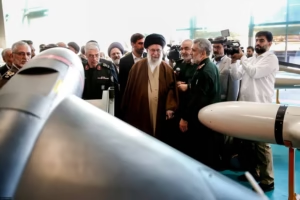
Iran, for its part, is trying to negotiate from a position of resilience, even as it works to keep its allies and its own economy from buckling further.
Trump has also claimed Tehran presented “a 10-point proposal from Iran,” which he called “a workable basis on which to negotiate.”
Whether that optimism holds is another question entirely.
Washington Also Tightens Pressure Elsewhere
Even as talks continue, the US is making clear it is not easing pressure across the board.
The State Department announced that Eissa Hashemi, the son of Masoumeh Ebtekar, would face deportation along with his wife and son. Secretary of State Marco Rubio wrote: “Her family should never have been allowed to benefit from the extraordinary privilege of living in our country,” Secretary of State Marco Rubio wrote on X.
Meanwhile, a fresh intelligence report added another dose of tension. According to people familiar with recent US intelligence assessments, China may be preparing to deliver air defense systems to Iran within weeks.
Beijing denied the accusation in blunt terms. A spokesperson for the Chinese embassy in Washington said, “China has never provided weapons to any party to the conflict; the information in question is untrue.”
The spokesperson added: “As a responsible major country, China consistently fulfills its international obligations. We urge the U.S. side to refrain from making baseless allegations, maliciously drawing connections, and engaging in sensationalism; we hope that relevant parties will do more to help de-escalate tensions.”
That denial may cool little. If anything, it sharpens the sense that the conflict could widen even while negotiators sit around the same table.
What Happens Next
The question now is brutally simple: can diplomacy move faster than the war?
The talks in Islamabad are historic, but they are also fragile. The ceasefire remains under strain. Israel is still striking Lebanon. Shipping routes are only partly moving. Markets are nervous. Allies are hedging. And both Washington and Tehran are walking into the room with vastly different ideas about what peace should actually look like.
For now, the talks continue. Into the night, perhaps into Sunday.
That alone tells the story. Nobody came to Islamabad expecting an easy day.