
Hungary has been thrust into fresh political turmoil after explosives were discovered near a major gas pipeline supplying Russian fuel, just days before a critical national election. The timing could not be more sensitive, and tensions are now spilling across borders, alliances, and political lines.
Prime Minister Viktor Orban quickly called an emergency meeting of Hungary’s National Defence Council, signaling the seriousness of the threat. But as details emerge, the incident is fueling a fierce political battle, with accusations flying in every direction.
Explosives Discovery Sparks Security Alarm

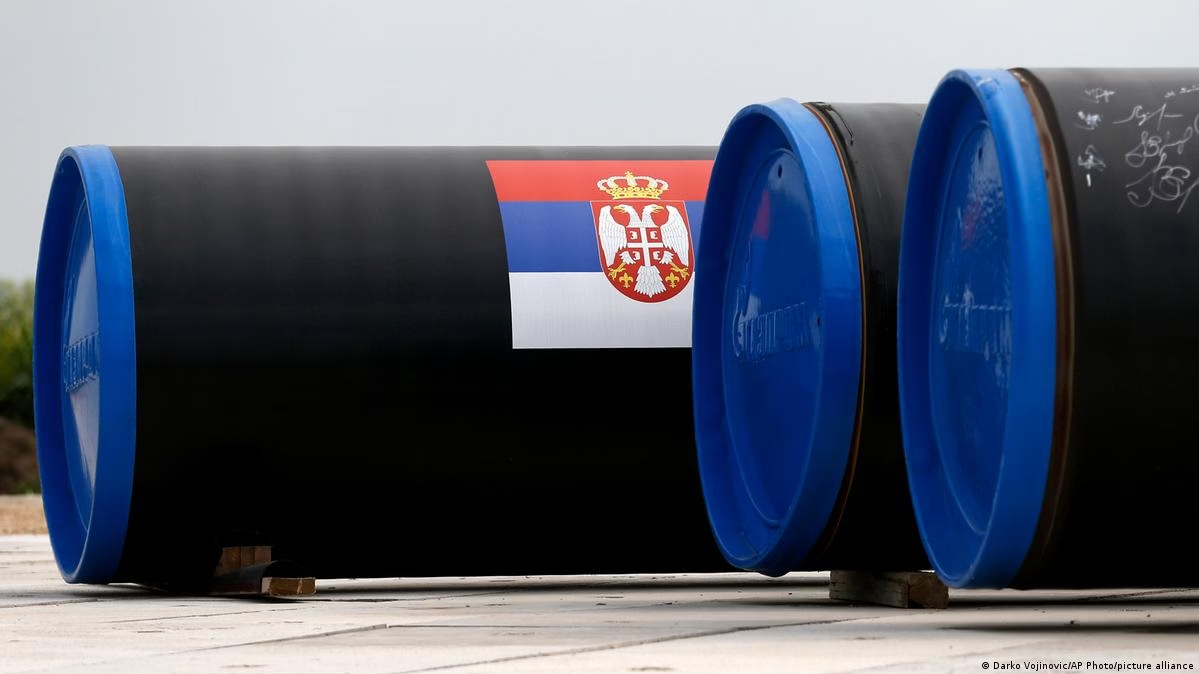
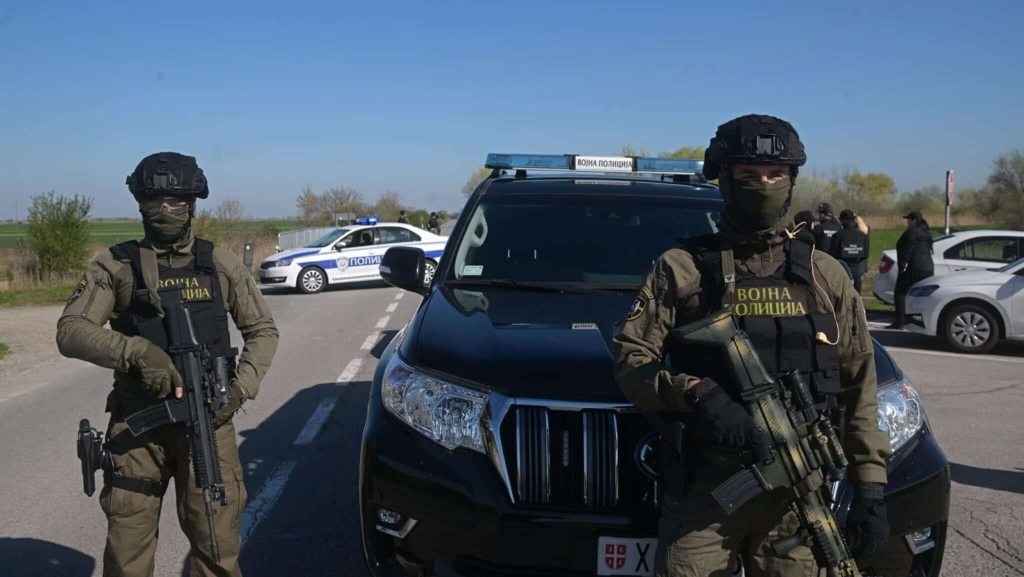
The alarm was raised after Serbian authorities uncovered two backpacks filled with explosives and detonators near the TurkStream pipeline, a key route for Russian gas into Hungary. The site sits close to Tresnjevac, in Serbia’s Kanjiza district, not far from the Hungarian border.
Serbian President Alexander Vucic revealed the discovery publicly, stating, “Our units found an explosive of devastating power,” and added, “I told PM Orban that we would keep him updated on the investigation.”
Meanwhile, the pipeline itself is critical to Hungary’s energy supply. The country receives between five and eight billion cubic metres of Russian gas annually through this route, making any threat to it a matter of national urgency.
Election Pressure And Political Stakes Rise
The discovery comes at a moment when Orban’s leadership faces mounting pressure. His Fidesz party is reportedly trailing in opinion polls ahead of next Sunday’s election, raising the stakes dramatically.
That context has intensified scrutiny. Opposition voices argue the incident may not be as straightforward as it appears.
Peter Magyar, a leading opposition figure, accused Orban of “panic-mongering” orchestrated by “Russian advisers”. His remarks echo broader concerns from analysts who fear the situation could be politically manipulated.
In recent weeks, Hungarian security experts have warned of a potential “false flag” operation, one that could be blamed on Ukraine to sway public opinion or justify drastic political steps.
Allies And Accusations Across Borders

The regional dimension adds another layer of complexity. Serbia’s Vucic, a close ally of Orban, was the first to inform him of the explosives. That coordination has raised eyebrows among critics.
Balint Pasztor, head of the Vojvodina Hungarian Association and an Orban ally, suggested a broader plot, writing: “If the investigation proves that we were not the primary target after all, but rather Hungary’s supply lines, then this makes it even clearer: the terrorist attack was planned with the aim of bringing down Viktor Orban.”
However, questions remain. Who would benefit most from such an attack? And is this truly an external threat, or something more calculated?
Ukraine Denies Any Involvement
As speculation grows, Ukraine has firmly rejected any link to the incident.
Foreign ministry spokesman Heorhiy Tykhyy stated, “Ukraine has nothing to do with this,” adding, “Most probably, a Russian false-flag operation as part of Moscow’s heavy interference in Hungarian elections.”
That denial comes amid already strained relations. Orban has repeatedly accused Kyiv of targeting Hungary’s energy security, including claims of an “oil blockade” after disruptions in the Druzhba pipeline.
Ukraine, however, maintains the disruption was due to damage caused by a Russian attack and insists repairs are underway.
Experts Warn Of Possible Manipulation
Security analysts have been sounding alarms even before the discovery. Hungarian expert Andras Racz warned that a “fake attack” on the TurkStream pipeline could be staged within Serbia.
Similarly, former counter-intelligence officer Peter Buda pointed to political motivations, stating, “We had some solid preliminary information about this operation, including details about the place and possible timing,” and added, “It’s clear that Ukraine’s interests aren’t at stake here. An operation like this would help Orban before the election by influencing public opinion in his favour.”
Such warnings deepen the uncertainty. If the threat is genuine, it highlights a dangerous escalation. If not, it raises serious concerns about political strategy in a volatile moment.
Government Insists Threat Is Real
Despite skepticism, Hungarian officials are standing firm. Foreign Minister Peter Szijjarto emphasized the broader pattern of risks, writing, “In the past few days and weeks, we’ve seen it all.”
He continued, “The Ukrainians organised an oil blockade against us. Then they tried to impose a total energy blockade on us by firing dozens of drones at the TurkStream pipeline while it was still on Russian territory.”
“And now we have today’s incident, in which Serbian colleagues found explosives capable of blowing up the pipeline.”
For the government, the message is clear: the threat is immediate, and the stakes are national.
Opposition Fires Back Ahead Of Vote
Meanwhile, the opposition is not backing down. Peter Magyar accused Orban and his allies of orchestrating the crisis for political gain.
“He will not be able to prevent next Sunday’s election. He will not be able to prevent millions of Hungarians from ending the most corrupt two decades in our country’s history.”
With just days to go before voters head to the polls, Hungary now finds itself at the center of a high-stakes drama. Security fears, political accusations, and international tensions are colliding, leaving one pressing question hanging in the air: what is really behind this alleged plot?