
Ukraine launched another major drone assault on St. Petersburg early Saturday, bringing the war deeper into Russian territory and highlighting Kyiv’s growing ability to strike targets far from the battlefield.
The latest attack came just one day after Russian President Vladimir Putin rejected a proposal from Ukrainian President Volodymyr Zelenskyy for direct face-to-face negotiations.
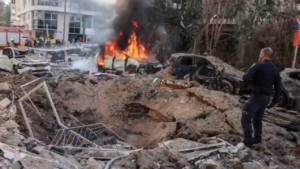
Russian officials reported injuries and widespread disruptions as air defense systems responded to what regional authorities described as one of the largest attacks yet on the area surrounding Russia’s second-largest city.
Residents Told To Stay Indoors
Authorities in St. Petersburg urged residents to remain inside their homes during the assault.
City Governor Alexander Beglov said three people suffered minor injuries. He also warned residents about potential interruptions to mobile internet services as emergency measures were put in place.
Meanwhile, Alexander Drozdenko, governor of the surrounding Leningrad region, said air defense forces intercepted 141 drones during what he called an “unprecedented attack.”
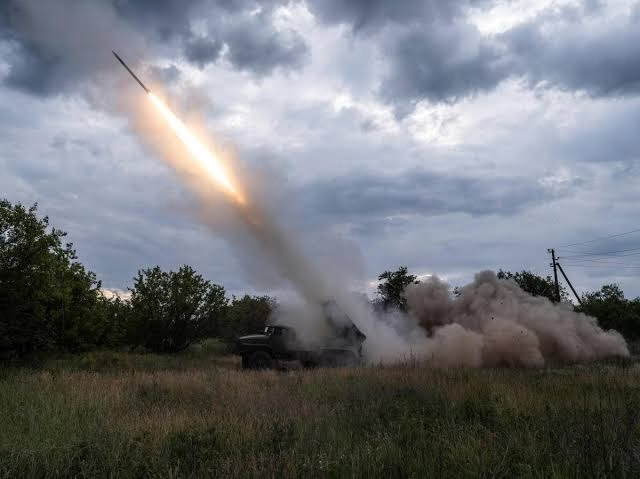
Russia’s Defense Ministry later reported that its forces had destroyed 376 Ukrainian drones across multiple regions.
Zelenskyy Highlights Deep Strike Capability
Ukraine quickly pointed to the operation as evidence of its expanding long-range reach.
“Last night, our drones covered a distance of about 1,000 kilometers to the St. Petersburg region — to the enemy navy’s arsenals and a base in Kronstadt,” Ukrainian President Volodymyr Zelenskyy wrote on X, adding that drones also hit an oil depot in Russia’s southern Krasnodar region.
The statement underscored Kyiv’s strategy of targeting military infrastructure and energy facilities far from the front lines.
Pressure Mounts On Kremlin
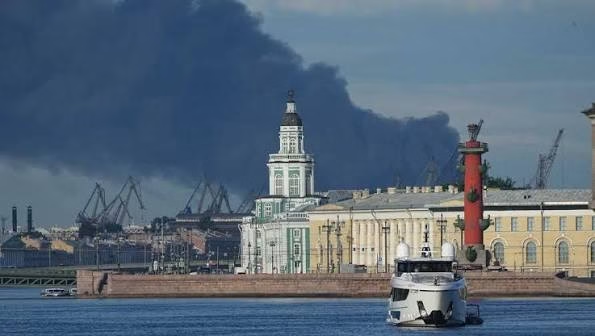 The renewed strike represents another challenge for Putin as he attempts to portray the war as a conflict that remains largely distant from everyday life inside Russia.
Just days earlier, a Ukrainian drone attack reportedly ignited a fire at an oil terminal and struck a nearby naval installation near St. Petersburg. The incident occurred shortly before the opening of the St. Petersburg International Economic Forum, a high-profile event often used by the Kremlin to promote investment opportunities.
Speaking during the forum, Putin announced plans to strengthen Russia’s air defense capabilities in response to the increasing frequency and range of Ukrainian drone operations.
Putin Rejects Zelenskyy’s Meeting Proposal
Diplomatic tensions also intensified this week.
On Friday, Putin dismissed Zelenskyy’s proposal for a direct meeting regarding the war, now entering its fifth year. The rejection followed a public letter from the Ukrainian leader, his first direct message to Putin since Russia launched its full-scale invasion in 2022.
According to Russian officials, Putin said he saw “no point” in holding such talks.
The exchange marked another sign of the widening divide between the two leaders as military operations continue to escalate.
Ukraine Warns Russia Of More Strikes
Ukraine’s foreign minister responded sharply to Moscow’s position.
“Failures will get more humiliating,” he wrote on X, warning that there are “no safe places in Russia that can be exempt” from Ukrainian long-range attacks, and that the intensity of attacks “will continue to grow.”
The remarks suggest Kyiv intends to continue expanding drone operations against strategic targets inside Russia.
Fighting Continues Across Ukraine
While long-range strikes dominate headlines, combat remains intense inside Ukraine.
Regional officials said one person was killed and three others were injured overnight in the Dnipropetrovsk region after Russian forces launched nearly 30 drone and artillery attacks across multiple districts.
In the southeastern Zaporizhzhia region, seven people sought medical treatment after a Russian drone strike sparked a fire in a parking area.
Ukraine’s air force reported that Russia launched 272 strike drones overnight. According to military officials, Ukrainian air defenses intercepted 249 of them.
As battlefield lines remain largely frozen and drone warfare becomes increasingly central to both sides’ strategies, the conflict continues to evolve into a contest of long-range precision strikes as much as ground combat.